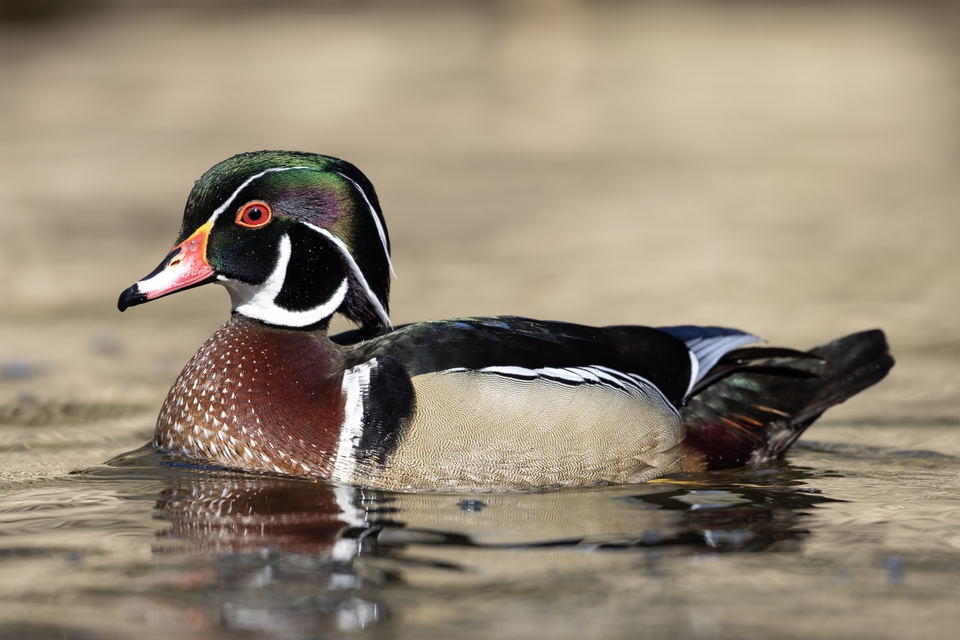
Few North American birds make a first impression like a male Wood Duck. Drifting out from the shadows of a flooded woodland, the drake looks almost painted: a glossy green-and-purple head swept back into a drooping crest, bold white finger-stripes on the face, a chestnut chest flecked with white, and buttery-tan flanks. For many birders, spotting a male Wood Duck for the first time is a small revelation that ducks can be this extravagant. The species' scientific name, Aix sponsa, roughly translates to "waterbird in bridal dress," and it fits.
Beyond its looks, the Wood Duck is one of our great conservation success stories. Hunting and the loss of bottomland forest pushed it to alarming lows by the early 1900s, but hunting limits, habitat protection, and a nationwide effort to put up nest boxes brought it roaring back. Today it is a familiar sight on wooded ponds, swamps, slow rivers, and beaver-flooded backwaters across much of the United States and southern Canada. Unlike most ducks, it perches readily in trees and nests in cavities high above the water, which gives it an unusual, almost squirrel-like presence in the forest.
Wood Ducks are medium-sized, boxy-bodied ducks with a distinctly large, blocky head, a short neck, and a long, square tail that they often hold cocked slightly upward. The shaggy crest gives the head a top-heavy, crested silhouette even at a distance, and in flight they show broad wings and that long tail, often twisting and dodging through trees rather than flying in open lines like most ducks.
| Male head | Glossy iridescent green and purple, swept into a drooping crest, with crisp white stripes bordering the face and throat |
| Male bill | Multicolored - red and orange at the base, with black and a pale tip, plus a white forehead patch |
| Female face | Gray-brown head with a bold white teardrop eye-ring that tapers to a point behind the eye |
| Eye color | Bright red in males; dark in females |
| Body (male) | Chestnut chest spangled with white spots, golden-tan sides, and a black-and-white shoulder bar |
| Tail & shape | Long, square tail often held up; boxy crested head gives a top-heavy profile |
Male vs. female
The sexes look strikingly different in breeding plumage. The male (drake) is unmistakable, with the iridescent green-purple crested head, white facial stripes, red eye, multicolored bill, chestnut breast, and golden flanks. The female (hen) is far subtler: warm gray-brown overall with a soft gray crested head, a speckled breast, and a clean white teardrop-shaped patch around a dark eye that is the single best field mark for telling her from other female ducks. From midsummer into early fall, males molt into a drab "eclipse" plumage and briefly resemble females, but they keep their red eye and reddish bill, which gives them away.
Juveniles
Ducklings are dark above and yellowish below with a dark eye-line, and they are famous for leaping from the nest cavity, often from heights of 20 feet or more, on their first day of life to follow their mother to water. Immature birds resemble the adult female, with the same understated gray-brown body and a paler, less sharply defined version of the white eye-patch. Young males begin showing patches of color and a reddening eye and bill through their first fall and winter as they molt toward full adult plumage.
Wood Ducks are not loud, but their calls are distinctive once learned. The female gives a rising, squealing flight call, often rendered oo-eek, oo-eek, that rises sharply at the end and is frequently the first clue that a bird is flushing from a hidden pool. It is sometimes described as a startled, almost panicked whistle.
The male is much quieter, producing a thin, drawn-out rising whistle, a soft jeeb or zeet, mostly during courtship and social interaction. Around the nest and when alarmed, females also give softer clucking and cr-r-ek notes. Compared with the loud quacking of a Mallard, Wood Ducks sound squeaky and reedy.
Wood Ducks breed across the eastern United States and southeastern Canada, as well as in a separate population along the Pacific Coast from British Columbia south through California. They favor wooded wetlands: flooded forests, beaver ponds, wooded swamps, marshes with standing timber, and quiet stretches of slow rivers and creeks.
Birds in the south and along the milder coasts are largely year-round residents, while those breeding in the northern interior migrate south in fall, wintering across the southern and central United States and into Mexico. Spring migrants return early, often appearing on northern ponds while ice is still breaking up, eager to claim the best nesting cavities.
Wood Ducks are omnivores with a strong taste for plant foods. Acorns are a staple, especially in fall and winter, and the birds will gather under oaks in flooded bottomlands to feed on fallen nuts; they also eat the seeds of grasses, sedges, smartweeds, and many aquatic plants, plus berries, waste grain, and duckweed. This reliance on acorns and woodland mast is part of why they are so tied to forested wetlands.
They feed by dabbling and tipping up at the surface, picking food from the water and from overhanging vegetation, and walking on land or fallen logs to forage. Animal foods become important in the breeding season: insects, snails, crustaceans, and other small invertebrates provide the protein that egg-laying females and fast-growing ducklings need.
Unlike most ducks, Wood Ducks nest in cavities, typically a natural hollow or an old woodpecker hole in a tree standing in or near water, sometimes 30 feet or more above the ground. They take readily to artificial nest boxes, and well-placed boxes have been central to the species' recovery. The female lines the cavity with down and lays a clutch of pale, creamy eggs, incubating them on her own for about a month.
Wood Ducks are well known for "egg dumping," in which females lay eggs in one another's nests; a single box can sometimes end up with an enormous, mixed clutch from multiple hens. The day after hatching, the downy ducklings climb to the cavity entrance and jump, bouncing unhurt to the ground or water below, then follow their mother to feeding areas. In the warmer parts of their range, females often raise two broods in a single season, which is unusual among North American ducks.
Wood Ducks won't come to a seed feeder, but if you live on or near a wooded pond, swamp, slow stream, or beaver wetland, you have a real chance of hosting them, and a properly built and placed nest box is the single most effective way to attract them.
- Put up a nest box built to Wood Duck specifications and mount it on a pole over or near the water, ideally with a predator baffle, rather than nailing it to a tree.
- Add a predator guard. Raccoons and snakes are the biggest threats; a cone or cylinder baffle on the mounting pole dramatically improves nesting success.
- Include nesting material. Wood Ducks add no nest of their own, so put a few inches of clean wood shavings (not sawdust) in the bottom of the box.
- Provide an exit ladder. Attach a strip of hardware cloth inside, below the entrance hole, so ducklings can climb out.
- Protect natural cavities. Leaving large dead and hollow trees standing near water gives wild birds the nest sites they prefer.
- Keep water quiet and vegetated. Wood Ducks favor calm, brushy, partly shaded water with cover; avoid over-manicuring shoreline edges.
- Mandarin Duck: The Wood Duck's Asian cousin and closest look-alike; male Mandarins have orange 'sail' feathers on the back and orange cheek whiskers. Mostly seen as escaped captive birds in North America.
- Hooded Merganser: Shares wooded ponds and nest boxes, and the male has a crest, but it raises a fan-shaped black-and-white hood and has a thin, spiky bill for catching fish, not a duck-like bill.
- Mallard: Females can be confused at a glance, but female Mallards are larger, lack the white teardrop eye-patch, and show a blue speculum and orange-and-black bill.
- American Wigeon: Another dabbler of ponds, but lacks the crest and bold face pattern; males show a white forehead and green eye-stripe rather than the Wood Duck's iridescent crested head.
Where do Wood Ducks nest?
They nest in tree cavities, usually a natural hollow or an abandoned woodpecker hole in a tree standing in or near water, sometimes 30 feet or more up. They also readily use human-made nest boxes, which have been key to their recovery.
Do Wood Duck ducklings really jump from the nest?
Yes. The day after hatching, the tiny ducklings climb to the cavity entrance and leap out, often from heights of 20 to 50 feet. They are so light and downy that they bounce unhurt, then follow their mother to the water.
What does a female Wood Duck look like?
She is a soft gray-brown duck with a gray crested head and a distinctive clean white teardrop-shaped patch around a dark eye. That white eye-patch is the best way to tell her from other female ducks.
How do I attract Wood Ducks to my property?
They don't visit seed feeders. If you have a wooded pond, swamp, or slow stream, install a Wood Duck nest box on a pole over the water with a predator baffle and a few inches of wood shavings inside, and add a hardware-cloth ladder so ducklings can climb out.
Are Wood Ducks rare?
No. Once severely depleted in the early 1900s, they have rebounded strongly thanks to hunting limits, habitat protection, and nest-box programs. Today they are common and increasing across much of the eastern and western United States and southern Canada.