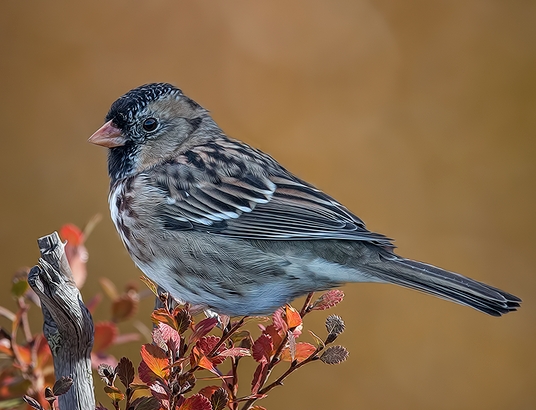
The Harris's Sparrow is a bird of superlatives: it's the largest sparrow in North America and the only songbird whose entire breeding range lies within Canada. In winter it becomes a familiar visitor to a narrow band of the southern Great Plains, where birders prize it for its handsome black hood and bib, its bubblegum-pink bill, and the way it bullies smaller sparrows away from the feeder. A flock scratching through brushy fencerows in Kansas or Oklahoma on a gray December day is one of the quiet pleasures of Plains birding.
For most of the year, though, this is a bird of remote places. It nests in the stunted spruce and willow at the edge of the Arctic tundra, a transition zone so inaccessible that its nest wasn't even described by science until 1931, among the last North American songbirds to give up that secret. Because its breeding and wintering ranges are both so narrow, the species is considered Near Threatened, and long-term surveys show worrying declines, making every winter sighting feel a little more special.
This is a big, full-bodied sparrow with a long tail and a noticeably stout, conical pink bill, in good light the bill almost glows. Size alone is a useful first clue: at roughly the bulk of a Spotted Towhee, it dwarfs the White-crowned and White-throated Sparrows it often travels with. The amount of black on the face and breast varies with age and season, so focus on the overall pattern and that pink bill.
| Bill | Stout, conical, and bright pink to flesh-colored, the most reliable field mark in any plumage |
| Black hood & bib | Breeding adults show a solid black crown, face, and large bib running down onto the breast |
| Face | Gray cheeks and gray on the sides of the neck contrast with the black crown and throat |
| Underparts | Clean white belly with dark streaks along the flanks, set off by the black bib above |
| Upperparts | Brown back boldly streaked with black; two thin white wingbars |
| Size & shape | Largest North American sparrow, bulky body, long tail, often looks heavy-headed |
Male vs. female
Males and females look essentially alike, there is no reliable plumage difference visible in the field. Both sexes wear the same black hood and bib in breeding plumage and the same scaled-back winter pattern. On the breeding grounds males do average a slightly more extensive and solidly black bib, but this overlaps so much that you can't sex an individual by sight. Behavior is the better clue in summer: the singing bird perched at the top of a spruce is almost always the male.
Juveniles
First-winter birds, the ones most backyard birders see, look distinctly different and trip up newcomers. They lack the clean black hood, showing instead a buffy or whitish throat bordered by a dark "necklace" of streaks, a streaky brown crown, and dark blotches on the breast rather than a solid bib. The pink bill and large size still give them away. As spring approaches, these young birds molt toward the bold black-hooded adult look, and you'll see every intermediate stage in a late-winter flock.
On the breeding grounds the male's song is a series of clear, plaintive, quavering whistles, often two or three notes on the same pitch followed by another set on a different pitch, a wistful tewwww, tewwww... teee, teee that carries far across the open tundra-edge. The effect is haunting and a little melancholy, quite different from the buzzy trills of many sparrows.
In winter you're far more likely to hear the calls than any song. Listen for a sharp, metallic wink or chink call note, and a softer seet given by flock members keeping in contact as they forage. Wintering birds also produce a subdued, rambling subsong on warm late-winter days as they tune up before heading north.
Harris's Sparrow has one of the most sharply defined ranges of any North American songbird. It breeds in a narrow band across the far north of Canada, from the Northwest Territories east through northern Manitoba to the Hudson Bay coast, in the transitional zone where boreal spruce forest breaks up into open tundra. No other songbird breeds exclusively within Canada.
In fall it funnels almost due south into a compact wintering area centered on the southern Great Plains: from Nebraska and Kansas through Oklahoma into north-central Texas, with smaller numbers in Missouri, Iowa, and South Dakota. Because the route is so direct and narrow, the species is a genuine rarity anywhere outside that corridor, coastal and far-western sightings always cause a stir among local birders.
Like most sparrows, the Harris's Sparrow is largely a seed-eater outside the breeding season. In winter it forages on the ground in brushy fields, weedy hedgerows, and shelterbelts, scratching through leaf litter with a quick double-footed hop-and-kick to expose ragweed, foxtail, smartweed, and other weed seeds, along with waste grain. It also takes berries and small fruits when available.
During the brief Arctic summer the diet shifts heavily toward insects and other invertebrates, beetles, flies, and spiders, which provide the protein nestlings need to grow fast in the short season. Conifer needles, buds, and crowberries round out the breeding-season menu.
Harris's Sparrows nest on the ground in the stunted spruce-and-willow scrub at the tundra's edge, typically tucking the nest into a mossy hummock, beneath a low shrub, or against a small spruce for shelter from wind and predators. The cup is built of moss, grasses, small twigs, and lichens and lined with finer grass. The female does the building and the incubating.
A typical clutch is 3 to 5 pale, finely speckled eggs, incubated for about 12 to 14 days. Both parents feed the nestlings, which leave the nest in roughly 8 to 10 days, fast development suited to the compressed Arctic summer. The species raises a single brood per year given how short the breeding window is this far north.
If you live within or near the southern Great Plains wintering range, the Harris's Sparrow is very much a feeder bird, and a bold one. Outside that corridor it's a scarce stray, so attracting it is mostly a matter of geography plus the right ground-feeding setup.
- Offer white millet, black-oil sunflower, and cracked corn scattered on the ground or on a low platform feeder, this species prefers feeding low, not on hanging tube feeders.
- Keep a brushy edge, hedgerow, or unraked leaf pile nearby; Harris's Sparrows want quick cover to dive into and will scratch through litter for fallen seed.
- They readily join mixed flocks with White-crowned and White-throated Sparrows and juncos, so a yard that attracts those is more likely to turn up a Harris's.
- A ground-level water source or heated birdbath in winter is a strong draw on the dry Plains.
- Be patient and check your sparrow flocks carefully in November through March, and remember they're large and pushy, often displacing smaller birds at the feed.
- White-crowned Sparrow: Smaller, with a clean bold black-and-white striped crown and a plain pale gray breast, never a black bib. Often flocks with Harris's in winter.
- White-throated Sparrow: Smaller, with a crisp white throat patch, yellow lores, and striped crown; lacks the black hood, large size, and pink bill.
- Lapland Longspur: Breeding males show a black face and bib, but they are streaky open-country birds with rusty nape and a much shorter tail, not brushy-edge sparrows.
- Dark-eyed Junco: Shares the winter flocks and pink bill, but is far smaller, slate-gray, and shows flashing white outer tail feathers in flight.
What does a Harris's Sparrow look like?
It's the largest sparrow in North America, with a stout pink bill, brown streaked back, and white belly. Breeding adults have a striking solid black crown, face, and bib. First-winter birds are duller, showing a buffy throat and a dark 'necklace' of breast streaks instead of the full black hood.
Where are Harris's Sparrows found?
They breed only in far northern Canada at the edge of the Arctic tundra and winter in a narrow band of the southern Great Plains, mainly Kansas, Oklahoma, Nebraska, and north Texas. They are rare anywhere outside that corridor.
Why is the Harris's Sparrow special?
It's the only songbird that breeds exclusively in Canada and the largest sparrow on the continent. Its remote nesting grounds meant its nest wasn't scientifically described until 1931, among the last North American songbirds to be documented.
How do I attract Harris's Sparrows to my feeder?
If you're in or near their Plains wintering range, scatter white millet, sunflower seed, and cracked corn on the ground near a brushy edge or leaf pile. They feed low rather than at hanging feeders and often join mixed sparrow and junco flocks.
How do I tell a Harris's Sparrow from a White-crowned Sparrow?
Both have pink bills and flock together in winter, but the Harris's is noticeably larger and bulkier, has black on the throat and face (especially adults), and shows dark flank streaks. The White-crowned has a clean black-and-white striped crown and a plain gray breast with no black bib.