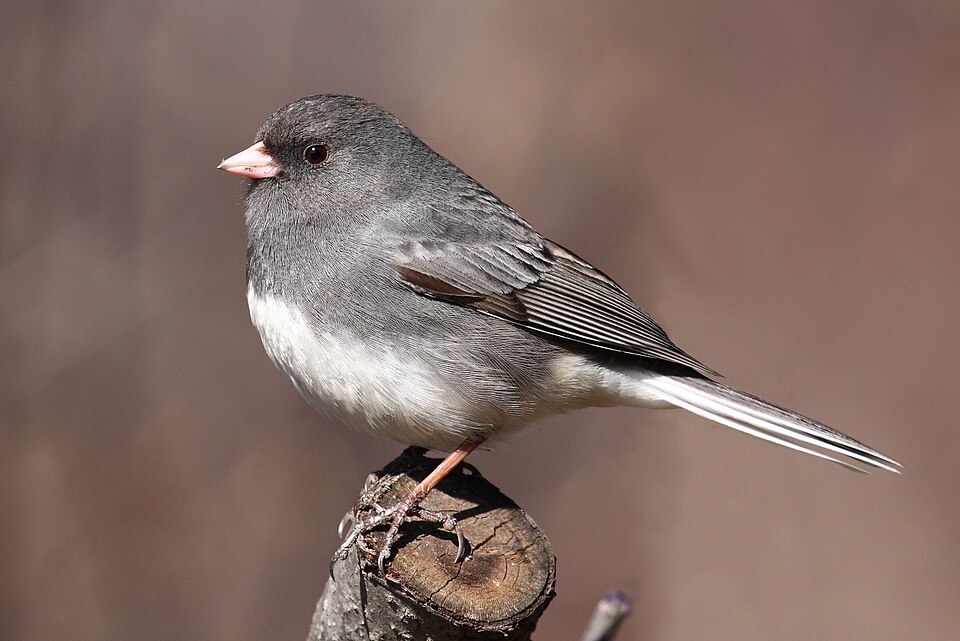
The Dark-eyed Junco is one of the most familiar winter birds in North America, and for millions of people it is the bird that announces the cold season. Across much of the continent it earns the affectionate nickname "snowbird" because flocks seem to arrive on lawns and under feeders just as the first hard weather sets in. It is a small, neat sparrow built like a dapper little gentleman in gray and white, and its habit of flashing bright white outer tail feathers as it flushes is one of the quickest ways to recognize it.
What makes the junco fascinating is how wildly variable it looks from region to region. The species was once split into several different "species" before ornithologists realized they all interbreed where their ranges meet. Today they are lumped into one species with a handful of strikingly different regional forms, from the plain slate-gray birds of the East to the rusty-backed, pink-sided "Oregon" juncos of the West. Wherever you live, there is a good chance a junco is hopping around your yard for at least part of the year.
Juncos are small, round-bodied sparrows with a stout, pale pinkish bill, a fairly long notched tail, and a crisp two-toned look: a dark hood and back contrasting sharply with a clean white belly. The flash of white outer tail feathers in flight is diagnostic and visible even at a distance.
| Overall pattern | Dark gray or brown above, abruptly clean white below, like a bird dipped halfway in cream |
| Tail | Bright white outer feathers flash conspicuously when the bird flushes or flicks its tail |
| Bill | Short, conical, and pale pink to ivory, standing out against the dark face |
| Eye | Dark, beady eye set in the dark hood (the source of the name 'dark-eyed') |
| Size & shape | Small and rounded, about sparrow-sized, with a fairly long tail often flicked open |
| Regional forms | Slate-gray (East), rusty-backed pink-sided 'Oregon' (West), gray-headed, and others |
Male vs. female
In the widespread "Slate-colored" form, males are a clean, dark charcoal gray over the head, breast, and back, while females and immatures are paler and washed with brownish or buffy tones, especially on the back and flanks. In the "Oregon" form of the West, males have a crisp black hood that contrasts with a rusty-brown back and pinkish sides, and females show a softer gray hood with the same warm flanks. As a rule, the darker, more sharply contrasting bird is the male and the browner, washed-out bird is the female, but the difference is one of degree rather than a hard line.
Juveniles
Recently fledged juncos look quite different and often puzzle backyard birders: they are heavily streaked with brown on the breast and back, looking much more like a typical streaky sparrow than the clean gray adult. They still show the telltale white outer tail feathers and pale bill, which give them away. This streaky plumage is held only briefly in summer; by their first fall, young juncos have molted into a plumage resembling adult females.
The most familiar sound is the song: a level, musical trill on one pitch, a dry ringing "treeeeee" that lasts a couple of seconds. It is sweeter and more musical than a Chipping Sparrow's drier, faster trill, though the two are easy to confuse. Males sing from exposed perches in spring and on the breeding grounds.
Around feeders in winter you are far more likely to hear the calls: a sharp, smacking "tchip" or "tsick" note, and a rapid twittering or kew-kew-kew given when birds flush or jostle in a flock. They also give a soft, tinkling series of notes as flock members keep contact while foraging on the ground.
Dark-eyed Juncos breed across the vast boreal forests of Canada and Alaska and down through the mountains of the western United States and the Appalachians. They favor coniferous and mixed woodlands with open ground for foraging during the breeding season.
In fall, huge numbers move south and to lower elevations, spreading across nearly the entire United States and into northern Mexico for the winter. This is when most people meet them, hence "snowbird." In the far north and the high mountains where they breed, some are present year-round, but for much of the lower 48 the junco is strictly a winter visitor that vanishes again each spring.
Juncos are primarily seed eaters, especially in fall and winter, when they feed heavily on the small seeds of grasses and weeds. They are ground specialists, hopping and scratching through leaf litter, snow edges, and lawn debris to glean fallen seed. During the breeding season they shift to a diet rich in insects, caterpillars, beetles, and spiders, which provide the protein their nestlings need.
At feeders they prefer to forage on the ground beneath the feeder rather than perch on it, picking up seeds that other birds knock down. They have a distinctive feeding style, sometimes giving a quick double-scratch with both feet to kick aside litter and expose seeds underneath.
Juncos build their nests on or very near the ground, often tucked into a sheltered hollow under a tussock of grass, a fallen log, an overhanging bank, or the roots of an upturned tree. The female does most of the building, weaving a cup of grasses, moss, rootlets, and fine plant fibers and lining it with hair and fine grass. Occasionally they will nest in unusual elevated spots such as hanging planters or building ledges.
A typical clutch is three to five pale eggs, marked with brown and gray speckles often concentrated at the larger end. The female incubates for roughly twelve to thirteen days, and both parents feed the young, which leave the nest in under two weeks. Pairs commonly raise two broods in a season where the summer is long enough.
The Dark-eyed Junco is one of the easiest and most reliable winter feeder birds to attract, especially if you cater to its ground-feeding habits. In most of the country it will simply show up once cold weather arrives.
- Scatter seed on the ground or use a low platform or tray feeder, since juncos prefer to feed under and below feeders rather than perch on them.
- Offer millet, cracked corn, and black-oil sunflower seeds (or sunflower hearts), which are their clear favorites.
- Leave a brushy corner, a leaf pile, or a low shrub near the feeding area so they have cover to dart into when a hawk appears.
- Avoid raking up every fallen leaf; juncos love to scratch through leaf litter for seeds and insects.
- Provide a ground-level or heated water source in winter, as open water is scarce when temperatures drop.
- Expect them mainly from late fall through early spring across most of the U.S.; they usually depart north to breed by April or May.
- Chipping Sparrow: Has a rusty cap, streaked brown back, and a dark line through the eye; lacks the junco's clean gray hood and white outer tail feathers. Its trill is drier and faster.
- Black Phoebe: Superficially two-toned black-and-white but is a flycatcher with an upright posture, dark bill, and tail-pumping behavior; catches insects in the air rather than feeding on the ground.
- Eastern Towhee: Shares the dark hood and white belly and even flashes white in the tail, but is much larger, has bold rufous sides and red eyes, and noisily scratches in leaf litter.
- Spotted Towhee: Like the Eastern Towhee but with white spotting on the back; larger and bulkier than a junco with rusty flanks and red eyes.
Why are juncos called snowbirds?
Across much of the United States, juncos appear at feeders and on lawns just as the first cold weather and snow arrive in fall, then disappear north again in spring. Because their arrival seems to track the snow, people have called them 'snowbirds' for generations.
Where do juncos go in summer?
They migrate north to breed in the boreal forests of Canada and Alaska, and up into the cooler high elevations of the western mountains and the Appalachians. If you live in the southern or central U.S., your wintering juncos simply leave for these breeding grounds each spring.
What do juncos eat at feeders?
Mostly small seeds. They favor white millet, black-oil sunflower seeds or hearts, and cracked corn. Because they prefer to feed on the ground, scattering seed on the ground or using a low tray feeder works far better than a tube feeder.
Why do juncos flash white in their tails?
The bright white outer tail feathers are flashed when a junco flushes or flicks its tail. Researchers think the flash helps startle predators and signals alarm to other flock members; it is also one of the quickest ways for birders to identify the bird in flight.
Are there different kinds of Dark-eyed Junco?
Yes. They are a single species with several distinct regional forms, including the plain charcoal 'Slate-colored' junco of the East, the rusty-backed, pink-sided 'Oregon' junco of the West, plus gray-headed and other variants. These forms interbreed where their ranges overlap, which is why they are considered one species.