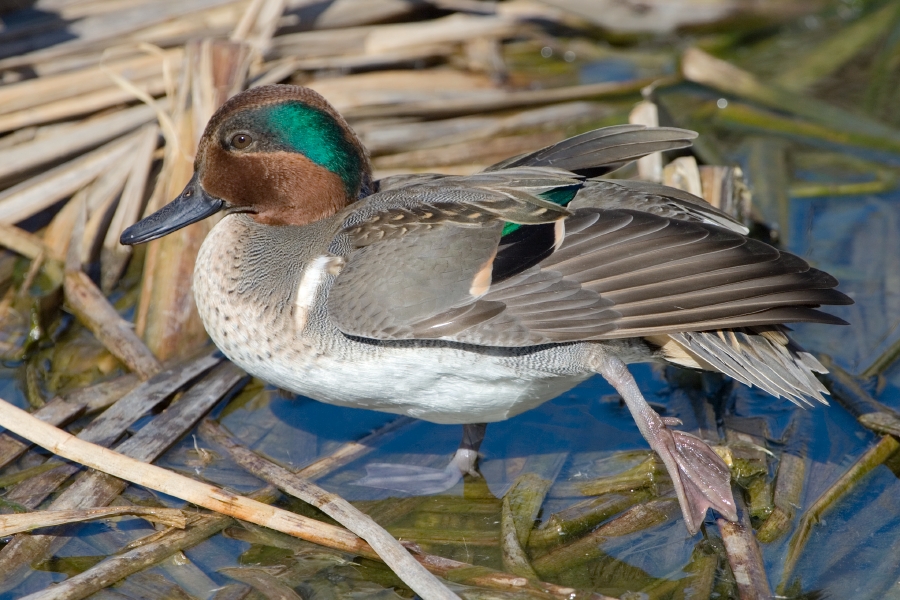
The Green-winged Teal is the smallest dabbling duck in North America, a compact, fast-flying bird barely larger than a pigeon. Despite its tiny size it is one of the continent's most numerous ducks, gathering by the thousands on shallow marshes, flooded fields, and mudflats during migration and winter. Tight flocks twist and bank in unison, flashing pale bellies and dark wings, then drop suddenly to the water in a way that has earned them comparisons to flocks of shorebirds rather than other ducks.
In good light a breeding male is a small masterpiece: a chestnut head split by a sweeping iridescent-green crescent, a finely vermiculated gray body, and a creamy patch under the tail. Both sexes share the bird's namesake feature, a brilliant emerald-green wing patch (speculum) that flashes in flight. Because they favor the shallowest water, often loafing on exposed mud at the marsh edge, they are a familiar and rewarding bird for anyone who scans wetlands, refuge impoundments, or sewage ponds in the cooler months.
Start with size and shape: this is a very small, short-necked, round-headed duck with a small dark bill, noticeably tinier than a Mallard and even smaller than the other teal. On the water it sits compact and low; in flight it looks fast, agile, and short-winged. The green wing patch is shared by both sexes and is the single best clincher when plumage is hard to read.
| Size | Smallest North American dabbling duck, only about two-thirds the bulk of a Mallard |
| Male head | Rich chestnut with a broad iridescent-green crescent sweeping back from the eye, often outlined in buff |
| Male body | Pale gray, finely vermiculated, with a vertical white bar on the side (American birds) and a creamy patch under the tail |
| Female | Mottled brown overall, small dark bill, plain face with a darker eyeline; easy to overlook |
| Speculum | Brilliant green wing patch bordered by buff in front and white behind, visible in flight and at rest |
| In flight | Tiny, fast, twisting flocks; dark wings, pale belly, very quick wingbeats |
Male vs. female
Breeding males are unmistakable: chestnut head, green eye crescent, gray body, and a creamy tail patch. North American (\"American\") males also show a vertical white bar on the side of the chest, while the Eurasian form shows a horizontal white stripe along the body instead. Females are far plainer, mottled warm brown with a small dark bill and a subtle dark line through the eye, and they can be confused with other female teal until the green speculum and the buff streak beside the tail are seen. In late summer, eclipse males look much like females but keep the green speculum and often a warmer cast to the face.
Juveniles
Juveniles closely resemble adult females, mottled brown with a small dark bill, but tend to look fresher and more uniformly marked with finer spotting on the underparts. Young males begin showing traces of their adult pattern through fall and into winter, with the green head crescent and gray body emerging gradually. At all ages the green speculum is present, so a flushed bird showing that emerald wing patch is a teal regardless of how drab the rest of the plumage appears.
The most distinctive sound is the male's call, a clear, high, whistled preep or krick that carries surprisingly far across a marsh and is often the first clue that teal are present. In a flock these whistles overlap into a cheerful, almost cricket-like chorus, which gives the Eurasian form its other name, the \"common teal,\" and inspired its old country nickname related to that ringing note.
Females are much quieter, giving a thin, high quack and short clucking notes, especially when flushed or tending young. During courtship displays on wintering grounds, several males may gather around a female, whistling and tipping their bills up while raising their wings to flash the green speculum.
Green-winged Teal breed across the northern half of North America, from Alaska and the Canadian boreal forest and prairies south into the northern United States, favoring small ponds, marshes, and wooded wetlands. They are strongly migratory, moving south in fall to winter across the southern United States, Mexico, and the Gulf and Pacific coasts, with concentrations in places like the Central Valley of California, the Gulf Coast marshes, and southern wetland refuges.
This is one of the earliest ducks to head south in fall and among the hardier in late winter, lingering wherever shallow water stays open. The closely related Eurasian (Common) Teal occurs across Europe and Asia, and individuals of that form turn up rarely but regularly among North American flocks, where a sharp-eyed observer can pick out the horizontal white side stripe.
Green-winged Teal are dabblers, not divers. They feed in very shallow water and on exposed mud, picking and straining seeds, aquatic plants, and tiny invertebrates with their small bills. Seeds of grasses, sedges, smartweeds, and other wetland plants make up much of the diet, especially in fall and winter, while breeding birds and ducklings take more insects, snails, and other small animals for protein.
Their preference for the shallowest margins sets them apart from larger ducks. They will walk on mudflats and flooded stubble, sifting ooze for seeds and invertebrates, and often feed in dense, busy groups at the water's edge. Because of this they show up readily on flooded agricultural fields, refuge impoundments, and the muddy fringes of ponds.
The female chooses the nest site and does all the incubating. She places the nest on the ground, usually well hidden in dense grass, sedges, or brush, often some distance from water, and lines a shallow scrape with grasses and a thick layer of down. The clutch is typically large for such a small duck.
She incubates for roughly three weeks. The ducklings are precocial, leaving the nest within a day of hatching and following the female to water, where they feed themselves on insects and other small prey. The female tends the brood while the drakes gather elsewhere to molt. Green-winged Teal raise a single brood per season.
The Green-winged Teal is a wetland bird, not a backyard or feeder species, so you won't lure it to a seed feeder. The way to enjoy them is to go where they are or, if you own suitable land, to provide the shallow wetland habitat they need.
- Visit shallow wetlands in fall and winter, refuge impoundments, flooded fields, marsh edges, and even sewage ponds reliably hold teal in the cooler months.
- Scan the muddy margins, not just open water; teal loaf and feed at the shallowest edges where larger ducks won't go.
- Bring a spotting scope; these ducks are tiny and often distant, and a scope makes the male's green head crescent and the green speculum easy to confirm.
- If you manage wetland property, maintain shallow, seasonally flooded areas with native wetland plants such as smartweeds and sedges to provide seeds and invertebrates.
- Go early and look for movement; tight, fast-twisting flocks dropping into shallows at dawn are a classic teal sight.
- Blue-winged Teal: Similar tiny size, but males show a bold white facial crescent and a powder-blue forewing patch in flight rather than a green head crescent; females are warmer-faced and lack the green speculum's buff-and-white border.
- Cinnamon Teal: Males are a striking rich rusty-red all over with a blue forewing; females are very like Blue-winged Teal females and show the blue wing patch, not the green speculum of Green-winged Teal.
- Mallard: Much larger and longer-bodied; the male's green is on the whole head, not a crescent, and Mallards show a blue (not green) speculum bordered by white above and below.
- Northern Shoveler: Also has a green wing area but is far bigger with an enormous spatula-shaped bill and, in males, a green head and white chest with rusty sides.
How can I tell a Green-winged Teal from a Blue-winged Teal?
Look at the wing and head. Green-winged Teal show a green wing patch and, in males, a green crescent on a chestnut head. Blue-winged Teal show a powder-blue forewing patch in flight, and males have a bold white crescent on the face. Green-winged Teal are also a touch smaller and have a noticeably shorter, daintier look.
Why is it called a teal if many ducks have green?
The name 'teal' refers to this group of small dabbling ducks, and the 'green-winged' part points to the brilliant emerald speculum (wing patch) that both sexes show. The drake also has a green crescent on its head, but it's the wing patch that gives the bird its name.
Where and when can I see Green-winged Teal?
In most of the United States they are a fall and winter bird, found on shallow marshes, flooded fields, refuge impoundments, and pond edges. They breed across Canada, Alaska, and the northern U.S. They are one of the earliest ducks to migrate south, so look for them from early fall through late winter.
Are Green-winged Teal rare?
No. Despite their small size they are one of the most abundant ducks in North America, with healthy and stable populations. They are listed as Least Concern. They can be easy to overlook simply because they are small and often feed at distant marsh edges.
What is the difference between American and Eurasian (Common) Teal?
They are very closely related forms of the same species complex. The American male shows a vertical white bar on the side of the chest, while the Eurasian (Common) Teal male shows a horizontal white stripe along the body and lacks the vertical bar. Eurasian birds turn up rarely among North American flocks.