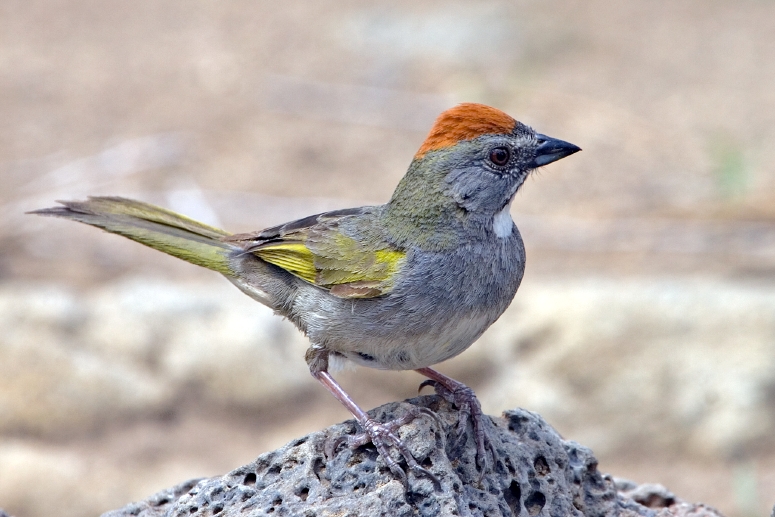
The Green-tailed Towhee is the smallest and most colorful of North America's towhees, and arguably the most secretive. A bird of dry mountain shrublands across the interior West, it spends much of its time on the ground beneath sagebrush, mountain mahogany, and manzanita, scratching for seeds with both feet. What first catches your eye is the bright rusty-red crown, set against a clean white throat and soft gray face. The rest of the bird is a warm olive-green that earns it its name, with the wings and tail glowing yellow-green in good light.
Despite being widespread and fairly common in the right habitat, it is a bird many people hear far more often than they see. It favors brushy slopes and recently burned or logged areas where dense low cover has regrown, and it slips through that cover like a mouse. Patient birders are often rewarded when a male climbs to the top of a shrub to sing, or when a curious bird answers a squeaky pish with its distinctive cat-like mew.
Roughly the size of a large sparrow and noticeably smaller than the more familiar Spotted or Eastern towhees, this is a slim, long-tailed, ground-loving bird. On the ground it often runs with its tail cocked, and it tends to stay low in brush, making the bright head pattern the most reliable thing to lock onto.
| Crown | Bright rufous (rusty-red) cap, the single best field mark |
| Throat | Clean white throat bordered by dark malar (mustache) stripes, set off against a gray face and breast |
| Upperparts | Olive-green back with brighter yellow-green wings and tail |
| Underparts | Plain gray below, fading to whitish on the belly, with no streaking or spots |
| Size & shape | Slim, long-tailed sparrow-sized bird, about 7 in long; often runs on the ground with tail raised |
| Bill & legs | Conical gray seed-eater's bill; pinkish legs |
Male vs. female
Males and females look essentially alike, and there is no reliable way to tell them apart in the field by plumage. Both sexes show the rufous crown, white throat, gray face, and olive-green upperparts. Males average very slightly brighter and are the ones you will see and hear singing from exposed perches, but females sing occasionally too, so song alone is not a perfect sex indicator. For practical birding purposes, treat the sexes as identical.
Juveniles
Juveniles look quite different and can briefly confuse observers. Fresh young birds lack the rufous crown entirely and are dull brownish-olive above with distinct dark streaking on the breast and back, more like a typical young sparrow. They do, however, already show the greenish wash in the wings and tail that hints at their identity. As summer progresses they molt, the streaking fades, and the rufous cap and white throat grow in, so that by fall they closely resemble adults.
The song is a bright, variable jumble that begins with one or two clear introductory notes and breaks into a buzzy, trilled finish, often written as weet-chur, cheee-churr, trrrrr. To many ears it recalls a Fox Sparrow or a scrambled Spotted Towhee song: sweet whistled notes up front, raspy and accelerating at the end. Males deliver it from the top of a sagebrush or small tree, especially in the cool hours of morning.
The call, though, is the giveaway. Green-tailed Towhees give a distinctive cat-like, rising mew or meww that sounds remarkably like a kitten, along with a sharp, metallic chink note when alarmed. That nasal mew, drifting up out of a brushy slope, is often the first and best clue that one is nearby.
This is a bird of the interior West. It breeds across the Great Basin and mountain regions from eastern Oregon, Idaho, and Montana south through Nevada, Utah, Colorado, and into the higher country of Arizona, New Mexico, and California's eastern ranges. Breeding habitat is dry montane and foothill shrubland, often between about 5,000 and 9,000 feet, including sagebrush, chaparral, pinyon-juniper edges, and brushy regrowth after fire.
It is a complete migrant. In late summer and fall, birds withdraw southward to winter in the deserts and thornscrub of the U.S. Southwest borderlands and well into central and northern Mexico. During migration it can turn up in lowland brush, weedy fields, and desert washes far from breeding habitat, and vagrants occasionally appear well east of the normal range, delighting birders in the eastern states.
The Green-tailed Towhee is an omnivore that shifts with the seasons. In spring and summer it eats a great many insects and other small invertebrates, including beetles, grasshoppers, caterpillars, and true bugs, and feeds these protein-rich items heavily to its nestlings. The rest of the year, and especially in winter, the diet tilts toward seeds of grasses, weeds, and shrubs, along with some small fruits and berries.
It forages almost entirely on the ground, using the classic towhee two-footed backward scratch (a quick double-kick that throws leaf litter and soil aside) to expose seeds and insects beneath the surface. Most of this happens under the protective cover of shrubs, which is one reason the bird can be so hard to spot even where it is common.
Nesting is a well-hidden, ground-level affair. The female builds a bulky open cup of twigs, bark strips, and dry grasses, lined with finer grass and animal hair, placed on or very close to the ground inside a dense shrub such as sagebrush, rabbitbrush, or a low bush. The thick cover screens the nest from both predators and view.
A typical clutch is 3 to 4 pale, finely speckled eggs, and pairs commonly raise two broods in a season where conditions allow. The female does the incubating, which lasts close to two weeks, while both parents feed the young. Like many ground-nesting brushland birds, Green-tailed Towhees are sometimes parasitized by Brown-headed Cowbirds.
This is not a classic backyard feeder bird, and most people will never host one at home. It needs dry, brushy mountain or desert habitat, so your odds depend almost entirely on where you live. That said, if your property sits within or near its range and offers the right cover, you can improve your chances.
- Location matters most: you must be within its western range, ideally near sagebrush, chaparral, or brushy foothill slopes, or along a fall/winter migration route in the Southwest.
- Offer dense low cover: native shrubs, brush piles, and unmanicured shrubby edges give it the protected ground it needs to forage and feel safe.
- Scatter seed on the ground: as a ground-feeding scratcher, it is far more likely to take millet or mixed seed spread beneath shrubs than from a hanging feeder.
- Provide a low ground-level water source: a shallow dish or ground birdbath near cover can draw one in, especially in dry country.
- Be patient in fall and winter: in the Southwest, wintering and migrating birds visiting brushy yards are your most realistic shot at one.
- Spotted Towhee: Larger and darker, with a black hood, rufous flanks, and white wing spots; lacks the rufous cap, white throat, and green tones.
- Eastern Towhee: An eastern counterpart, larger with a black-and-rufous pattern and no green; ranges barely overlap.
- Chipping Sparrow: Also has a rufous cap but is much smaller and grayer, with a bold white eyebrow and dark eyeline, and no green wings or white throat patch.
- Fox Sparrow: Similar brushy habits and song, but heavily streaked below and reddish or gray-brown overall, with no rufous crown or green tail.
How do you identify a Green-tailed Towhee?
Look for the combination of a bright rufous (rusty-red) crown, a clean white throat, a gray face and breast, and olive-green upperparts with yellow-green wings and tail. That head pattern paired with the green body is unique among North American towhees and sparrows.
What sound does a Green-tailed Towhee make?
Its most distinctive sound is a cat-like, rising 'mew' that resembles a kitten. The song is a bright, variable phrase of sweet whistled notes followed by a buzzy trill, somewhat like a scrambled Fox Sparrow or Spotted Towhee song. It also gives a sharp 'chink' when alarmed.
Where do Green-tailed Towhees live?
They breed in dry mountain and foothill shrublands across the interior West, including the Great Basin and the Rocky Mountain states, often in sagebrush and chaparral at moderate to high elevations. In winter they migrate south to the desert Southwest and Mexico.
Will Green-tailed Towhees come to a backyard feeder?
Rarely. They are ground-foraging brush birds and are not typical feeder visitors. If you live within their range with brushy cover, you may attract one by scattering seed on the ground beneath shrubs and offering a low water source, especially in fall and winter.
What is the difference between a Green-tailed Towhee and a Spotted Towhee?
The Green-tailed Towhee is smaller, has a rufous cap, a white throat, and olive-green upperparts. The Spotted Towhee is larger and darker, with a black hood, white spots on the wings and back, and rufous flanks, and it shows no green coloring.