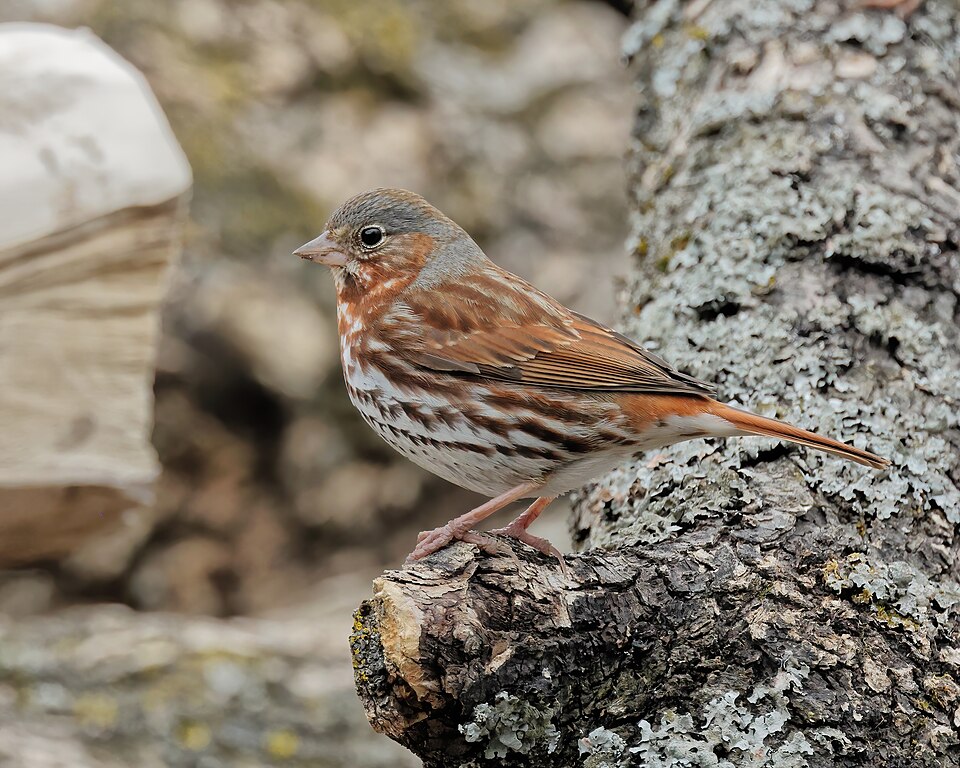
The Fox Sparrow is one of North America's largest and most handsome sparrows, a chunky, big-headed bird most birders first notice not by sight but by sound. Listen for a loud, double-footed scratching in the dead leaves under a hedge or brush pile and there's a good chance you'll find a Fox Sparrow at work, kicking backward with both feet to expose the insects and seeds hidden beneath the litter. Where most sparrows are streaky little brown jobs, this one has heft and presence, and the boldly marked eastern form glows with a foxy red-brown that gave the species its name.
It is also one of the most variable songbirds on the continent. Ornithologists recognize several strikingly different regional populations, sometimes split into separate species, ranging from the bright rusty "Red" Fox Sparrows of the boreal forest to the sooty-brown birds of the Pacific coast and the gray-headed "Slate-colored" birds of the interior mountains. For backyard birders, the Fox Sparrow is mostly a cold-season visitor, a welcome heavyweight that turns up under the feeders in fall and winter and then vanishes north to nest in tangled, remote country few people ever see.
Start with shape and size. The Fox Sparrow is noticeably bigger and rounder than a House or Song Sparrow, with a large head, a stout conical bill, a fairly long tail, and a heavy-chested, almost thrush-like build. The heavy triangular breast streaks that gather into a central spot are the most reliable mark across all the color forms.
| Size & shape | Large, plump sparrow with a big rounded head, stout bill, and longish tail; clearly bigger than a Song Sparrow |
| Breast | Heavy, blurry, triangular reddish or dark streaks converging into a central breast spot on a white background |
| Tail & rump | Rusty or reddish tail and rump, often the brightest part of the bird, obvious as it flushes |
| Eastern 'Red' form | Bright foxy red-brown above with gray on the head and nape, very rusty face and tail |
| Pacific 'Sooty' form | Uniform dark chocolate-brown above and on the head, with dense dark brown breast streaking, little or no rust |
| Interior 'Slate-colored' form | Plain gray head and back contrasting with a bright rufous tail and rusty-streaked breast |
Male vs. female
Male and female Fox Sparrows look alike. There is no seasonal or sexual difference in plumage you can see in the field, so you cannot reliably tell the sexes apart by eye. On the breeding grounds, behavior is the giveaway: the singing bird perched up on an exposed twig is the male, while the female does the nest-building and incubating and stays lower and quieter in the cover.
Juveniles
Juvenile Fox Sparrows, seen mostly on or near the breeding grounds in summer, are duller and softer-looking than adults, with buffier, less crisply defined streaking on the underparts and a somewhat mottled, fluffier appearance. They acquire essentially adult-like plumage by their first fall, so the birds arriving at southern feeders in autumn and winter generally look like full adults and can't be reliably aged in the field.
The song is one of the loveliest of any sparrow: a rich, loud, sweet series of clear whistles and sliding, slurred notes, often opening with one or two pure whistles and then tumbling into musical, churry phrases. It carries a long way through dense brush and has a fuller, more thrush-like quality than the buzzier songs of most sparrows. The exact pattern varies a great deal among the regional forms, so birds in Alaska and birds in the Rockies can sound quite different.
The most familiar sound to wintering birders is the call note: a loud, hard, smacking tchup or smack, lower and more emphatic than a Song Sparrow's note, often the first clue that one is rummaging in the undergrowth. In flight or when agitated it may give a thin, high tseet.
Fox Sparrows breed across a vast swath of northern and western North America: the eastern "Red" birds in the boreal forest and taiga from Alaska and across Canada to Newfoundland, and the western forms down the mountain chains and Pacific ranges from Alaska through British Columbia and the western United States. They favor dense shrubby thickets, willow and alder tangles, chaparral, and the brushy edges of coniferous forest.
Most are migratory. In fall they move south and to lower elevations, with the eastern Red form wintering through much of the southeastern and south-central United States and along the East Coast, and the western forms wintering along the Pacific coast and into the Southwest. Some Pacific-slope birds move only short distances. For the majority of the country, the Fox Sparrow is a fall-through-spring bird, passing through or settling in for the winter from roughly October to April.
Fox Sparrows are ground foragers, and their signature move is the energetic double-scratch: a quick hop forward followed by a backward kick with both feet at once, raking leaf litter aside to uncover food. In the warmer months they take a lot of insects, spiders, and other invertebrates, especially while feeding nestlings. In fall and winter the diet shifts heavily toward seeds, along with small fruits and berries.
This is a bird of the shadows and edges rather than open lawns. It works methodically along the base of hedges, under shrubs, and through brush piles, and it can be surprisingly hard to see despite its size because it sticks close to dense cover. The loud rustling it makes while scratching is often easier to detect than the bird itself.
Fox Sparrows nest in dense low cover on or near the ground, depending on the population and habitat. Boreal and northern birds often place the nest right on the ground, tucked under a shrub or in a clump of vegetation, while many western birds build a bit higher in a low shrub or small conifer. The nest is a bulky open cup of grasses, twigs, moss, and rootlets, lined with finer material such as fine grass, fur, or feathers.
The female builds the nest and incubates the clutch of pale, heavily spotted eggs for roughly two weeks. Both parents feed the nestlings, which leave the nest within a couple of weeks of hatching. In the short northern summers a single brood is typical, while pairs in milder western areas may attempt a second.
Yes, you can attract Fox Sparrows, but on their terms. They are reliable cold-season feeder visitors across much of their wintering range, though they almost always feed on the ground and stay near cover rather than perching at a hanging feeder.
- Scatter millet, sunflower seed, and cracked corn directly on the ground or on a low platform near shrubbery, where these ground-feeders prefer to forage.
- Provide dense cover: a hedge, native shrubs, or a brush pile gives them the protected leaf-litter habitat they need and makes your yard far more attractive.
- Place feeding spots close to thick edges rather than out in the open lawn, since Fox Sparrows rarely venture far from escape cover.
- Leave fallen leaves and natural litter under shrubs so they can do their trademark double-scratch foraging.
- Offer a ground-level birdbath or shallow water source, kept open in winter, which can draw them in along with other sparrows.
- Be patient and watch in late fall through early spring, the season when most regions host wintering or migrating Fox Sparrows.
- Song Sparrow: Smaller and slimmer with crisper, thinner streaks; lacks the Fox Sparrow's heavy bulk and bright rusty tail, and pumps its tail in flight.
- Hermit Thrush: Similar reddish tail and ground habits, but it has a thin thrush bill, spotted (not streaked) breast, and a plain unstreaked face.
- Swamp Sparrow: Much smaller with a rusty cap and rusty wings but a mostly unstreaked grayish breast; lacks the Fox Sparrow's bold breast spotting and bulk.
- Hermit Thrush: Often confused with the rusty-tailed Fox Sparrow at a glance, but the thrush is slimmer-billed and forages with upright thrush posture.
Why is it called a Fox Sparrow?
The name comes from the rich, foxy red-brown coloring of the classic eastern ("Red") form, especially its rusty tail and reddish streaking, which recalls the color of a red fox. Not all regional forms are this rusty, but the name stuck.
Are Fox Sparrows rare?
No. The Fox Sparrow is a common and widespread species rated Least Concern. It just goes overlooked because it breeds in remote northern and mountain country and spends winter skulking in dense brush rather than out in the open.
What is that loud scratching sound under my bushes?
It may well be a Fox Sparrow. They feed with a vigorous "double-scratch," kicking back with both feet to fling leaf litter aside, which makes a surprisingly loud rustling for a single small bird.
When will I see Fox Sparrows in my yard?
For most of the United States, they're cold-season birds, showing up during fall migration and through the winter from roughly October to April, then heading north to breed. Look for them under feeders and along brushy edges.
Why do Fox Sparrows look so different from place to place?
There are several distinct regional populations, sometimes treated as separate species, ranging from bright rusty Red birds in the boreal forest to dark sooty-brown Pacific birds and gray-headed Slate-colored birds of the interior mountains. The heavy triangular breast streaks tie them all together.