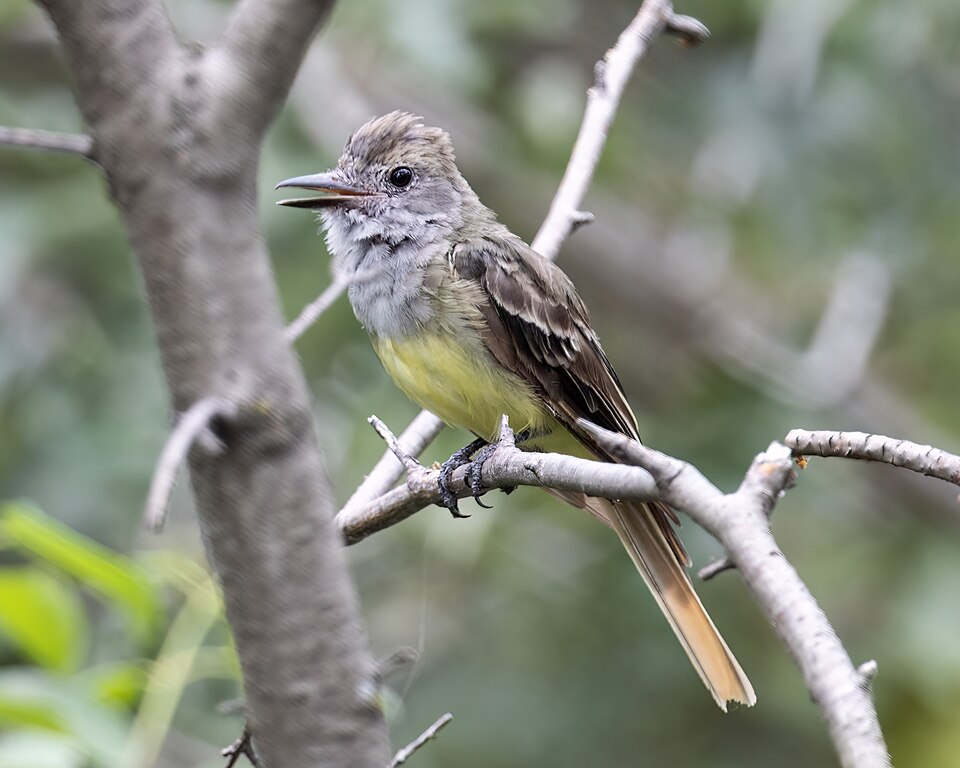
The Great Crested Flycatcher is a big, boldly colored member of the tyrant flycatcher family that spends most of its life high in the leafy canopy of eastern North America's woodlands. You will often hear it long before you see it: its ringing, rising wheep! carries through the treetops on summer mornings. When it does come into view, it is unmistakable for a flycatcher, with a gray-brown back, a clean lemon-yellow belly, and a flash of cinnamon-rust in the wings and tail.
Unlike most of our flycatchers, this species is a cavity nester, tucking its nest into old woodpecker holes, natural tree hollows, and nest boxes. It is also famous for a quirky habit: it frequently weaves a shed snakeskin (or, these days, a strip of crinkly plastic) into the nest lining. A bird of forest edges, open woods, and wooded suburbs, the Great Crested is a long-distance migrant that winters in the tropics and returns each spring to fill the canopy with noise.
This is a large, big-headed flycatcher with an upright posture, a slightly shaggy crest that gives the head a peaked look, and a fairly long tail. At rest it looks heavy-bodied and sits tall on a high, exposed perch. The combination of a gray throat and breast, bright yellow belly, and rusty tail is diagnostic among eastern flycatchers.
| Belly | Bright lemon-yellow, contrasting sharply with the gray throat and upper breast |
| Tail | Long, with extensive rufous (cinnamon-rust) in the inner webs of the feathers, obvious in flight |
| Head | Gray-brown with a bushy, peaked crest; large-headed look |
| Wings | Dark with two pale wingbars and rufous edges to the flight feathers |
| Bill | Stout, broad-based, mostly dark with a paler base to the lower mandible |
| Size & shape | Robin-sized but more upright and big-headed; sits tall on high perches |
Male vs. female
Males and females look essentially identical in the field. Both sexes show the same gray breast, yellow belly, and rusty tail, and there is no reliable plumage difference you can pick out with binoculars. Males average slightly larger, but the difference is not visible in practice. During the breeding season, behavior is your best clue: the loud, persistent wheep calling and territorial chasing are usually the male advertising and defending his nesting area.
Juveniles
Juveniles look much like adults and are not easy to separate in the field. Freshly fledged young show the same gray-and-yellow pattern with rusty wings and tail, but their plumage is a bit softer and fluffier, the wingbars and feather edges can look slightly buffier, and the rufous tones may appear a touch warmer and less crisp. By the time they head south on their first migration, young birds are very close to adult appearance.
The signature call is a loud, emphatic, rising wheep!, a single whistled note that snaps upward at the end and rings through the forest canopy. It is one of the most recognizable woodland sounds of the eastern summer. Birds also give a rolling, burry prrrreeet or creeep, and an excited series of churring and rattling notes when agitated or interacting with a mate or rival.
The dawn song, delivered mostly in the early breeding season, is a repeated, throaty phrase often written as wheep... wheep... prrreet-wheep, given over and over from a high perch. Once you learn the bright, slurred wheep, you will start noticing this bird in summer woods everywhere, even when it stays hidden in the leaves.
The Great Crested Flycatcher breeds across the eastern United States and southern Canada, from the Atlantic coast west to the eastern Great Plains and north into southern Manitoba, Ontario, Quebec, and the Maritimes. It favors deciduous and mixed woodlands, forest edges, open woods, orchards, and wooded suburbs and parks.
It is a long-distance, Neotropical migrant. In fall it leaves the breeding grounds and travels to wintering areas from southern Mexico through Central America to northern South America, with some birds wintering in southern Florida. Spring migrants typically arrive back in the eastern U.S. from April into May, announcing their return with that loud wheep from the treetops.
Insects make up the bulk of the diet. The Great Crested Flycatcher hunts mostly from a high perch in the canopy, sallying out to snatch flying insects in midair or pluck them from foliage in a quick hovering grab. Favorite prey includes beetles, moths and butterflies (and their caterpillars), katydids, crickets, cicadas, dragonflies, true bugs, and wasps and bees. It often returns to the same perch to beat larger prey before swallowing it.
In late summer and on the wintering grounds it readily adds fruit to its diet, taking small berries and wild fruits whole. Because it forages high and on the wing, it spends much of its time out of easy view, which is part of why it is heard far more often than seen.
This is the only cavity-nesting flycatcher in most of eastern North America. Pairs nest in natural tree hollows, abandoned woodpecker holes, and readily in nest boxes, including those put up for bluebirds, kestrels, or wood ducks. The cavity is filled with a bulky cup of leaves, grass, bark, feathers, fur, and other debris. Famously, the lining often includes a shed snakeskin, and in modern times birds frequently substitute a strip of clear plastic or cellophane that mimics it.
The female lays a clutch of about 4 to 8 eggs (commonly 5 to 6), creamy to buff and marked with brown and lavender scrawls and blotches. She does the incubating for roughly two weeks, and both parents feed the nestlings, which leave the nest around two weeks after hatching. Most pairs raise a single brood per year.
The Great Crested Flycatcher is not a feeder bird, it will not come to seed or suet, but you can absolutely attract one to a wooded yard, where it is one of the more achievable cavity-nesting "specialty" birds to host.
- Put up a nest box. A box with a roughly 1.75-2 inch entrance hole, mounted 8-20 feet up at a wooded edge, is your single best tool. Boxes meant for Eastern Screech-Owls, kestrels, or large bluebird/flicker boxes often work well.
- Keep dead trees and snags when it is safe to do so, natural cavities and old woodpecker holes are prime nest sites.
- Skip the insecticides. This bird lives on beetles, moths, caterpillars, and other insects, so a pesticide-free, insect-rich yard is what feeds it.
- Offer native fruiting shrubs and trees such as dogwood, serviceberry, and wild cherry for late-summer fruit.
- Provide a leafy canopy and high perches. Mature trees and a wooded edge give it the elevated lookouts it hunts from.
- Leave a little nesting material handy, these birds will collect odd bits, and providing a brush pile or natural debris nearby can help.
- Eastern Kingbird: Also large and upright, but black-and-white (dark above, white below) with a white tail tip, no yellow belly or rusty tail.
- Eastern Phoebe: Smaller and plainer gray-brown with a whitish belly, no rufous in the tail, and a habit of pumping its tail while perched low.
- Eastern Wood-Pewee: Much smaller and drabber gray with a pale belly and bold wingbars but no bright yellow and no rusty tail; gives a plaintive pee-a-wee.
- Western Kingbird: Has a yellow belly too, but a pale gray head/chest and a black tail with white edges rather than a rusty tail; a western, open-country bird.
What does a Great Crested Flycatcher sound like?
Its trademark call is a loud, rising, whistled wheep! that rings through the treetops. It also gives a rolling, burry prrreeet or creeep, and excited churring rattles when agitated. You will usually hear it well before you spot it high in the canopy.
Why do Great Crested Flycatchers put snakeskin in their nests?
They commonly weave a shed snakeskin into the nest lining, and today they often use a strip of clear plastic instead. The exact reason is debated, it may help deter predators or simply be a favored bit of crinkly material, but it is a well-documented and characteristic habit of the species.
Will a Great Crested Flycatcher use a nest box?
Yes. It is the only widespread eastern flycatcher that nests in cavities, and it readily takes to nest boxes with a roughly 1.75-2 inch entrance hole mounted high at a wooded edge. Boxes intended for screech-owls, kestrels, or large bluebird setups often attract them.
Do Great Crested Flycatchers come to bird feeders?
No, they eat insects caught on the wing or gleaned from foliage, plus some fruit, so they ignore seed and suet feeders. To draw one in, offer a nest box, keep your yard pesticide-free and insect-rich, and plant native fruiting shrubs and trees.
How can I tell a Great Crested Flycatcher from a kingbird?
Look at the belly and tail. The Great Crested has a bright lemon-yellow belly, a gray throat, and a rusty tail. The Eastern Kingbird is black-and-white with a white-tipped tail, and the Western Kingbird has a black tail with white edges rather than a rusty one.
When do Great Crested Flycatchers migrate?
They are long-distance migrants. Most arrive on eastern breeding grounds from April into May and head south in late summer and fall to winter from southern Mexico through Central America into northern South America, with a few wintering in southern Florida.