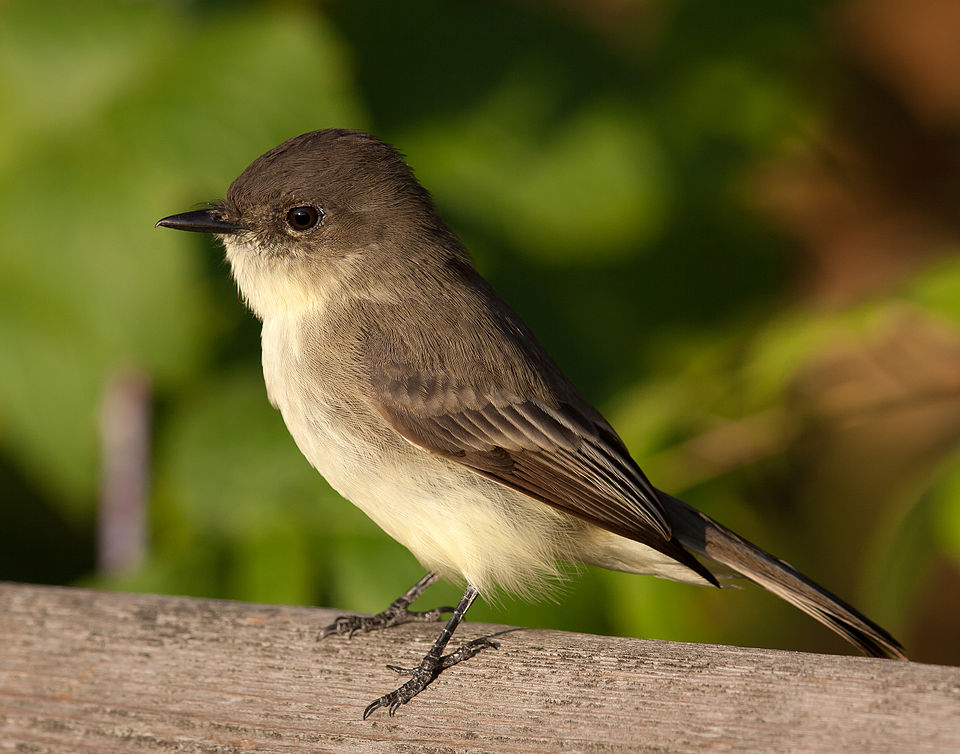
The Eastern Phoebe is one of the most approachable and easily recognized flycatchers in eastern North America. A plump, grayish-brown songbird with a dark head and a habit of pumping its tail almost constantly, it tends to perch low and in the open, making it far easier to study than the maddeningly similar Empidonax flycatchers that birders often struggle to tell apart. Its loud, raspy fee-bee song, which sounds almost exactly like its name, is one of the first signs of spring across much of the East.
Phoebes are tightly linked to people and water. They love nesting on the ledges, rafters, and overhangs of houses, barns, bridges, and culverts, and they hunt insects along streams, woodland edges, and open yards near cover. This is also a bird with a place in history: in 1804 John James Audubon tied silver threads to the legs of phoebe nestlings near Philadelphia and confirmed they returned to the same area the next year, one of the earliest bird-banding experiments in North America.
The Eastern Phoebe is a medium-small flycatcher with a fairly large, slightly peaked head, a thin straight bill, and a long tail it wags and dips frequently while perched. Overall it looks plain and unmarked compared with other flycatchers, and that very plainness, combined with the tail-wagging, is the best first clue to its identity.
| Head | Dark grayish to blackish, distinctly darker than the back and contrasting with the paler throat and underparts |
| Underparts | Whitish, often washed pale yellow on the belly in fresh fall plumage; dusky smudging across the breast |
| Tail | Long and dark; constantly pumped and flicked downward, the single most reliable behavioral mark |
| Wings | Plain brownish-gray with NO bold white wingbars (unlike most similar flycatchers) |
| Bill | All black, thin and straight; lacks the pale lower bill of many Empidonax flycatchers |
| Eye-ring | Faint or absent, never the crisp bold eye-ring shown by Empidonax flycatchers |
Male vs. female
Male and female Eastern Phoebes look alike. The sexes cannot be reliably separated in the field by plumage, size, or color, and even in the hand they are very similar. If you see a pair near a nest, you can sometimes infer roles by behavior, since only the female builds the nest and incubates, but both parents feed the young.
Juveniles
Juvenile phoebes resemble adults but look softer and browner overall, often with two faint cinnamon or buffy wingbars and warmer brown edging on the wing feathers. These pale wingbars can briefly confuse birders into thinking they are seeing an Empidonax flycatcher, but the dark head, tail-wagging habit, all-dark bill, and lack of a bold eye-ring still point to phoebe. The wingbars fade as the bird molts into adult-like plumage.
The song is an emphatic, buzzy fee-bee, with the second note often sounding lower and rougher than the first. Birds frequently alternate two versions, a clearer rising fee-bee and a more burry, downslurred fee-b-be-bee, repeated steadily from a perch. Unlike the sweet whistled song of a chickadee (which can also sound like fee-bee), the phoebe's voice is hoarse and scratchy, almost as if the bird has a sore throat.
The common call is a sharp, clear chip, given as the bird sallies after insects or shows agitation. Phoebes sing early and often in spring, sometimes before dawn, and continue calling through the breeding season.
Eastern Phoebes breed across the eastern and central United States and through much of Canada, from the Maritimes and Quebec west across the boreal edge to the Northwest Territories and south into the central states. They favor wooded areas near water, farmland, and suburban edges, especially anywhere with bridges, buildings, or rocky overhangs for nesting.
They are short-distance migrants and one of the earliest songbirds to return north in spring, often arriving in March when snow may still be on the ground. In winter they retreat to the southeastern United States and into eastern and central Mexico. Their tolerance of cool weather is helped by a willingness to switch to berries and fruit when insects are scarce, allowing some birds to linger surprisingly late into fall.
The Eastern Phoebe is primarily an insectivore, and it hunts in classic flycatcher style. From a low, exposed perch it watches for passing prey, then sallies out to snatch flying insects from the air before returning to the same or a nearby perch. It also drops to the ground or hovers briefly to glean insects and spiders from foliage and surfaces, and it readily catches prey over water.
Its diet includes wasps, bees, beetles, flies, moths, dragonflies, and many other flying and crawling insects, along with spiders and ticks. In cold weather or late in the season, phoebes supplement with small fruits and berries, a flexibility that helps them survive farther north and later in the year than most flycatchers.
The female builds a sturdy cup of mud, moss, leaves, and grass, lined with fine grass and hair, and anchors it to a sheltered ledge. Natural sites include rock faces and stream banks, but phoebes have embraced human structures and now commonly nest on the beams, eaves, and ledges of buildings, under bridges, and inside culverts. Pairs often reuse and refurbish a successful nest site year after year.
A typical clutch is 3 to 6 white eggs, sometimes with a few fine reddish spots. The female incubates for about two weeks, and the young fledge roughly 15 to 16 days after hatching. Phoebes commonly raise two broods a season, and they are frequent hosts to Brown-headed Cowbird eggs, which they often accept and raise alongside their own.
Eastern Phoebes do not eat seed and will not visit a seed or suet feeder, so the way to attract them is by offering habitat and nest sites rather than food. If you have a yard near water, woods, or open ground, you have a good chance of hosting a pair.
- Mount a small, flat nesting shelf under a porch roof, eave, or shed overhang, ideally in a sheltered spot 8-12 feet up and protected from rain and predators.
- Keep a water feature like a stream, pond, or even a shallow garden pool nearby, since phoebes hunt heavily over and around water.
- Leave some open perches such as fence posts, low bare branches, or a garden stake, which phoebes use as launch points for catching insects.
- Avoid or minimize insecticides in your yard, since flying and ground insects are this bird's entire food supply.
- Tolerate a little mud near a water source in spring, which females gather to build their nests.
- If a pair nests on your house, leave the nest in place between broods and seasons, as phoebes often reuse the same site.
- Eastern Wood-Pewee: Has bold whitish wingbars and does NOT wag its tail; also gives a clear, plaintive whistled pee-a-wee rather than a raspy fee-bee.
- Least Flycatcher: Smaller, with a bold white eye-ring and two crisp white wingbars; says a dry che-bec and lacks the constant downward tail-pumping.
- Eastern Kingbird: Larger and cleaner black-and-white with a white tail tip; perches upright and is far more aggressive, with no tail-wagging.
- Black Phoebe: A western relative with a sharply demarcated black breast and clean white belly; ranges barely overlap, so location usually settles it.
How do I know if a bird on my porch is an Eastern Phoebe?
Watch the tail. A phoebe perches low and pumps and dips its tail almost constantly, has a dark head, plain wings with no bold wingbars, and an all-black bill. If it also says a raspy fee-bee, you can be confident it is an Eastern Phoebe.
Why does the Eastern Phoebe wag its tail?
Phoebes flick and pump their tail downward almost continuously while perched. The exact reason is not fully understood, but it may signal alertness or fitness to predators and rivals. Whatever the cause, it is the single most useful field mark for telling phoebes from look-alike flycatchers.
Will Eastern Phoebes use a nest box or shelf?
They will not use an enclosed nest box, but they readily use an open nesting shelf or platform mounted under a sheltered overhang such as a porch, eave, or shed. A flat ledge protected from rain and predators is ideal.
What is the difference between a phoebe's song and a chickadee's?
Both can sound like fee-bee, but the Black-capped Chickadee's version is a sweet, clear, whistled two-note song, while the Eastern Phoebe's is hoarse, buzzy, and scratchy, as if the bird has a sore throat. The phoebe also pumps its tail, which chickadees do not.
Do Eastern Phoebes come back to the same nest every year?
Often yes. Phoebes show strong site fidelity and frequently return to refurbish and reuse a successful nest, or build a new one at the same location, year after year. Leaving an old nest in place can encourage a pair to return.