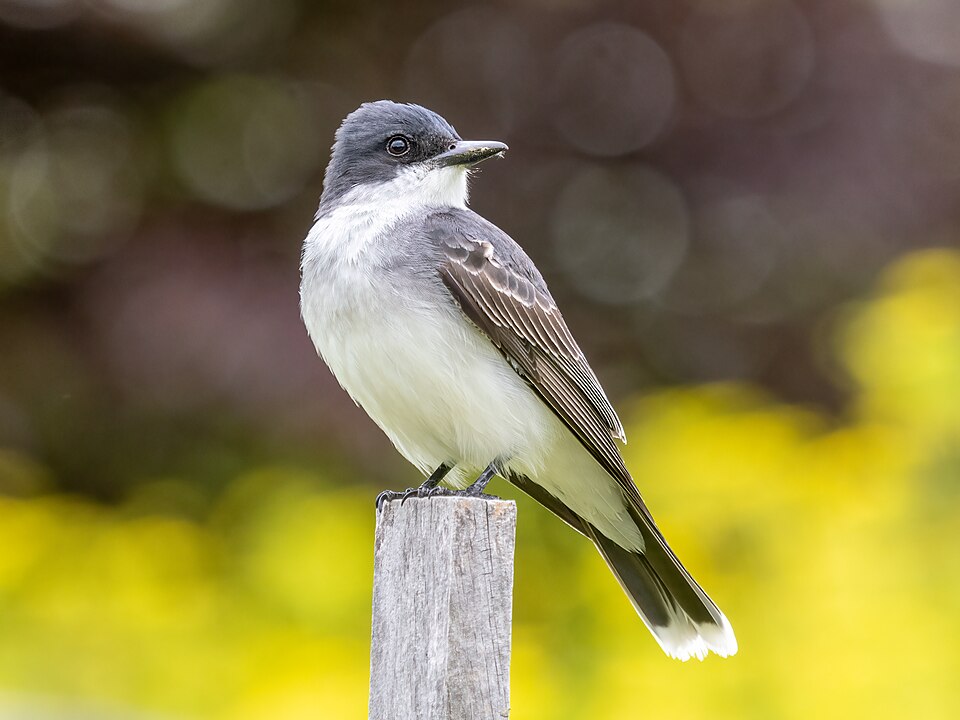
The Eastern Kingbird is a sturdy, slate-and-white flycatcher of open country, and it more than lives up to its regal name. Despite being smaller than a robin, it rules its summer territory with astonishing nerve, launching itself at crows, hawks, and even Great Blue Herons that drift too close to its nest. Birders learn to spot it not just by its crisp black-above, white-below plumage but by its attitude: an upright bird perched on a fence wire or dead branch at the edge of a field, scanning for insects and ready to pick a fight with anything bigger than itself.
Its scientific name, Tyrannus tyrannus, says it all twice over: the "tyrant" flycatcher. Yet there is a striking double life behind that aggression. The bird that defends a hayfield in Ohio with such ferocity spends its winters in the rainforests of the western Amazon, traveling in loose, peaceable flocks and feeding largely on fruit. Few backyard birds show such a complete change of character between the seasons, which is part of what makes the Eastern Kingbird a favorite among people who watch open fields, fencelines, and country roadsides.
Look for a stocky, big-headed flycatcher that perches bolt upright, often on a wire, fencepost, or the bare top of a shrub at the edge of open ground. The clean two-tone pattern (dark above, white below) and the distinctive white band across the tip of the tail are the quickest ways to clinch the identification, even at a distance.
| Upperparts | Blackish-slate head and back; the head is the darkest part, almost like a black cap. |
| Underparts | Clean white from chin to belly, with a faint grayish wash across the chest. |
| Tail | Black tail with a bold, clean white band across the tip - the single best field mark. |
| Crown patch | A hidden red-orange crown stripe, rarely visible, flared only in courtship or aggression. |
| Bill & posture | Short, straight black bill; upright, alert stance typical of tyrant flycatchers. |
| Size | Robin-sized but chunkier through the chest, with a relatively large head. |
Male vs. female
Males and females look alike to the eye, both wearing the same blackish upperparts, white underparts, and white-tipped tail. There are no reliable plumage differences a backyard birder can use in the field, and even the concealed red-orange crown patch is present in both sexes. Males average slightly larger and do most of the showy aerial displays and territorial fighting, but you cannot sex a perched kingbird by sight with any confidence.
Juveniles
Recently fledged Eastern Kingbirds look much like adults but a bit more muted and brownish, with the upperparts a softer slate-brown rather than crisp black, and pale buffy or grayish edgings on the wing feathers. The white tail-tip is present but may look duller or narrower, and young birds lack the hidden crown patch. By the time they leave on fall migration they have largely molted into adult-like plumage.
The Eastern Kingbird does not really sing in the melodic sense; instead it produces a busy series of sharp, electric, sputtering notes. The most familiar sound is a high, buzzy dzee-dzee-dzee or a sputtering kit-kit-kitter-kitter, often described as sounding like a tiny crackle of static electricity or a metallic stutter. The notes are thin, high-pitched, and slightly insect-like.
Most vocalizing is tied to alarm and territory. When mobbing a predator or chasing an intruder, the bird unleashes rapid, agitated chatters. In the pre-dawn hours, males give an extended, twittering display flight song, repeating buzzy phrases as they flutter on quivering, shallow wingbeats. Once you learn the bright, zapping quality of the calls, kingbirds are easy to detect by ear along any open fenceline.
In the breeding season Eastern Kingbirds spread across most of the eastern and central United States and well up into Canada, favoring open and semi-open habitats: farm fields, pastures, orchards, woodland edges, marsh borders, and the brushy margins of rivers and lakes. They reach from the Atlantic Coast westward across the Great Plains and into parts of the Pacific Northwest, anywhere with scattered perches and open hunting ground.
They are long-distance migrants. By late summer they gather and head south, funneling through Central America to spend the winter in South America, mainly the western Amazon basin. There, remarkably, they abandon their solitary, combative summer lifestyle and travel in flocks, switching their diet heavily toward fruit. Spring migration brings them back north from April into May, and most have departed again by early fall.
Through the breeding season the Eastern Kingbird is a classic aerial insectivore. From an exposed perch it watches for passing prey, then sallies out to snatch flying insects with an audible snap of the bill before returning to the same or a nearby perch. Bees, wasps, flies, beetles, grasshoppers, dragonflies, and winged ants all feature on the menu, and the bird is an agile, acrobatic flier when in pursuit. It often hunts low over water or open fields, hovering briefly to pick insects from foliage or the surface.
The seasonal twist is dramatic. On the South American wintering grounds, where flying insects are less dependable, kingbirds shift to a fruit-heavy diet, feeding in flocks on small berries and other soft fruits. This flexibility, insect-hunting tyrant in summer and sociable fruit-eater in winter, helps explain how a single small flycatcher thrives across two such different worlds.
Pairs nest in open or edge habitat, usually placing the nest on a horizontal limb of a tree or shrub, often near or over water, though they will also use fenceposts, snags, and artificial structures. The female builds a bulky, somewhat untidy cup of twigs, weed stems, and grass, lining it with finer rootlets, hair, and plant down. Construction takes roughly one to two weeks.
A typical clutch is three to four creamy white eggs blotched with brown and lavender. The female does the incubating for about two and a half weeks, and both parents feed the nestlings, which fledge roughly two to three weeks after hatching. The adults are famously aggressive nest defenders, mobbing crows, hawks, and other large birds relentlessly, sometimes landing on a hawk's back in mid-air to drive it off. Most pairs raise a single brood per season because of the long round-trip migration.
The Eastern Kingbird is not a feeder bird and will not come to seed, suet, or sugar water, but it is very much a bird you can encourage if you have the right setting. It hunts flying insects from open perches, so the key is open space and a place to sit and watch for prey.
- Provide open, unmowed space nearby - a meadow, hayfield, large yard, or pasture edge produces the flying insects kingbirds hunt.
- Leave a dead snag, bare branch, or fence wire standing as a hunting perch; kingbirds favor exposed, elevated lookouts.
- Sites near water (a pond, marsh, or stream edge) are especially attractive, since insects swarm there and they like to nest over water.
- Avoid heavy pesticide use - a healthy population of flying insects is the single best draw for any flycatcher.
- Plant or keep fruiting native shrubs; while they eat mostly insects here, kingbirds will take berries, especially late in the season before migration.
- Keep some scattered trees or tall shrubs at the edge of open ground to offer secure nest sites.
- Eastern Phoebe: Smaller and plainer grayish-brown, lacks the white tail-tip, and constantly pumps its tail; gives a clear fee-bee song rather than buzzy chatter.
- Eastern Wood-Pewee: Grayer overall with wing bars and no clean black-and-white contrast or white tail band; sings a slow, plaintive pee-a-wee from the forest, not open fields.
- Gray Kingbird: A coastal southern relative that is paler gray above with a heavier bill and a notched, dark tail lacking the bold white tip.
- Loggerhead Shrike: Similar gray-and-white pattern and fencepost perching, but has a thick hooked bill and a bold black mask through the eye, and hunts large insects and small vertebrates rather than flycatching.
Why does the Eastern Kingbird attack hawks and crows?
Eastern Kingbirds are exceptionally aggressive nest defenders. They mob much larger birds - hawks, crows, herons, even Ospreys - to drive potential nest predators out of their territory. They will dive at, harass, and sometimes land on the backs of these intruders in mid-air. This bold behavior is exactly what earned them the name 'kingbird' and the scientific name Tyrannus tyrannus, the tyrant.
What does an Eastern Kingbird look like?
It is a robin-sized, big-headed flycatcher that is blackish-slate above and clean white below, with a faint gray wash on the chest. The standout field mark is a bold white band across the tip of its black tail, visible in flight and at rest. It perches upright on wires, fenceposts, and bare branches at the edge of open fields.
What is the white tip on the kingbird's tail for?
The crisp white terminal band on the tail is the Eastern Kingbird's most reliable field mark and helps distinguish it from other flycatchers. Its exact function isn't fully understood, but the flash of white is conspicuous during the bird's fluttering display flights and aggressive chases, so it likely plays a role in signaling during territorial and courtship behavior.
Where do Eastern Kingbirds go in winter?
They are long-distance migrants that leave North America entirely, wintering in South America, primarily the western Amazon basin. Remarkably, their behavior flips on the wintering grounds: instead of defending solitary territories and hunting insects, they gather in flocks and feed largely on fruit.
Will Eastern Kingbirds come to a bird feeder?
No. Eastern Kingbirds are insect-eating flycatchers and won't visit seed, suet, or nectar feeders. To attract them, provide open habitat with flying insects, exposed perches like dead branches or fence wires, and ideally a nearby pond or marsh - especially if you avoid heavy pesticide use.