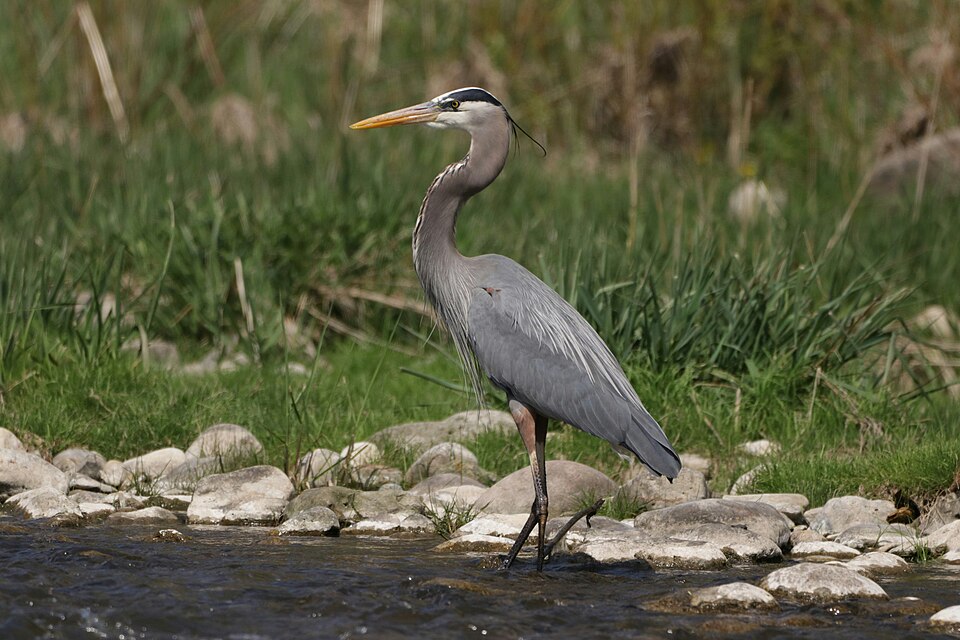
The Great Blue Heron is the heron most North Americans picture when they think of a heron: a tall, statuesque, blue-gray wading bird standing motionless at the edge of a pond, marsh, or shoreline. Standing up to four feet tall with a wingspan approaching six and a half feet, it is the largest heron on the continent and one of the most familiar large birds in wetland country. Despite its imposing size, it weighs only five to six pounds, its bulk being mostly long legs, a long sinuous neck, and broad, slow-flapping wings.
You will find this bird almost anywhere there is shallow water and fish, from coastal mudflats and freshwater lakes to roadside ditches, suburban retention ponds, and even backyard koi pools (much to the dismay of homeowners). It is a patient ambush hunter, capable of standing stock-still for long minutes before striking. Adaptable, hardy, and present across nearly all of the United States at some point in the year, the Great Blue Heron is a bird that rewards quiet observation and is well worth getting to know.
Size alone usually clinches the identification: this is a very large, long-legged, long-necked wading bird that in flight folds its neck into a tight S-shape and trails its legs straight out behind. At rest it has a hunched, dignified posture with the neck often pulled in against the body, looking almost like a gray statue at the water's edge.
| Overall color | Blue-gray body, paler gray neck, with a shaggy ruff of feathers on the chest and a grayish-blue back |
| Head pattern | White crown and face with a bold black stripe running from above the eye to slender black plumes off the back of the head |
| Bill | Long, heavy, dagger-shaped bill, dull yellow to orange, brighter at the start of breeding season |
| Neck | Long and S-curved; rusty-cinnamon tones on the sides of the neck and thighs |
| Legs | Very long, dull gray to greenish, becoming reddish at the top during courtship |
| In flight | Neck folded back in a tight kink, legs trailing, slow deep wingbeats; two-toned gray wings with darker flight feathers |
Male vs. female
Males and females look essentially alike in plumage, both showing the same blue-gray body, white-and-black head pattern, and dagger bill. Males average slightly larger and heavier with somewhat longer plumes, but the difference is subtle and not reliable for identifying a lone bird in the field. At the nest, the male typically arrives first to establish a territory and does most of the courtship display, which can be the easiest behavioral clue to sex in a breeding pair.
Juveniles
Young Great Blue Herons are duller and more uniformly gray-brown than adults. The key giveaway is the head: juveniles have a solid dark gray to blackish cap rather than the clean white crown bordered by black of the adult, and they lack the long, elegant head plumes. Their bill tends to be darker and grayer, and their overall appearance is scruffier, with less of the shaggy chest and back plumage. They reach adult plumage in their second to third year.
The Great Blue Heron is not a songbird and has no melodic voice. Its signature sound is a loud, harsh, guttural squawk, often given when it is flushed or alarmed and takes flight: a deep, croaking frahnk or braak that carries well across a wetland and sounds almost prehistoric. Some describe it as a hoarse, rolling roh-roh-roh.
Around nesting colonies the birds are far more vocal, producing a range of croaks, clucks, and harsh greeting calls as pairs exchange duties at the nest. They also make a dry clattering sound by snapping the bill (bill-clappering) during courtship and territorial displays. Away from the colony, a lone heron is usually silent until disturbed.
The Great Blue Heron ranges across nearly all of North America, from southern Canada and Alaska's coast south through the United States, Mexico, the Caribbean, and into northern South America and the Galapagos. It occupies an enormous variety of wetland habitats: freshwater and saltwater marshes, lake and river edges, estuaries, mangroves, flooded fields, and beaches.
Birds breeding in the colder northern interior migrate south for winter, while populations along coasts and in the milder southern and western United States are largely year-round residents. As long as water stays open and fish are reachable, herons will linger surprisingly far north into winter. A striking all-white form known as the Great White Heron occurs in coastal southern Florida and the Caribbean and is considered a regional color morph of the same species.
Fish are the staple of the Great Blue Heron's diet, but it is an opportunistic generalist that takes whatever it can catch and swallow. The menu includes frogs, salamanders, crayfish, aquatic insects, snakes, small turtles, rodents such as voles and gophers, and even small birds. In farm fields and meadows away from water, herons will hunt mice and gophers like a long-legged stalking cat.
The classic hunting method is to stand motionless or wade slowly through shallow water, neck coiled, then strike with a lightning-fast forward thrust of the head, grabbing or spearing the prey with that powerful bill. Larger fish are maneuvered head-first and swallowed whole, sometimes with a visible bulge sliding down the neck. Herons hunt by day and night and will defend a productive feeding spot from other herons.
Great Blue Herons nest in colonies called heronries (or rookeries), often shared with other wading birds and sometimes numbering dozens to hundreds of nests. Most nests are placed high in trees near or over water, though herons will also nest on the ground on predator-free islands, in shrubs, or on artificial structures. The male gathers most of the sticks and the female does most of the building, assembling a large platform of branches lined with finer twigs, grass, and leaves that grows bulkier with reuse over the years.
The female lays a clutch of pale blue eggs, typically three to five, and both parents share incubation over roughly four weeks. Both adults feed the young by regurgitation, and the nestlings grow quickly, branching and exercising their wings before fledging at around two months. Pairs usually raise a single brood per year, occasionally attempting a second in the south.
The Great Blue Heron is not a feeder bird and cannot be drawn in with seed or suet, but it readily visits yards and properties that offer water and prey. If you have a pond, water feature, or stocked fish pool, you may attract one whether you want to or not.
- A pond or water feature with fish, frogs, or aquatic life is the single biggest draw; ornamental koi and goldfish ponds are especially attractive to a hunting heron.
- Leave a natural, unmanicured shoreline with shallow margins where the bird can wade and stalk prey.
- Tall trees near water can serve as roosting or even nesting sites if you are lucky enough to live near a wetland.
- If you instead want to protect pond fish, use netting, add deep zones and hiding caves for fish, or place a motion-activated sprinkler; heron decoys are largely ineffective since real herons are territorial only seasonally.
- Give a hunting heron space and quiet; they flush easily and will abandon a spot that feels exposed or disturbed.
- Avoid using pesticides or rodenticides near water, since herons eat fish, amphibians, and rodents and can accumulate toxins through their prey.
- Sandhill Crane: Similar size and gray color, but cranes fly with the neck fully extended (not folded), have a red crown and a bustled rear, and feed in dry fields in flocks; herons fly neck-folded and are usually solitary near water.
- Great Egret: Same general size and shape but entirely white with a yellow bill and black legs; the Great White Heron form of the Great Blue is bulkier with dull yellowish legs.
- Little Blue Heron: Much smaller and a darker slaty blue-purple with a two-toned bluish bill tipped black, and lacks the white crown and head plumes of the Great Blue.
- Tricolored Heron: Notably smaller and slimmer with a distinctive white belly contrasting a dark blue-gray body and neck, plus a white stripe down the front of the neck.
How big is a Great Blue Heron?
They stand about three to four feet tall, measure 38 to 54 inches from bill to tail, and have a wingspan of roughly five and a half to six and a half feet. Despite that imposing size, they weigh only about five to six pounds because their bones are light and much of their height is leg and neck.
Is a Great Blue Heron the same as a crane?
No. They look alike at a distance, but they are unrelated. The easiest way to tell them apart is in flight: herons fold the neck into a tight S, while cranes fly with the neck stretched straight out. Cranes also have a red crown, gather in flocks in open fields, and have a loud bugling call, whereas herons are usually solitary near water with a harsh croaking squawk.
What does a Great Blue Heron eat?
Mostly fish, but they are flexible hunters that also take frogs, crayfish, salamanders, aquatic insects, snakes, small turtles, rodents, and even small birds. They hunt by standing still or wading slowly and then striking with a fast thrust of the bill.
Will a Great Blue Heron eat the fish in my backyard pond?
Yes, ornamental ponds stocked with koi or goldfish are a favorite target. To protect your fish, use pond netting, provide deep water and hiding spots or caves, or install a motion-activated sprinkler. Plastic heron decoys rarely work for long, since these birds are not consistently territorial outside the breeding season.
Do Great Blue Herons migrate?
Some do and some don't. Birds that breed in the colder northern interior move south for winter, while populations along the coasts and across the milder southern and western United States are year-round residents. As long as water stays open and fish are catchable, herons will winter surprisingly far north.