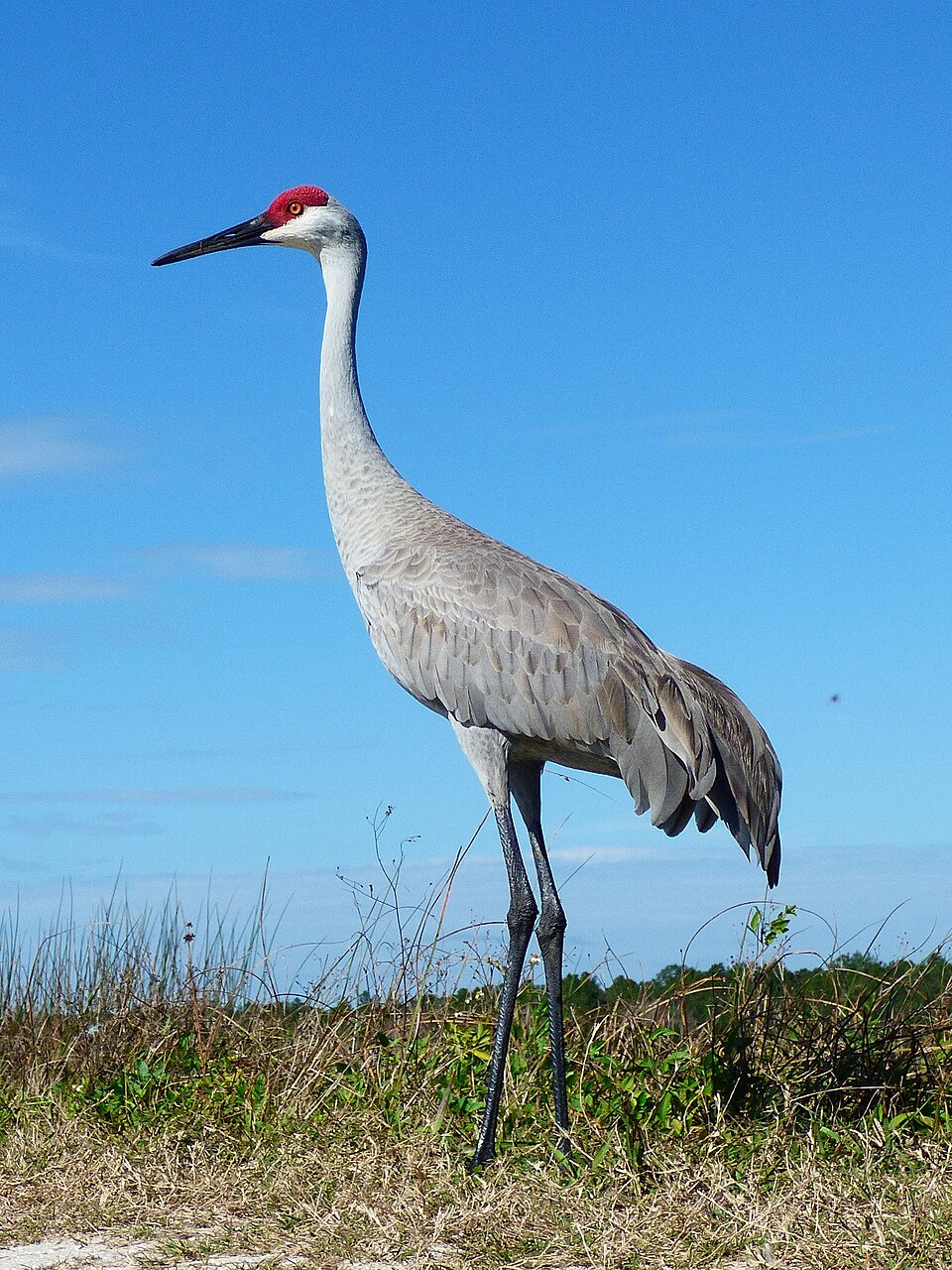
The Sandhill Crane is one of North America's most impressive and recognizable birds: a long-legged, long-necked gray crane that stands nearly as tall as a person and announces itself with a rolling, trumpeting call you can hear long before you see the bird. Where Great Blue Herons stalk quietly through the shallows, Sandhill Cranes stride across open fields and marshes in family groups and, in migration and winter, in flocks numbering into the tens of thousands. They are ancient birds, part of a lineage that stretches back millions of years, and watching a flock spiral down out of a high autumn sky is one of the great spectacles in birding.
Despite their size and their wild reputation, Sandhill Cranes have adapted remarkably well to a landscape of farms, prairie wetlands, and even suburban edges. Their populations have grown steadily over recent decades, and they now nest across a broad swath of the northern continent while gathering in famous concentrations such as Nebraska's Platte River during spring migration. Their bugling, their graceful courtship dances, and their devotion to mates and young make them a favorite of casual observers and serious birders alike.
Look for a very large, stately gray bird with an upright, elegant posture, a long neck held straight, long dark legs, and a distinctive bustle of drooping feathers over the rump (often called the "bustle" or "tail bustle"). In flight, cranes hold the neck fully extended rather than tucked, a key difference from herons.
| Overall color | Slate to pale gray body; plumage often stained rusty brown from preening with iron-rich mud, especially in breeding season. |
| Crown | Bare patch of red skin on the forehead and crown, brightest on adults and more vivid when displaying. |
| Face | White cheek patch contrasting with the gray neck and red crown. |
| Bustle | Shaggy, drooping feathers over the rear give a distinctive 'bustle' silhouette when standing. |
| Legs and bill | Long blackish legs and a straight, fairly heavy dark bill. |
| In flight | Neck outstretched, legs trailing well past the tail, with deep deliberate wingbeats and a quick upward flick on the upstroke. |
Male vs. female
Males and females look alike in plumage and color, so you cannot reliably tell them apart by sight in the field. Males average slightly larger and heavier, and in a bonded pair the male is often the taller of the two, but this is only useful when a pair stands side by side. During their unison calling, the male and female produce slightly different notes, and males typically hold the bill more steeply upward, but visually the sexes are essentially identical.
Juveniles
Young Sandhill Cranes, called colts, are covered in cinnamon-buff down as chicks and follow their parents within a day of hatching. By their first fall, juveniles are mostly gray but show a rusty or tawny wash over the head, neck, and back, and crucially they lack the bare red crown of adults, instead having a fully feathered, brownish head. Immatures stay with their parents through the first winter and migration, so a "rusty-headed" crane traveling with two gray adults is almost always a bird of the year.
The Sandhill Crane's call is unmistakable: a loud, rolling, rattling bugle often written as a trumpeting karrooo-karrooo-karrooo or a guttural garoo-a-a-a. The sound carries for more than a mile thanks to an unusually long, coiled windpipe that resonates inside the breastbone, giving the call its rich, vibrating quality. A high flock on migration produces a continuous, far-carrying chorus that many people hear before they ever spot the birds.
Mated pairs perform a synchronized "unison call," standing close together and bugling in a coordinated duet that reinforces their bond and helps defend territory. Birds also give softer purring and rattling contact notes within family groups, and colts have a thin, peeping whistle they use to stay in touch with their parents.
Sandhill Cranes breed across a vast northern range, from the wetlands and tundra of Alaska and arctic Canada south through the Great Lakes region, the upper Midwest, and parts of the northern Rockies and Great Basin. Several non-migratory populations are resident year-round, including birds in Florida, the Gulf Coast, Mississippi, and Cuba. Migratory populations winter in the southern United States and into Mexico, concentrating in places such as Texas, New Mexico's Bosque del Apache, Arizona, and California's Central Valley.
Migration is the season cranes are most famous for. Each spring, several hundred thousand birds funnel through Nebraska's Platte River valley, staging in spectacular numbers to rest and feed before continuing north. They migrate by day in large flocks, soaring on thermals and calling constantly, and a single high "V" or ragged line of bugling cranes is one of the surest signs of changing seasons.
Sandhill Cranes are opportunistic omnivores that forage mostly by walking slowly across open ground and probing or pecking at the surface. Plant matter makes up the bulk of their diet in many seasons: waste grain such as corn left in harvested fields, plus seeds, roots, tubers, and the shoots of marsh plants. This reliance on agricultural fields is a big reason migrating flocks now thrive in farm country.
They are far from strict vegetarians, though. Cranes readily take insects, snails, earthworms, small rodents, frogs, snakes, and the eggs and nestlings of ground-nesting birds. Foraging families spread out across a field, heads down, occasionally pausing to call or to watch for danger, and they will dig with the bill to reach buried tubers and invertebrates.
Sandhill Cranes form long-term pair bonds and are famous for their courtship dancing, in which partners bow, leap into the air with wings spread, toss grass and sticks, and run with exaggerated steps. Pairs nest in isolated, defended territories, usually in or beside shallow marshes, bogs, or wet meadows where standing water helps protect the nest from predators.
The nest is a large mound of grasses, sedges, reeds, and other vegetation, built up in shallow water or on a small island or hummock. The female typically lays two eggs, pale and marked with brown blotches, and both parents share incubation over roughly a month. Although two eggs are the norm, the older, stronger chick often outcompetes its sibling, so many pairs raise just one colt to fledging. Young follow the adults on foot, fledge in two to three months, and remain with their parents through the first migration and winter.
Sandhill Cranes are not feeder birds, and you should not try to feed them by hand, as habituated cranes can become aggressive and lose their natural wariness. Instead, you attract cranes by offering the open, wet habitat they need and by knowing when and where to look.
- If you live near wetlands, marshes, or farm fields in their range, simply provide open space and quiet; cranes will sometimes forage in large lawns and pastures on their own.
- Never hand-feed cranes or leave grain out to lure them; it endangers the birds and can lead to property damage and aggression.
- Maintain or restore shallow wetlands and undisturbed wet meadows on larger properties to give breeding pairs the nesting cover they require.
- Leave waste grain in harvested fields and avoid mowing wet meadows during nesting season to support local birds.
- To reliably see big flocks, plan a trip to a known staging or wintering site such as the Platte River in spring or a national wildlife refuge in winter.
- Watch and listen overhead during spring and fall migration; bugling flocks often pass high over backyards far from any wetland.
- Great Blue Heron: Often confused at a distance, but herons fly with the neck folded back in an S-curve, lack the red crown and bustle, and stalk fish in water rather than walking across dry fields.
- Whooping Crane: Much rarer and mostly white with black wingtips and a red-and-black face; Sandhills are gray overall. The two sometimes travel together, so scan crane flocks carefully.
- Wood Stork: A large white wading bird with a bare dark head and black flight feathers, found in the Southeast; lacks the gray body, red crown, and bugling call of a Sandhill Crane.
What is the difference between a Sandhill Crane and a Great Blue Heron?
The easiest tell is in flight: cranes fly with the neck stretched straight out, while Great Blue Herons fold the neck back into an S. Cranes are overall gray with a red crown and a shaggy rear bustle, travel in flocks, and walk across fields; herons are bluish-gray, usually solitary, and hunt fish at the water's edge.
Why are some Sandhill Cranes rusty or brown instead of gray?
Adult cranes deliberately preen iron-rich mud into their feathers, which stains the gray plumage a rusty brown, especially during the breeding season. Juveniles also show a natural tawny wash on the head and back. The underlying plumage is gray, so the rust color fades as feathers are replaced.
What sound does a Sandhill Crane make?
They give a loud, rolling, trumpeting bugle, often written as karrooo or garoo-a-a-a, that can carry over a mile. The unusually long, coiled windpipe gives the call its deep, rattling resonance. Mated pairs perform a coordinated duet called a unison call.
Where and when can I see large flocks of Sandhill Cranes?
The most famous gathering is along Nebraska's Platte River in spring, where hundreds of thousands stage during migration. In winter, refuges such as Bosque del Apache in New Mexico and sites in Texas, Arizona, and California's Central Valley host large flocks. Watch and listen overhead during spring and fall migration anywhere along their flyways.
Do Sandhill Cranes mate for life?
Sandhill Cranes form long-term, often lifelong pair bonds, reinforced each year by their elaborate dancing and synchronized unison calling. Pairs raise their young together, and the previous year's colt typically stays with its parents through its first winter before striking out on its own.