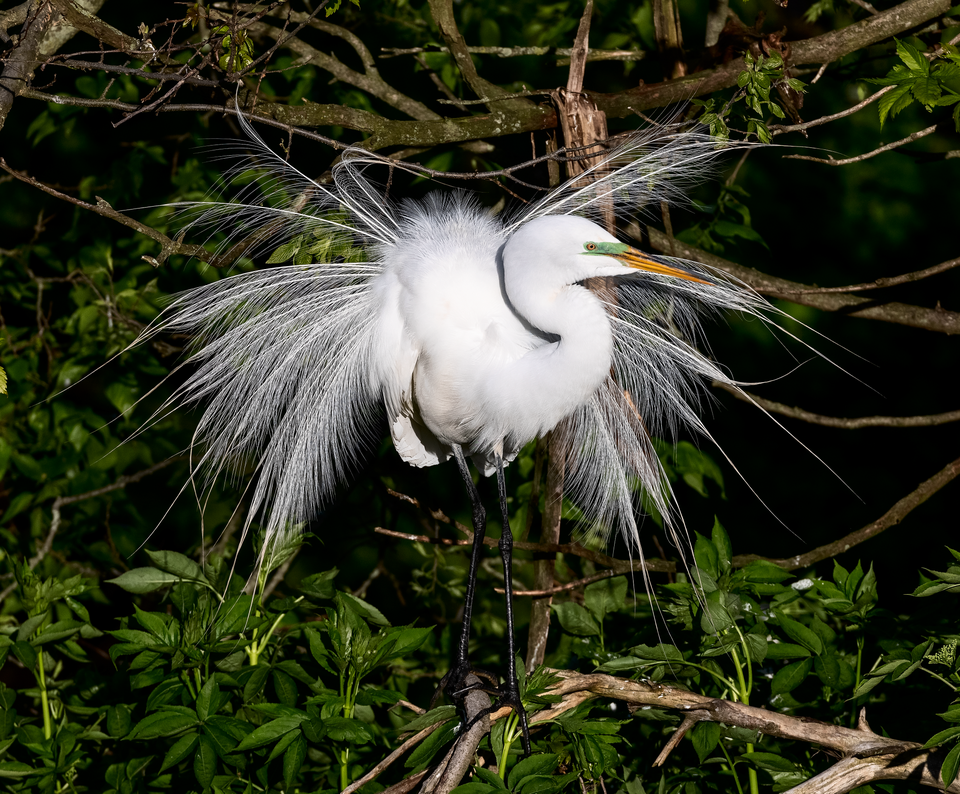
The Great Egret is one of North America's most elegant and recognizable wading birds: a tall, slender, snow-white heron that stands motionless in the shallows like a patient statue before striking at a fish with a lightning thrust of its dagger bill. Found along the edges of marshes, ponds, rivers, estuaries, and flooded fields, it is a familiar sight across much of the warmer parts of the continent and, in fact, on every continent except Antarctica. Its size, brilliant white plumage, yellow bill, and black legs make it hard to confuse with much else once you learn the handful of similar species.
This bird carries real conservation history on its back. In the late 1800s and early 1900s, Great Egrets were slaughtered by the hundreds of thousands for the fine, lacy breeding plumes (called "aigrettes") that adorned women's hats. The outrage over that trade helped launch the modern bird-conservation movement and the founding of the National Audubon Society, whose logo to this day is a Great Egret in flight. Protected and recovered, the species is now common and a true success story of early conservation.
Look for a large, lanky, entirely white heron standing in or near water. The Great Egret holds its long neck in a graceful S-curve at rest and flies with the neck pulled back and the legs trailing well behind the tail. Its overall length and slim build give it an unmistakably stately profile.
| Plumage | Entirely white at all ages and seasons, with no dark feathers anywhere on the body |
| Bill | Long, heavy, and dagger-like; yellow to orange-yellow |
| Legs and feet | Black legs and black feet (an important mark separating it from the Snowy Egret) |
| Neck | Very long and slender, kinked into a kinked S-shape when standing or stalking |
| Size | Tall and large; clearly bigger than a Snowy Egret, smaller than a Great Blue Heron |
| Breeding plumes | Long, wispy aigrette plumes trail off the back during the breeding season, and the lores turn bright lime-green |
Male vs. female
Males and females look alike. The sexes share the same all-white plumage, yellow bill, and black legs, and they cannot be reliably told apart in the field by color or pattern. Males average slightly larger than females, but this difference is subtle and only useful when a known pair stands side by side. During courtship both sexes grow the long ornamental back plumes and develop the green lores, so plumes alone do not indicate sex.
Juveniles
Juvenile Great Egrets look much like adults: all white, with the same black legs and yellow bill. They lack the long, lacy breeding plumes of courting adults, and the bill may appear duller. Because there is no streaky brown immature plumage as in some herons, young Great Egrets are essentially identifiable by the same field marks as adults, just without the breeding finery.
The Great Egret is not a songbird and has no true song. Its common call is a low, dry, grating croak, often given when flushed or in flight, usually rendered as a harsh kraak or cuk-cuk-cuk. The voice is deeper and rougher than you might expect from such a graceful bird.
Around the nesting colony the birds are far noisier, producing a range of rough croaks, rattles, and squawking arrr and frawnk notes during displays, squabbles over nest sites, and exchanges between mates. Away from the colony, a lone foraging egret is usually silent.
The Great Egret has one of the widest ranges of any heron, breeding across the Americas, Europe, Africa, Asia, and Australia. In North America it nests across much of the southern and eastern United States, up the Atlantic and Gulf coasts, through the Mississippi Valley, and in scattered western wetlands, with populations also throughout Mexico, Central America, and beyond.
Northern breeders are migratory, moving south in fall to the southern U.S., Mexico, the Caribbean, and Central America, while birds in the warmer southern parts of the range are largely resident year-round. After the breeding season, Great Egrets are well known for post-breeding dispersal, when young and adults wander widely, sometimes turning up far north of the breeding range at lakes and ponds where they are not normally expected.
Great Egrets are primarily fish-eaters, but they take a wide variety of aquatic and semi-aquatic prey: small to medium fish, frogs, tadpoles, crayfish, aquatic insects, snakes, salamanders, and occasionally small mammals, lizards, or even nestling birds. They hunt mainly in shallow water and along soft muddy margins.
The classic feeding style is "stand and wait": the egret freezes in the shallows, neck cocked, then spears or grabs prey with a quick stab of its bill. It also stalks slowly and deliberately through the water. In open fields and pastures it will hunt grasshoppers and rodents, and it readily gathers at receding pools, drainage ditches, and fish concentrations where prey is trapped and easy to catch.
Great Egrets nest colonially, often in mixed heronries alongside other herons, egrets, ibises, and cormorants. Colonies are usually placed in trees or shrubs over or near water, or on islands that offer protection from ground predators. The male establishes a nest territory and displays to attract a mate, raising his plumes and stretching skyward.
The nest is a fairly large, somewhat flimsy platform of sticks built in the canopy, with the male typically gathering material and the female doing most of the construction. The female lays a clutch of pale blue-green eggs, and both parents share incubation. The chicks are fed regurgitated food by both adults and can be aggressive toward one another in the nest, with the strongest often outcompeting weaker siblings during lean times.
The Great Egret is not a backyard or feeder bird, so you will not lure one with seed or suet. It is a specialist of open shallow water, and the only realistic way to attract one is to provide or live near suitable wetland habitat. If you want to see them, the surest approach is to visit the right places rather than to draw them to a typical yard.
- If you have a large pond, marshy edge, or shoreline property, keep the shallows healthy and stocked with fish, frogs, and aquatic life that egrets hunt.
- Maintain natural, undisturbed vegetation around water edges and avoid mowing or hardening the entire shoreline, which removes foraging habitat.
- Skip pesticides and herbicides near water; they reduce the insects, amphibians, and small fish egrets depend on.
- To reliably see them, visit wetlands, refuges, estuaries, and flooded fields at dawn or dusk when egrets are actively foraging.
- Watch fields and ditches after heavy rain or during drawdowns, when receding water concentrates prey and draws wandering post-breeding birds.
- Snowy Egret: Smaller and daintier with a thin black bill and black legs ending in bright yellow feet (the famous golden slippers); Great Egret has a yellow bill and all-black legs and feet.
- Great Blue Heron: A rare all-white form (great white heron) is similar in size, but typical Great Blue Herons are blue-gray, and the white form has dull yellowish legs rather than the Great Egret's black legs.
- Cattle Egret: Much smaller and stockier with a shorter neck and shorter yellow bill, often seen in dry fields near livestock; breeding birds show buff plumes, unlike the all-white Great Egret.
- Great White Heron: This pale Florida-area form of the Great Blue Heron is bulkier with thicker legs and a heavier head, and lacks the slim, plumed elegance of the Great Egret.
What is the difference between a Great Egret and a Snowy Egret?
The quickest way to tell them apart is bill and feet. The Great Egret is large with a yellow bill and entirely black legs and feet. The Snowy Egret is smaller and slimmer with a thin black bill and black legs that end in bright yellow feet, often described as golden slippers.
Are Great Egrets the same as white herons?
Great Egrets are herons, so calling one a white heron is not wrong, but the name can be ambiguous. A few other white waders exist, including the Snowy Egret, Cattle Egret, immature Little Blue Heron, and the rare white form of the Great Blue Heron, so it helps to check size, bill color, and leg color to be sure.
Why do Great Egrets stand so still?
That stillness is a hunting strategy. By freezing in the shallows the egret avoids spooking fish and frogs, then waits for prey to come within range before striking with a fast thrust of its bill. Patience is how it catches a meal.
Where do Great Egrets go in winter?
Northern breeders migrate south in fall to the southern United States, Mexico, the Caribbean, and Central America. Birds in warmer southern regions often stay put year-round, so in much of the South you can see Great Egrets in every season.
Why is the Great Egret on the Audubon Society logo?
Great Egrets were nearly wiped out around 1900 when they were hunted for the lacy breeding plumes used to decorate hats. The campaign to stop that slaughter helped launch the National Audubon Society, which adopted the Great Egret in flight as its symbol of bird conservation.