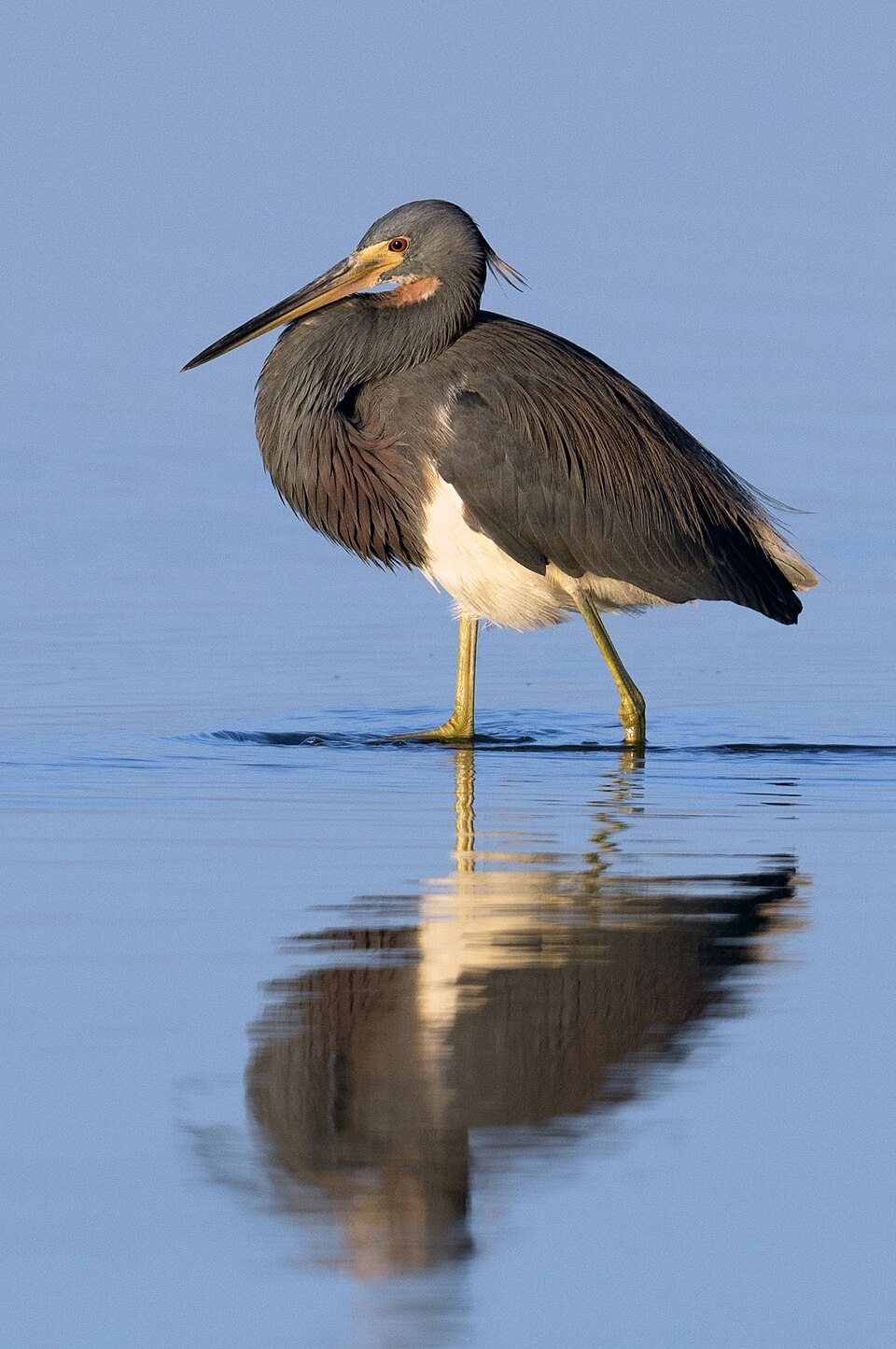
The Tricolored Heron is one of the most elegant and energetic of the small herons, a slender blue-gray bird that seems to be in constant motion as it hunts. Once known by the more romantic name "Louisiana Heron," it is a signature bird of the warm coastal Southeast, the kind of wader you watch dash, stab, and pirouette through shallow water rather than stand patiently like a Great Blue. Its single most useful field mark is a clean white belly that contrasts sharply with its otherwise dark body, a feature no other dark heron in North America shares.
Look for it along the edges of salt marshes, mangrove channels, tidal flats, brackish lagoons, and freshwater impoundments from the Gulf Coast up the Atlantic seaboard. It is rarely far from the salt, which sets it apart from the more widespread Little Blue and Green Herons. Active, lean, and beautifully marked, the Tricolored Heron rewards anyone willing to stand quietly at the marsh edge and watch it work.
This is a medium-small heron with a notably long, thin neck and a long, slender bill, a built-for-stalking silhouette that looks lankier and more delicate than the chunkier Little Blue or Snowy. At rest it appears slim and upright; in flight the long neck folds into a tight S and the legs trail well past the tail.
| Belly | Clean white belly and under-tail, sharply set off from the dark body, the diagnostic mark |
| Body & neck | Slaty blue-gray upperparts and neck, with a rusty-maroon wash down the foreneck and a white throat stripe |
| Bill | Long, thin, and dagger-like; yellowish to grayish, with a dark tip |
| Legs | Long and dull yellow-green, becoming brighter in breeding birds |
| Breeding plumes | Adults grow shaggy white head plumes and buff-and-white back plumes; the bill base and lores flush bright blue |
| Size | Slender, mid-sized heron, larger than a Green Heron, daintier than a Snowy Egret in build |
Male vs. female
Males and females look alike. The sexes share the same blue-gray plumage, white belly, and rusty neck wash, and they cannot be reliably told apart in the field. Males average slightly larger, but the difference is too subtle to judge on a lone bird. During courtship both sexes develop the same brightening of the bare facial skin and the same wispy plumes.
Juveniles
Juveniles are easy to recognize once you know the adult: they keep the same white belly but are far rustier overall, with rich chestnut and cinnamon edging on the neck, wing coverts, and back instead of clean slate-gray. This warm reddish tone fades gradually over the first year as the bird molts toward adult blue-gray. The combination of a rusty neck and a bright white belly is unique among young North American herons and prevents confusion with the all-dark immature Little Blue Heron.
Tricolored Herons are not songbirds, and away from the colony they are often silent. When flushed or annoyed they give a harsh, nasal croak or groan, a low aaahh or raaa that is rougher and more grating than musical.
Around nesting colonies they are much noisier, producing a range of guttural squawks, grunts, and bill-snapping during courtship and territorial squabbles. These rookery sounds blend into the general clamor of egrets and ibises that often nest alongside them.
In North America the Tricolored Heron is mainly a bird of the Southeast and Gulf coasts, breeding along the Atlantic shore from roughly the mid-Atlantic states south through Florida and west along the Gulf to Texas. It is largely a coastal specialist, far more numerous near salt and brackish water than inland. The species also ranges widely through the Caribbean, Mexico, and Central America into northern South America.
Birds in the northern part of the U.S. range pull back south for winter, withdrawing toward Florida, the Gulf, and the tropics, while populations in the Deep South and tropics are largely resident year-round. After breeding, like many herons, young birds wander and individuals occasionally turn up well north or inland of the usual range as post-breeding strays.
The Tricolored Heron is an active, restless hunter that eats mostly small fish, supplemented by shrimp, crabs, aquatic insects, tadpoles, frogs, and other small aquatic prey. Small killifish, mosquitofish, and similar shallow-water minnows make up much of the diet in tidal creeks and marsh pools.
Its feeding style is distinctive and fun to watch. Rather than waiting motionless, it stalks rapidly through shallow water, then dashes, runs, and lunges after prey, often with wings half-spread for balance or to cast shade on the water. It will crouch low, stir the bottom with a foot, and pivot quickly, frequently wading belly-deep where other small herons hesitate. This energetic, almost frantic pursuit-hunting is one of the best ways to recognize the species at a distance.
Tricolored Herons nest colonially, usually in mixed rookeries with egrets, ibises, and other herons, choosing shrubs, mangroves, or small trees over or near water on coastal islands and in swamps. The male typically selects the site and begins building, displaying to attract a mate, after which the pair completes a fairly flimsy platform of sticks and twigs lined with finer material.
A typical clutch is three to four pale blue-green eggs. Both parents share incubation, which lasts around three weeks, and both feed the chicks by regurgitation. The young clamber about the nest branches well before they can fly and fledge a few weeks after hatching. Pairs generally raise a single brood per season.
This is not a backyard or feeder bird, it will never visit a seed feeder or birdbath, and there is no realistic way to draw it to a typical yard. It is a coastal wading specialist, so "attracting" it really means knowing where and how to find it.
- Look in coastal salt and brackish habitats: tidal creeks, salt marshes, mangrove edges, mudflats, and managed wetland impoundments.
- Visit at low tide, when receding water concentrates small fish in shallow pools and channels where the heron hunts.
- Scan for the hunting style, a slim dark heron dashing and lunging through the shallows, often belly-deep, rather than standing still.
- If you own coastal property, the best help is habitat: protect marsh edges and water quality and avoid disturbing nesting islands during the breeding season.
- Coastal wildlife refuges and national seashores along the Gulf and Atlantic are reliable places to find them; bring binoculars or a scope for marsh viewing.
- Give nesting colonies a wide berth, herons flush easily, and disturbance can cause whole rookeries to abandon nests.
- Little Blue Heron: Adult is uniformly dark slate-purple with NO white belly; lacks the rusty neck and white throat stripe of the Tricolored.
- Reddish Egret: Larger and bulkier with shaggy rusty head and neck; the famous dark morph lacks a white belly and has a pink-based, black-tipped bill.
- Snowy Egret: Entirely white with a black bill and yellow feet; only the active, dancing hunting style is similar, not the plumage.
- Green Heron: Much smaller and stockier with short legs and a chestnut neck; crouches and waits rather than dashing through open shallows.
How do I tell a Tricolored Heron from a Little Blue Heron?
The white belly is the key. A Tricolored Heron has a clean white belly that contrasts with its dark blue-gray body, plus a white throat stripe and a rusty wash on the neck. An adult Little Blue Heron is dark all over with no white belly. Tricoloreds are also slimmer with a longer, thinner neck and bill.
Why is it called a Tricolored Heron?
The name comes from its blend of three color tones, blue-gray upperparts and neck, rusty-maroon along the foreneck and shoulders, and a clean white belly. It was formerly called the Louisiana Heron, but the name was changed to reflect its much wider range.
Where can I see a Tricolored Heron?
Look along the U.S. Gulf and Atlantic coasts, from the mid-Atlantic south through Florida and Texas, especially in salt marshes, tidal creeks, mangroves, and coastal impoundments. It is strongly tied to salt and brackish water and is much harder to find inland.
What does a Tricolored Heron eat?
Mainly small fish such as killifish and minnows, along with shrimp, crabs, aquatic insects, tadpoles, and small frogs. It hunts actively, dashing and lunging through shallow water rather than standing and waiting.
Is the Tricolored Heron endangered?
No. It is listed as Least Concern globally and remains fairly common in suitable coastal habitat. However, it depends on healthy wetlands and undisturbed nesting colonies, so local populations can decline where marshes are degraded or drained.