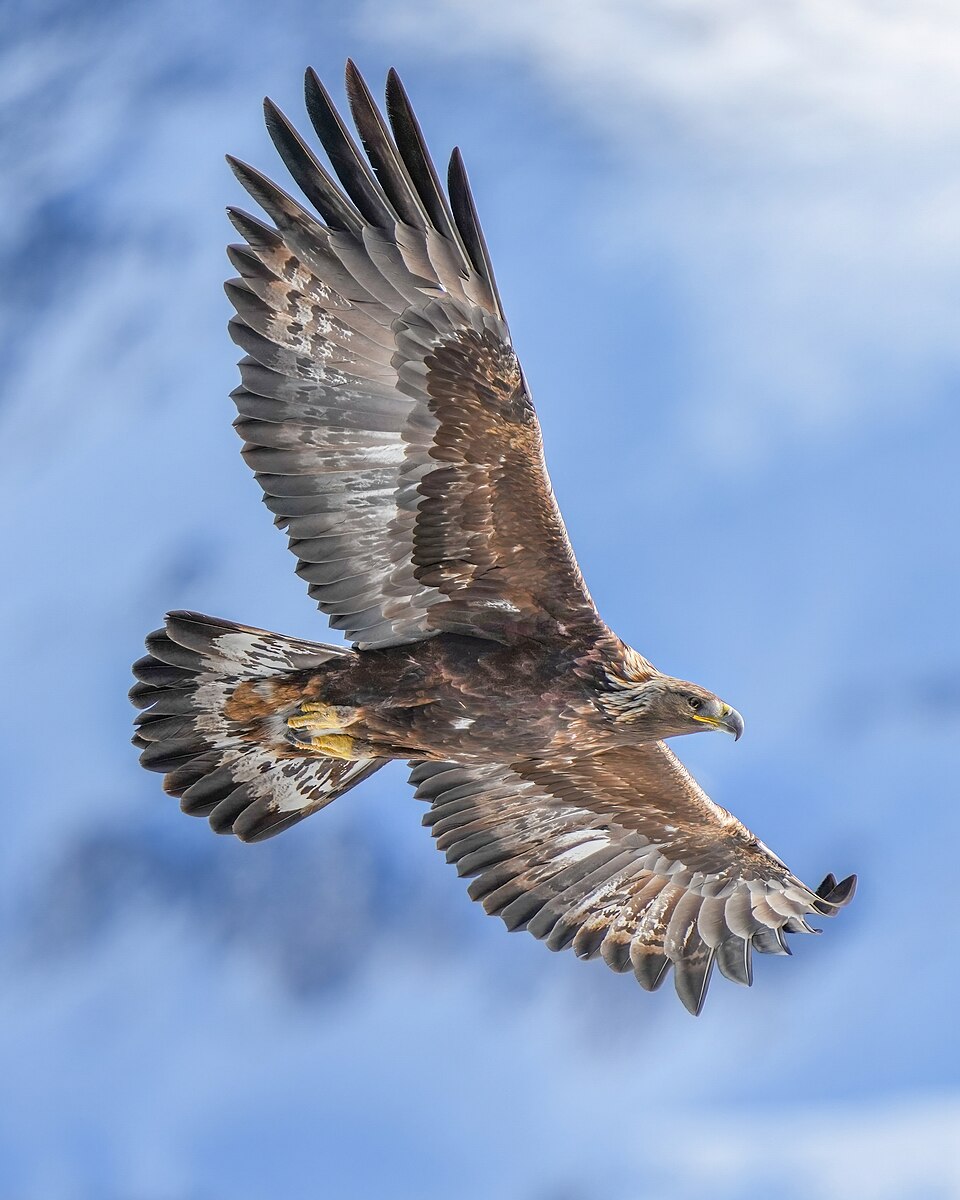
The Golden Eagle is one of the largest and most formidable birds of prey in the Northern Hemisphere, and arguably the most accomplished aerial hunter on the continent. Dark chocolate-brown all over with a wash of golden feathers across the back of the head and neck, it is a bird of wide-open spaces: sagebrush flats, alpine ridges, canyon country, and the rolling foothills of the West. Where the Bald Eagle is tied to water and fish, the Golden Eagle belongs to the dry uplands, where it patrols vast territories in search of jackrabbits, ground squirrels, and other mammals.
Although it carries enormous cultural weight, appearing on flags, coats of arms, and in the traditions of many Indigenous peoples, the Golden Eagle is genuinely uncommon and easy to miss. It does not gather conspicuously the way Bald Eagles do, and a soaring individual high overhead is easily dismissed as a large hawk or vulture. Learning its proportions, flight style, and habitat preferences turns those distant specks into a thrilling, unmistakable bird.
Golden Eagles are huge, long-winged raptors with a small head, a fairly long tail, and broad wings that give a powerful, slightly eagle-versus-hawk silhouette in flight. In a soar they hold their wings in a very shallow V (a slight dihedral), unlike the flat-winged Bald Eagle. Size alone is striking: this is a bird with a wingspan well over six feet, dwarfing the buteo hawks it might otherwise be confused with.
| Overall color | Dark chocolate-brown body, appearing nearly black at a distance |
| Golden nape | Tawny to golden-buff feathers on the crown and back of the neck, the field mark that gives the bird its name |
| Bill and head | Relatively small head and dark, hook-tipped bill; head projects only modestly beyond the wings in flight |
| Legs | Feathered all the way down to the toes (a key separator from Bald Eagle and vultures) |
| Flight profile | Long, broad wings held in a slight dihedral when soaring; longer-tailed look than a Bald Eagle |
| Size | Wingspan roughly 6 to 7.5 feet; one of the largest raptors in its range |
Male vs. female
Male and female Golden Eagles look identical in plumage, so you cannot sex them by color or pattern. As with most raptors, the difference is size: females are noticeably larger and heavier than males, often by a quarter or more in weight. This is usually only apparent when a pair is seen together, where the female stands out as the bulkier bird. A lone eagle generally cannot be sexed in the field.
Juveniles
Juvenile and immature Golden Eagles are the source of much confusion. Young birds show clean white patches at the base of the flight feathers (forming bold white windows in the wings) and a broad white tail with a sharp black terminal band. These flashy white markings fade gradually over four or five years as the bird matures, eventually disappearing in the uniformly dark adult. A high-flying immature with crisp white wing-patches and a white-based tail is a classic Golden Eagle, not a Bald Eagle, whose immatures show messy, blotchy white scattered unevenly across the body and underwings.
For such an imposing bird, the Golden Eagle is remarkably quiet, and many birders go years without hearing one. It has no true song. The calls it does give are surprisingly weak and high for the bird's size: a thin, yelping kee-kee-kee or a soft, descending wee-oo whistle, sometimes likened to a puppy's bark or a far-off Northern Flicker. Calls are most often heard around the nest, between members of a pair, or from begging young.
Because vocalizations are infrequent and faint, sound is rarely the way you detect this species. Most sightings come from spotting the bird itself, soaring or perched, rather than from hearing it call.
The Golden Eagle has a vast range across the Northern Hemisphere, occurring throughout Europe, Asia, North Africa, and North America. On this continent it is overwhelmingly a bird of the West, breeding from Alaska and northern Canada south through the Rocky Mountains, Great Basin, and into Mexico. It is much scarcer in the East, where small numbers breed in remote parts of eastern Canada and winter sparingly along the Appalachians.
Northern breeders are migratory, moving south in fall to escape harsh winters, while many birds in milder western regions are year-round residents. Fall migration produces spectacular counts at western and Appalachian hawk-watch ridges, where eagles ride updrafts along the mountains. In winter, look for them over open valleys, rangeland, and prairie, often perched on cliffs, power poles, or lone trees scanning for prey.
Golden Eagles are superb predators of medium-sized mammals. Across most of their range, jackrabbits, cottontails, ground squirrels, marmots, and prairie dogs make up the bulk of the diet. They are powerful and bold enough to take larger prey when the opportunity arises, including young pronghorn, fawns, foxes, and the occasional bird such as a grouse or waterfowl. In winter and lean times they will readily scavenge carrion, including roadkill and winter-killed deer, which sometimes brings them into the open where they are easier to see.
They hunt with breathtaking skill, soaring high and then stooping at speed, gliding low and fast along a slope to surprise prey, or quartering over open ground much like a giant harrier. Their feet and talons are immensely powerful, capable of killing prey several times the eagle's own weight on rare occasions. This hunting prowess, rather than fishing or piracy, is the hallmark of the species.
Golden Eagles build enormous stick nests, called eyries, usually on a cliff ledge or rocky outcrop and sometimes in a large tree or even on a power-line tower. A pair often maintains several alternate nests within its territory and reuses and adds to them year after year, so old nests can grow to massive size. They line the nest cup with greenery, grasses, and other soft material.
The female lays a small clutch, typically one to three eggs, which are dull white with brown and lavender markings. Incubation, done mainly by the female and lasting roughly six weeks, often begins with the first egg, so chicks hatch days apart and the oldest has a head start. After hatching, the young remain in the nest for around ten weeks before fledging, and the parents continue to feed and protect them for some time afterward. Pairs typically raise a single brood per year and mate for the long term, defending large territories.
The Golden Eagle is not a backyard or feeder bird in any practical sense. It is a wide-ranging predator of open wild country that needs vast hunting territory and natural prey, so there is nothing you can put in a typical yard to draw one in. The best way to "attract" the experience is to go to the right habitat and learn to find them.
- Travel to open western habitat: sagebrush flats, grassland, canyon country, and mountain foothills are far more productive than wooded suburbs.
- Visit a fall hawk-watch site along a western or Appalachian ridge, where migrating eagles concentrate on updrafts in late autumn.
- Scan high cliffs, rock outcrops, power poles, and lone trees in open country, where eagles like to perch and survey for prey.
- In winter, watch open valleys and rangeland for eagles feeding on carrion or hunting jackrabbits.
- Bring good binoculars or a spotting scope and learn the slight-dihedral soaring profile so you can pick eagles out from distant hawks and vultures.
- Support land conservation and avoid lead ammunition, since lead poisoning from scavenged carcasses is a real threat to these birds.
- Bald Eagle: Adult Bald is unmistakable with white head and tail; immature Bald shows blotchy, irregular white on the body and underwings and a bare (unfeathered) lower leg, soars on flat wings, and has a larger head and bill.
- Turkey Vulture: Smaller and lighter, with a tiny bare reddish head, two-toned underwings, and a strong rocking, teetering flight on a pronounced dihedral; lacks the eagle's powerful build and golden nape.
- Red-tailed Hawk: Much smaller buteo with a shorter, fan-shaped tail (rusty above in adults), broader proportions, and quicker wingbeats; lacks the eagle's enormous size and long-winged silhouette.
- Ferruginous Hawk: A large pale buteo of open country that can look big at a distance, but it is paler overall with rusty leggings and a much smaller, lighter build than a Golden Eagle.
How can I tell a Golden Eagle from a Bald Eagle?
Adults are easy: a Bald Eagle has a white head and tail, while a Golden Eagle is all dark brown with a golden nape. The trick is with young birds. Immature Golden Eagles show clean white patches at the base of the wings and a white tail with a crisp black band, soar on slightly raised wings, and have feathered legs down to the toes. Immature Bald Eagles have messy, blotchy white scattered over the body and underwings, fly on flatter wings, and have a larger head and bill with bare lower legs.
Are Golden Eagles dangerous to pets or small children?
Attacks on humans are essentially unheard of, and a Golden Eagle will not carry off a child. They can occasionally take small unattended pets in open rural areas where eagles hunt, but this is rare. In normal suburban or urban settings the risk is negligible, and the birds avoid people.
Where is the best place to see a Golden Eagle?
Open country in the western United States and Canada is your best bet: sagebrush flats, grasslands, canyon country, and mountain foothills. Fall hawk-watch sites along western and Appalachian ridges can produce good numbers during migration, and winter is a fine time to scan open valleys and rangeland where eagles perch on cliffs, poles, and lone trees.
What do Golden Eagles eat?
Mostly medium-sized mammals: jackrabbits, cottontails, ground squirrels, marmots, and prairie dogs form the core of the diet. They occasionally take larger prey like fawns or foxes and will readily scavenge carrion in winter. Unlike Bald Eagles, they are not primarily fish eaters.
How big is a Golden Eagle?
They are among the largest raptors in their range, with a body length of roughly 27 to 33 inches and a wingspan typically between 6 and 7.5 feet. Females are noticeably larger and heavier than males, though the two sexes look identical in plumage.