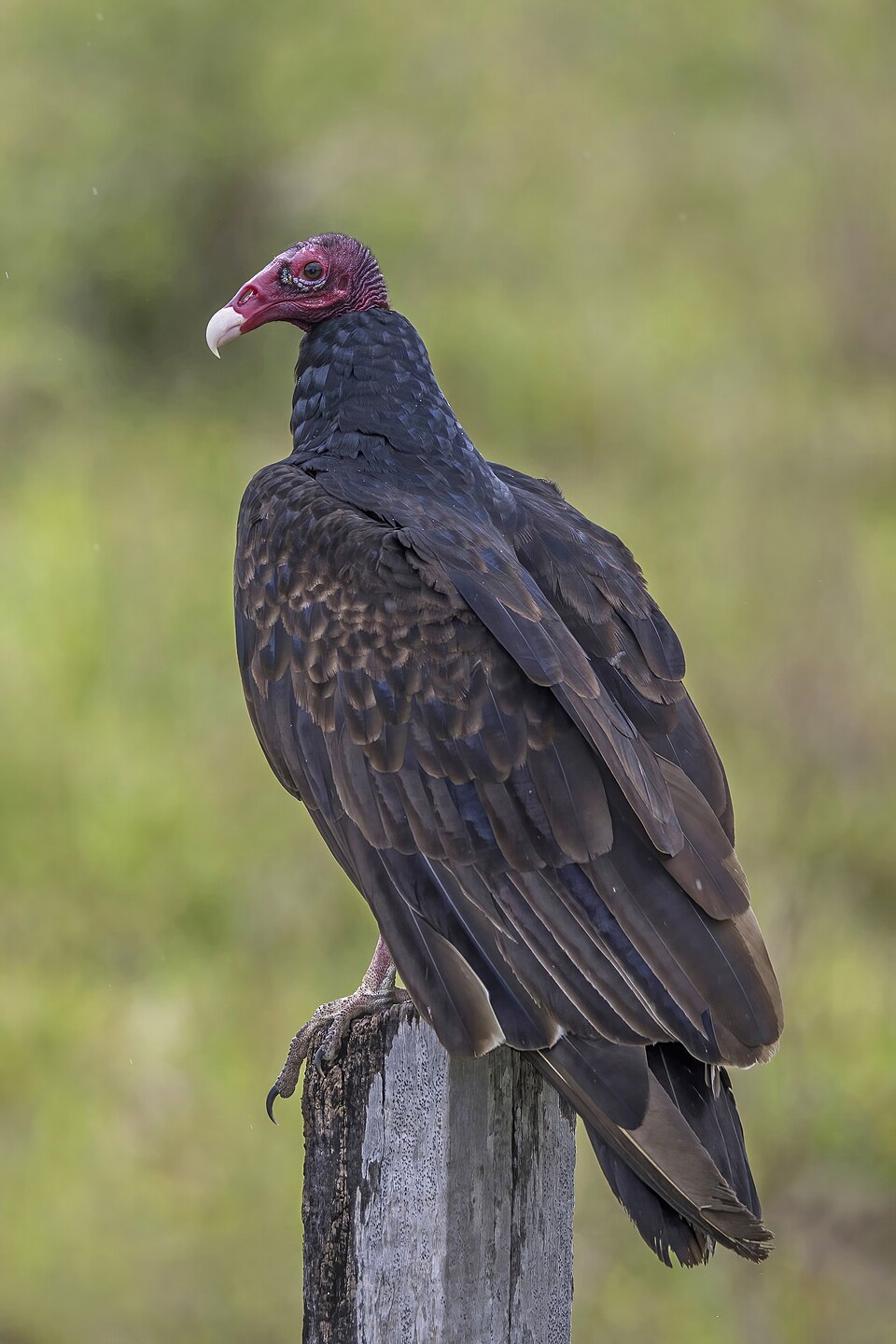
The Turkey Vulture is the dark, soaring silhouette almost every North American has watched without quite knowing what it was. Hold up a hand to the sky on a warm afternoon and the big bird tilting back and forth on long, raised wings, never seeming to flap, is almost certainly this species. Despite the gruesome reputation that comes with eating dead animals, the Turkey Vulture is one of the most useful and elegant birds on the continent. It cleans up carrion that would otherwise rot, spread disease, and foul the landscape, and it does the job for free.
What makes this vulture especially remarkable is its sense of smell, which is extraordinary among birds. Most birds barely use scent at all, but the Turkey Vulture can detect the gases of decay from high in the air, letting it find a hidden carcass under a forest canopy that no eye could spot. Its name comes from the resemblance of its bare red head and dark body to a wild turkey. Once largely a southern bird, it has steadily expanded northward over the last century and now nests across much of the United States and southern Canada.
Identification of the Turkey Vulture happens mostly in the air, and its flight style is the giveaway long before you can see any color. It is a large, eagle-sized raptor-like bird that holds its wings in a shallow V, or dihedral, and rocks unsteadily from side to side as it rides thermals, rarely flapping. Up close, the small naked red head looks almost too tiny for the heavy body.
| Wing shape in flight | Wings held in a shallow V (dihedral); bird teeters and rocks side to side, rarely flapping |
| Underwing pattern | Silvery-gray flight feathers contrast with black wing linings, giving a distinct two-toned look from below |
| Head | Small, bare, wrinkled head; bright red on adults, with an ivory-colored bill tip |
| Body plumage | Uniformly dark brownish-black, often looking blackish at a distance |
| Tail | Long, narrow tail extending well past the feet in flight |
| Size | Very large, with a wingspan near six feet; bigger than any hawk in its range |
Male vs. female
Male and female Turkey Vultures look identical in the field. The sexes share the same size, the same dark plumage, and the same bare red head, and there is no reliable visual way to tell them apart at a distance or even in the hand. Researchers must use behavior at the nest or laboratory methods to determine sex, so for birders the question of male versus female is simply not one you can answer by looking.
Juveniles
Young Turkey Vultures are easy to age by the head. Instead of the adult's bright red, a juvenile has a dull grayish or blackish bare head, and the bill is dark rather than tipped with ivory. The body plumage looks much like an adult's dark brown-black. The head gradually reddens as the bird matures over its first couple of years. A gray-headed vulture seen teetering on a dihedral is a young Turkey Vulture, not a different species.
Turkey Vultures are nearly silent birds because they lack a working syrinx, the vocal organ most birds use to sing. They cannot produce true songs or calls. Instead, the sounds they make are low, breathy, and reptilian. When disturbed, threatened, or squabbling over a carcass, they give a drawn-out hiss, something like a forceful hssssss, and they may also produce soft, guttural grunts and growls, rendered roughly as uh-uh-uh.
Because they have no melodic voice, you will almost never identify a Turkey Vulture by sound. The hissing and grunting are short-range noises used near the nest, at roosts, or at a meal, not advertising calls carried across the landscape.
The Turkey Vulture is one of the most widespread birds in the Western Hemisphere, breeding from southern Canada all the way to the southern tip of South America. In North America it occupies nearly the entire United States during the breeding season and has been steadily pushing its range northward into the upper Midwest, New England, and southern Canada over recent decades.
Birds in the southern United States, Mexico, and the tropics are largely year-round residents. Those that breed in the north are strongly migratory, funneling south each autumn in spectacular kettles, swirling columns of dozens to thousands of birds riding thermals together. Famous migration watch sites such as ridgelines and coastal points in the eastern U.S. and corridors in Texas and Central America record enormous numbers each fall as the birds stream toward wintering grounds in the southern states and Latin America.
Turkey Vultures are obligate scavengers, feeding almost entirely on carrion, the carcasses of dead animals ranging from roadkill and dead livestock to fish, reptiles, and small mammals. They strongly prefer fresh to moderately decomposed carcasses and will pass over meat that is too far gone. Their powerful immune systems and highly acidic stomachs let them safely consume bacteria-laden flesh that would sicken or kill most animals.
This species is famous for finding food by smell, an ability rare among birds. It cruises low over woodlands and fields sniffing for the gases released by early decay, then circles down to investigate. Other scavengers, including the keen-eyed Black Vulture, often follow Turkey Vultures to carcasses they could not have located on their own. At a carcass, Turkey Vultures use their relatively weak feet only for standing, tearing food with the bill rather than gripping and carrying it like a hawk.
Turkey Vultures build essentially no nest. They lay their eggs directly on the ground in a sheltered, hidden spot such as a cave, rock crevice, hollow log, the floor of an abandoned building or barn, a dense thicket, or a stump. The site is chosen for its seclusion and protection rather than for any constructed structure, and the same spot may be reused for years.
A typical clutch is one to three eggs, usually two, which are creamy white blotched with brown. Both parents share incubation over roughly five to six weeks, and both feed the chicks by regurgitation. The young are downy and slow to develop, remaining at or near the nest for two to three months before they can fly well. Pairs raise a single brood per year.
The Turkey Vulture is not a feeder bird and there is no birdseed, suet, or feeder that will draw one to your yard. It is, however, a bird you can encounter and appreciate in the right setting, and there are honest ways to see more of them.
- Watch the sky on warm afternoons. Vultures need rising thermals to soar, so mid-to-late morning through afternoon on sunny days is prime viewing time over open country, ridges, and roadsides.
- Look near communal roosts. Turkey Vultures gather to sleep in large groups in dead trees, on towers, or on rooftops; a known roost gives reliable dawn and dusk views as they leave and return.
- Visit a hawk-watch site in fall. Migration lookouts on ridges and coastlines concentrate thousands of vultures into kettles each autumn, the best chance to see them up close and in numbers.
- Leave large dead trees standing where it is safe. On rural property, snags and unused outbuildings provide the secluded roosting and nesting sites vultures rely on.
- Do not try to bait them. Putting out carrion is unsanitary, often illegal, and attracts pests; simply giving vultures undisturbed open space and roost trees is the real way to support them.
- Black Vulture: Stockier with short, square tail and broad wings held flat (not in a V); flaps in quick bursts and shows white wingtips, not silvery trailing wings. Head is black, not red.
- Golden Eagle: Soars on a slight dihedral and can look vulture-like, but has a feathered (not bare) head, larger head and bill, steadier flight, and golden nape; wings are broader and more evenly dark below.
- Bald Eagle: Soars on flat, plank-straight wings rather than a V, and adults show an obvious white head and tail; juveniles are blotchy but still hold wings flat and fly steadily.
- Zone-tailed Hawk: A southwestern hawk that mimics Turkey Vultures, teetering on a dihedral with two-toned wings, but is smaller with a feathered head and bold black-and-white tail bands.
How can I tell a Turkey Vulture from a Black Vulture?
Look at the wings and tail. A Turkey Vulture holds its wings in a shallow V, rocks side to side, rarely flaps, and shows silvery flight feathers along the whole rear edge of the wing, plus a long tail and red head. A Black Vulture holds its wings flat, flaps in short choppy bursts, has white only at the wingtips, a short stubby tail, and a black head.
Do Turkey Vultures really find food by smell?
Yes. Turkey Vultures have an exceptional sense of smell, unusual among birds, and can detect the gases given off by a decaying carcass from high in the air. This lets them locate dead animals hidden under forest canopy. Other scavengers, like Black Vultures, often follow them to food they could not find on their own.
Are Turkey Vultures dangerous to people, pets, or livestock?
No. Turkey Vultures eat only animals that are already dead and do not hunt or attack living prey, so they pose no threat to pets, livestock, or people. Their main defense is vomiting their stomach contents, which is unpleasant but harmless if you keep your distance. They are beneficial birds that clean up carrion.
Why do I see vultures spreading their wings in the morning?
That posture is called the horaltic stance. Vultures hold their wings open to the sun to warm up after a cool night, dry off dew or rain, and bake off bacteria from their feathers. You will often see several doing it together at a roost shortly after sunrise before they head out to soar.
What is the big group of circling vultures called and what does it mean?
A swirling flock of soaring vultures is called a kettle, and it usually just means the birds are gaining altitude together in a rising column of warm air called a thermal. Circling does not mean something is dying below them; it is simply how they get aloft efficiently, especially during migration.