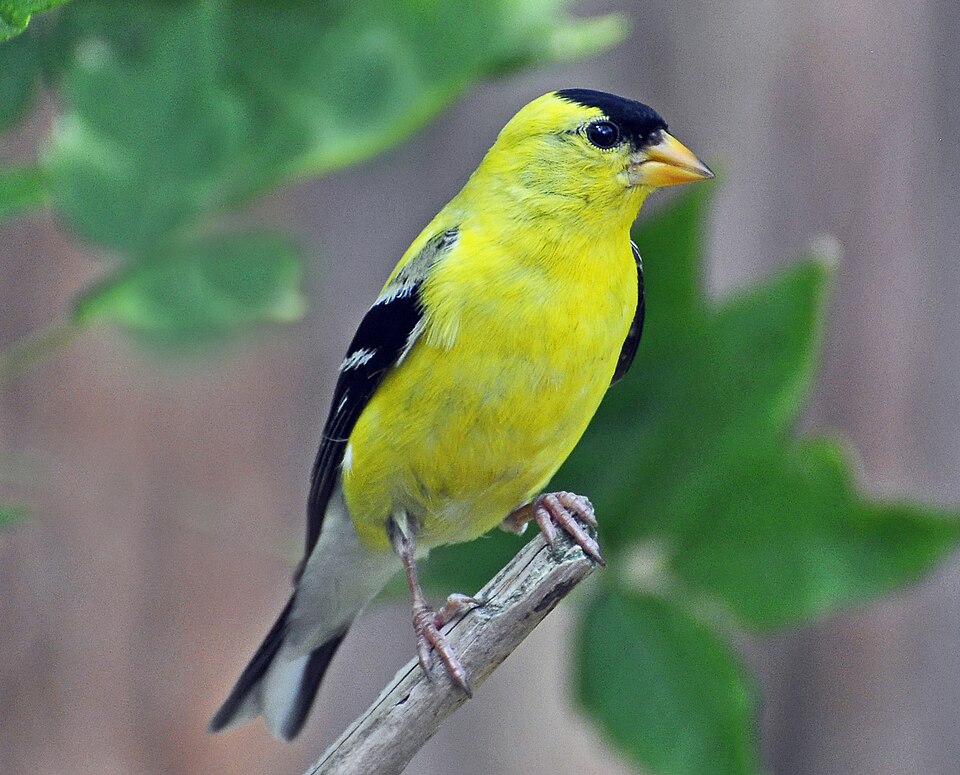
Few backyard birds turn heads like a male American Goldfinch in June. Glowing lemon-yellow with crisp black wings and a jaunty black cap, he looks almost tropical against a backdrop of thistle and coneflower. This small, social finch ranges across nearly all of the United States and southern Canada, and it is one of the most recognizable feeder visitors on the continent. Many people call it the "wild canary," and it is the official state bird of New Jersey, Iowa, and Washington.
What makes the goldfinch especially interesting is how much it changes through the year. The brilliant summer male fades to a drab olive-buff by winter, and the species times its entire breeding season around the seeds it eats. Strictly vegetarian for a finch, the American Goldfinch nests later than almost any other songbird in North America, waiting until midsummer when thistle and other composite plants are setting seed. Watch a flock long enough and you will see its other signature: a deeply undulating, roller-coaster flight, often accompanied by a cheerful flight call given on each bound.
The American Goldfinch is a small, compact finch with a short, conical seed-cracking bill, a notched tail, and a relatively large head. Even at a distance, the bounding flight and the habit of clinging acrobatically to seed heads help pick it out. Plumage varies dramatically by sex and season, so use shape and the black-and-white wing pattern as anchors when color is confusing.
| Breeding male | Bright canary-yellow body, jet-black forehead/cap, black wings with a bold white wingbar, white undertail coverts |
| Wings | Black with one prominent white wingbar; whitish edgings show in flight and at rest |
| Bill | Short, conical, pinkish-orange in breeding season, turning grayish in winter |
| Tail | Short and notched, black with white patches at the corners that flash in flight |
| Winter plumage | Drab olive-gray to buffy-brown overall, no black cap, but blackish wings with buff/white bars remain |
| Flight | Strongly undulating, bouncing flight; gives a flight call on each rising bound |
Male vs. female
Sexes look very different in summer and quite similar in winter. The breeding male is unmistakable: vivid yellow with a tidy black cap set forward on the forehead and clean black wings. The breeding female is a softer, duller yellow-olive below and grayish-olive above, with no black cap and browner-black wings. In winter both sexes molt into muted plumage, becoming grayish-buff overall; even then, males usually keep more yellow on the face and shoulder and show blacker wings, while females are browner and plainer. The black cap is a male-only feature, so a yellow goldfinch lacking any black on the head is a female.
Juveniles
Juveniles and fall immatures are warm buffy-brown overall with noticeably buff or cinnamon-tinged wingbars rather than the crisp white of adults. They lack any black cap and show little bright yellow, looking much like dull winter females. Young birds out of the nest are often heard before seen, giving a persistent, wheezy begging call as they follow parents to feeders and seed heads well into early fall.
The song is a long, rambling, musical jumble of twitters, trills, and warbles, often delivered from a high perch or in flight. It is sweet and canary-like but somewhat random in structure, lacking a fixed pattern. Males sing most persistently in late spring and summer as they settle on breeding territories.
The calls are the easiest way to detect goldfinches overhead. The classic flight call is a bright, bouncy per-chic-o-ree or po-ta-to-chip, given in rhythm with each undulation of the flight. Perched birds give a rising, querulous tswee? and a soft contact chip. Once you learn the "potato-chip" call, you will notice goldfinches passing over far more often than you realized.
The American Goldfinch breeds across southern Canada and the northern and central United States, from coast to coast, favoring weedy fields, floodplains, orchards, roadsides, and suburban edges with plenty of open ground and seed-bearing plants. It is found year-round through much of the central and eastern U.S. and the Pacific states.
Movements are partly migratory and partly nomadic. Birds breeding in the far north and at higher elevations withdraw southward in fall, and wintering goldfinches expand across the southern U.S. into northern Mexico. Numbers at any given feeder can swing widely from week to week as flocks wander in search of food. In much of the country, the goldfinches at your feeder in winter are not necessarily the same individuals you hosted in summer.
The American Goldfinch is one of the most strictly vegetarian songbirds in North America, feeding almost entirely on seeds. Favorites include thistle, sunflower, coneflower, aster, goldenrod, dandelion, ragweed, and birch and alder catkins. It also eats some tree buds and a few insects, but plant matter dominates year-round, and even nestlings are fed a regurgitated seed paste rather than the insects most songbird chicks receive.
Goldfinches are agile, acrobatic foragers, often hanging upside down to pry seeds from drooping seed heads or dangling catkins. They feed in lively flocks outside the breeding season, moving restlessly from patch to patch. This near-total reliance on seeds is also why they are such reliable, year-round feeder birds where seed is offered.
American Goldfinches are famously late nesters, usually not beginning until midsummer (often late June through August) when thistle and other composite plants produce both the seeds for food and the soft, silky down used to line the nest. The female builds a remarkably tidy, tightly woven cup of plant fibers in the fork of a shrub or sapling, often a few feet to a couple of dozen feet up. The cup is so densely constructed that it can reportedly hold water.
The female lays a clutch of pale bluish-white eggs and incubates them for roughly two weeks while the male feeds her on the nest. Both parents then feed the young the regurgitated seed diet. Most pairs raise a single brood per year, though a second is occasionally attempted in favorable seasons. Because brood timing comes so late, goldfinches are also poor hosts for Brown-headed Cowbirds, whose chicks struggle on the seed-only diet.
The American Goldfinch is one of the easiest and most rewarding feeder birds to attract, and it will often arrive in cheerful flocks. The key is offering the right seed and pairing your feeders with seed-bearing native plants.
- Offer nyjer (thistle) seed in a dedicated tube or mesh "finch sock" feeder, the single most reliable goldfinch magnet.
- Provide black-oil and hulled sunflower seed, which goldfinches readily crack with their conical bills.
- Keep nyjer dry and fresh: it spoils and dries out quickly, and goldfinches will ignore old or moldy seed.
- Plant natives such as coneflower, black-eyed Susan, cosmos, sunflowers, and native thistles, and leave the seed heads standing into fall and winter.
- Add a birdbath or shallow water source; goldfinches drink and bathe frequently and visit water readily.
- Use feeders with multiple perches or no-mess clinging mesh, since goldfinches feed in sociable groups and don't mind crowding together.
- Lesser Goldfinch: Smaller, with a black or greenish back (no black cap-only pattern), yellow underparts, and white wing patches; mainly western and southwestern. Males show a dark cap and dark back rather than the American's clean yellow body.
- Pine Siskin: Similar size and finch shape but heavily brown-streaked overall with thin pointed bill and yellow flashes in the wings and tail; lacks any clean yellow body or black cap.
- Yellow Warbler: Also bright yellow but has a thin, pointed warbler bill (not conical), lacks black wings and cap, and males show reddish breast streaks. It gleans insects rather than cracking seeds.
- Evening Grosbeak: Much larger and chunkier with a massive pale bill; males show bold yellow, black, and white but a heavy build and big-headed look unlike the dainty goldfinch.
Why did my goldfinches suddenly disappear or change color?
Goldfinches molt twice a year. In late summer and fall, bright yellow males fade to a drab olive-buff that can look like a completely different bird, and flocks also wander widely in search of seed. They usually have not left for good; watch for the blackish wings with pale wingbars, which stay year-round.
What is the best feeder and seed for American Goldfinches?
A tube or mesh feeder filled with fresh nyjer (thistle) seed is the top choice, with black-oil or hulled sunflower a close second. Keep nyjer dry and replace it if it clumps or smells stale, since goldfinches will avoid spoiled seed.
Are American Goldfinches here in winter?
In much of the central, eastern, and western U.S. they are present all year, though winter birds wear dull plumage and may be different individuals than your summer flock. Far-northern breeders move south, and goldfinches winter across the southern states into northern Mexico.
When do American Goldfinches nest?
Later than almost any other songbird, typically from late June into August. They wait for thistle and similar plants to produce seeds for food and silky down for nest lining, and most pairs raise just one brood per season.
How do I tell a male from a female goldfinch?
In summer the male is brilliant yellow with a black cap on the forehead, while the female is duller yellow-olive with no black cap. In winter both are muted gray-buff, but males keep blacker wings and more yellow on the face; only males ever show the black cap.