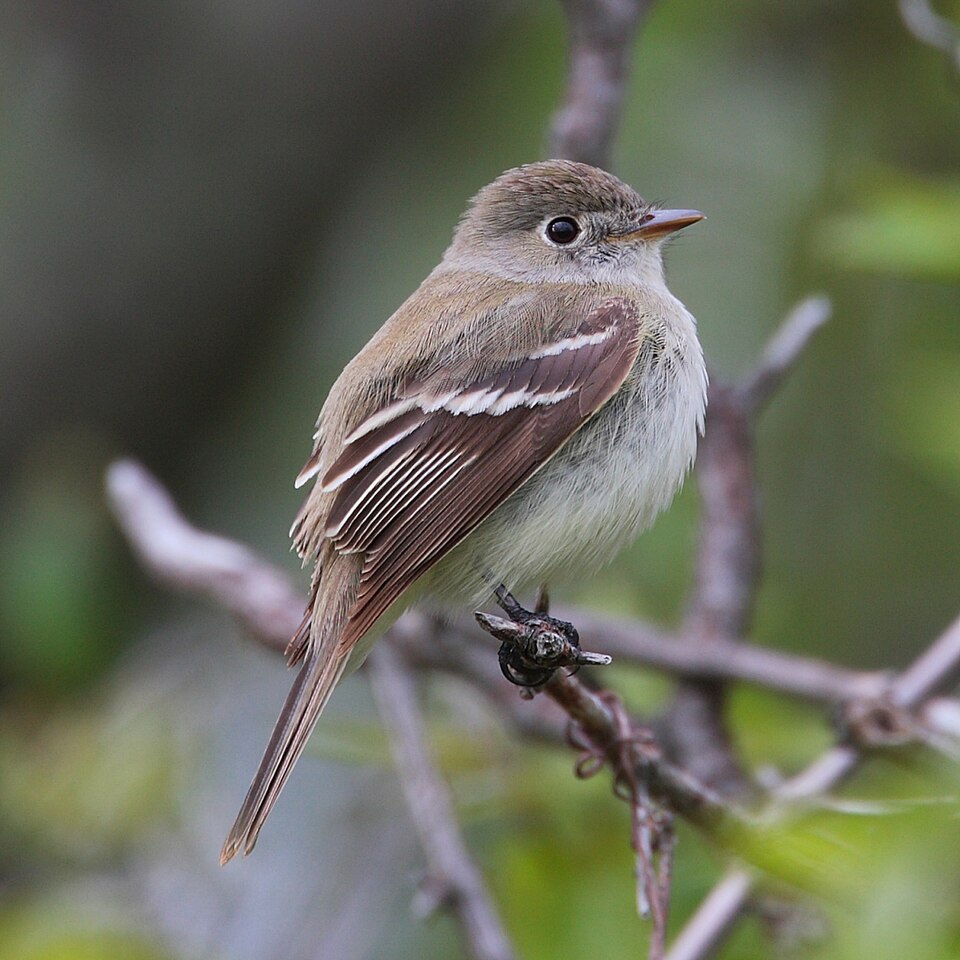
The Least Flycatcher is the smallest and one of the most familiar of the eastern Empidonax flycatchers, a notoriously tricky group of small, drab birds that birders affectionately (and exasperatedly) call "empids." What the Least Flycatcher lacks in flashy plumage it makes up for in voice and attitude: an emphatic, dry che-BEK snapped out endlessly from a shaded perch, often dozens of times a minute. Once you learn that song, you will hear this bird far more often than you see it, and you will realize it is one of the most common breeding flycatchers in the woodlots, second-growth forests, and orchards of the northern and northeastern United States and much of Canada.
It is a feisty, restless little bird, constantly flicking its wings and tail as it scans for flying insects. Males arrive on breeding grounds and pack into loose clusters of singing territories, a behavior that gives a stretch of woods a busy, buzzing energy in late spring. For backyard birders, the Least Flycatcher is more of a woodland-edge bird than a feeder visitor, but it is well worth seeking out for the satisfaction of confidently naming an empid by ear.
This is a tiny, big-headed flycatcher with a short tail and a small, fairly stubby bill. The overall impression is of a compact, round-headed bird that looks slightly "front-heavy," with a habit of nervously flicking its wings and jerking its tail upward. Plumage is grayish-olive above and pale below, with a bold whitish eyering and two pale wingbars.
| Size | Smallest eastern empid, about 5 in long, noticeably tiny and short-tailed |
| Eyering | Bold, complete whitish eyering that stands out on the gray face, giving a wide-eyed look |
| Upperparts | Grayish-olive to brownish-gray, grayer on the head than most other empids |
| Underparts | Whitish throat, pale grayish wash across the breast, faintly yellowish lower belly |
| Wings | Two pale (whitish to buffy) wingbars and pale edges to the wing feathers; relatively short primary projection |
| Bill | Small and short for an empid; upper mandible dark, lower mandible mostly pale orange-yellow |
Male vs. female
Males and females look essentially identical in the field. Both sexes share the gray head, bold eyering, two wingbars, and short tail, and there is no reliable plumage difference to separate them by sight. Behavior offers the best clue: in the breeding season the singing bird hammering out che-bek from a territorial perch is the male, while the female does the bulk of nest building and incubation and is generally quieter and less conspicuous.
Juveniles
Freshly fledged juveniles look much like adults but a touch buffier overall, with warmer, more buff-tinged wingbars and slightly looser, fluffier body feathers. The eyering is present but can look a bit softer. Through late summer and into fall, young birds in fresh plumage may show a faint yellowish wash below, which can add to the confusion with other empids during migration. By their first spring they are essentially indistinguishable from adults.
Voice is the single best way to identify this species. The song is a dry, sharp, emphatic che-BEK (sometimes written che-bec or tse-bek), with the accent snapped onto the second syllable. A singing male repeats it tirelessly, often more than 50 times a minute and for long stretches, especially at dawn. The sound is hard and unmusical compared with the wheezier or more whistled songs of related flycatchers, and once learned it is unmistakable.
The common call is a sharp, dry whit or pwit, given by both sexes and useful on migration when the birds are silent of song. Agitated birds may give a rapid series of these notes.
The Least Flycatcher breeds across a broad northern band of North America, from the Canadian provinces and into the northern and northeastern United States, the Upper Midwest, the Appalachians, and parts of the northern Rockies. It favors open deciduous and mixed woodlands, forest edges, second growth, orchards, and aspen and poplar stands rather than deep unbroken forest.
It is a long-distance migrant. Birds leave the breeding grounds relatively early, with southbound movement underway by late summer, and winter mainly in Mexico and Central America. During spring and fall migration the species can turn up in a wide variety of wooded and brushy habitats well beyond the breeding range, including parks and yards, where its whit call often gives it away.
The Least Flycatcher is almost entirely insectivorous. It hunts by the classic flycatcher method known as sallying: perching on an exposed twig in the mid to lower levels of a tree, watching for movement, then darting out to snatch a flying insect from the air before returning to a perch, often the same one. It also gleans insects directly from foliage and small branches.
Prey includes small flying insects such as midges, flies, beetles, ants, small wasps, caterpillars, and other soft-bodied arthropods. In late summer and on migration it will also take some small berries and fruit, but the great bulk of its diet is invertebrates captured in the air or picked from leaves.
The nest is a neat, compact open cup, woven from plant fibers, fine grasses, bark strips, and plant down, and lined with finer material; it is typically placed in a vertical fork or against the trunk of a small deciduous tree or sapling, often well off the ground in the mid-canopy. The female does most or all of the building.
A typical clutch is three to four creamy-white eggs, usually unmarked. The female incubates for roughly two weeks, and both parents feed the nestlings, which leave the nest about two weeks after hatching. Most pairs raise a single brood per season, reflecting the bird's early departure for migration. Least Flycatchers are frequent hosts to Brown-headed Cowbird parasitism.
The Least Flycatcher is an insect specialist and will not come to seed or suet feeders, so it is not a classic backyard bird. That said, you can absolutely make a property more attractive to migrating and breeding birds, and tune your ears to detect the ones passing through.
- Skip the feeders, grow the habitat: this bird wants insects and cover, not seed. Native trees and shrubs that support caterpillars and flying insects are the real draw.
- Provide water: a clean, moving water feature or shallow birdbath can pull in migrating flycatchers that ignore everything else in the yard.
- Favor woodland edges and saplings: properties bordering second-growth woods, orchards, or aspen and poplar stands are far more likely to host breeding birds.
- Go easy on insecticides: spraying for bugs removes the food supply this and many other birds depend on.
- Learn the che-bek song and the dry whit call so you can pick the bird out by ear; you will detect it far more often than you will spot it.
- Alder Flycatcher: Larger, browner, and longer-tailed; weaker eyering and a buzzy free-BEER song rather than a dry che-bek. Prefers wet thickets.
- Willow Flycatcher: Very similar to Alder; faint eyering and a sneezy fitz-bew song. Larger and less gray than Least, found in shrubby wet areas.
- Acadian Flycatcher: Greener above with longer bill and longer primary projection; explosive peet-sah song. A bird of mature southern bottomland forest, not open woodlots.
- Eastern Wood-Pewee: Larger, longer-winged, lacks a bold eyering, and sings a plaintive slurred pee-a-wee. Sits more upright and does not flick wings nervously.
How do I tell a Least Flycatcher from other empids?
Voice is the key. The dry, emphatic che-BEK song, repeated rapidly and tirelessly, is diagnostic. Visually, look for the smallest size, a short tail, a grayer head, and a bold complete whitish eyering. Silent empids on migration are genuinely hard to separate, so don't be afraid to leave one unidentified.
What does the Least Flycatcher's song sound like?
A sharp, dry che-BEK with the accent on the second syllable, snapped out over and over, often more than 50 times a minute. It sounds hard and almost mechanical rather than musical. The common call is a dry whit note.
Will Least Flycatchers come to my bird feeder?
No. They eat flying insects and other arthropods caught in the air or gleaned from leaves, so they ignore seed and suet feeders. You're far more likely to attract them with insect-rich native plantings, woodland edge habitat, and a water feature.
Where do Least Flycatchers live and migrate?
They breed in open deciduous and mixed woods across Canada and the northern and northeastern U.S., favoring forest edges, second growth, and orchards. They are long-distance migrants that winter mainly in Mexico and Central America, leaving the breeding grounds relatively early.
Why do Least Flycatchers flick their wings and tail so much?
This restless wing-flicking and upward tail-jerking is characteristic behavior for the species and a helpful field clue. It likely helps flush or detect insect prey and is part of how the bird signals alertness while perched and scanning for food.