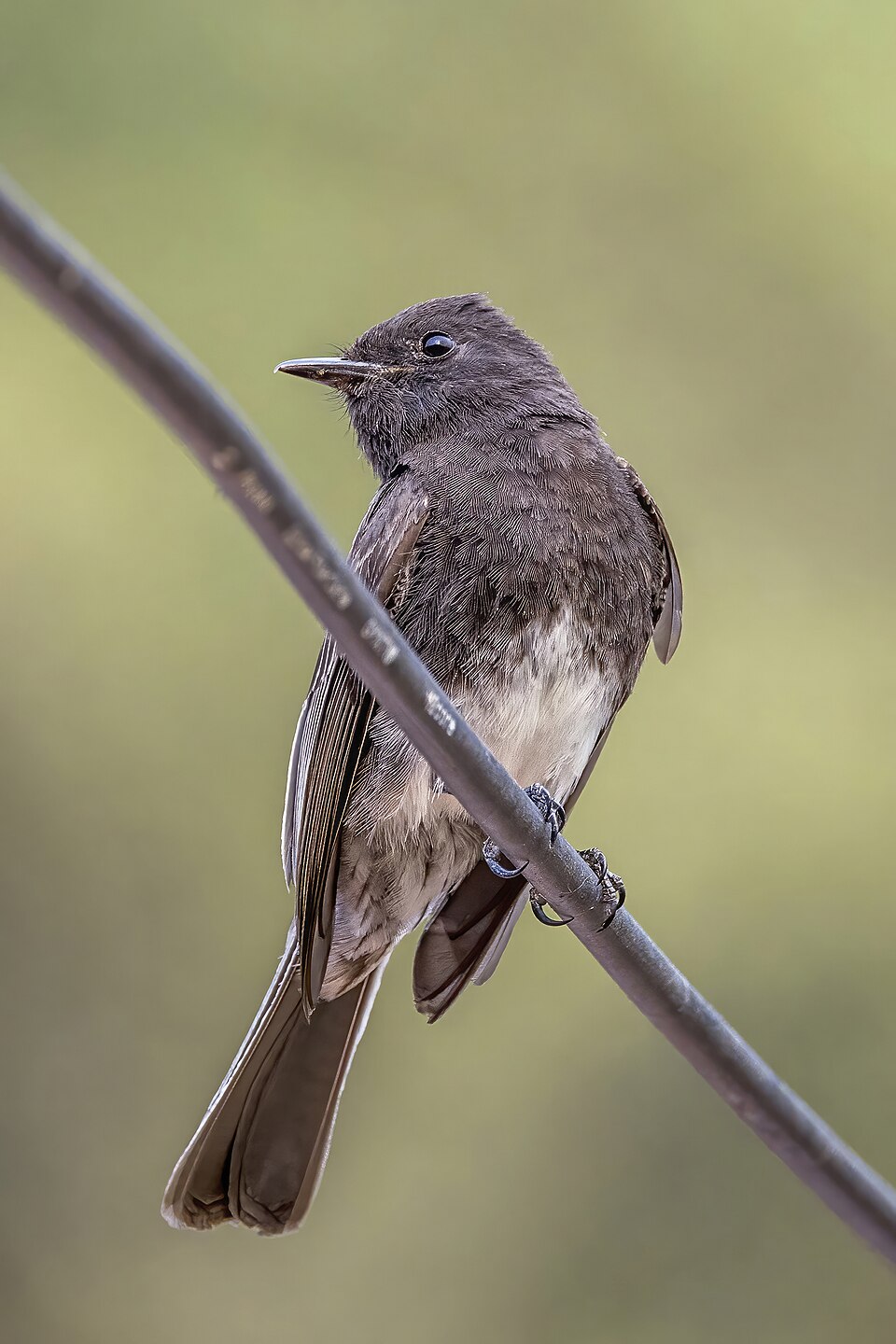
The Black Phoebe is one of the most distinctive and easily recognized flycatchers in the American West. With its sooty black head, breast, and upperparts set against a clean white belly, it looks as if it is wearing a tidy little tuxedo, and that crisp two-tone pattern makes it almost impossible to confuse with any other small western songbird. Add its low, open perches, its habit of pumping and fanning its tail, and its strong attachment to water, and you have a flycatcher that backyard birders can actually learn to know on sight.
This is a bird of edges and water. You will find it along streams, ponds, irrigation ditches, coastal bluffs, fountains, and the eaves of buildings, almost always within easy reach of moisture and mud. Where many flycatchers vanish north for the winter, the Black Phoebe is largely a year-round resident across much of its range, and it has steadily expanded northward and into suburban areas as people have created the ponds, walls, and overhangs it favors. The result is a confiding, watchable bird that often becomes a familiar fixture of a single backyard or park.
The Black Phoebe is a medium-small flycatcher with a fairly large, slightly peaked head, an upright posture, a thin straight black bill, and a longish tail it dips and wags while perched. Its strongly contrasting black-and-white plumage is unique among small western flycatchers, so a quick look at the sharp line between the black breast and white belly usually settles the identification at once.
| Overall pattern | Sooty blackish head, breast, back, wings, and tail contrasting sharply with a clean white lower belly and undertail |
| Breast line | The black of the breast ends in a crisp, well-defined border against the white belly, often dipping down the center in an inverted V |
| Tail | Long and dark with whitish outer edges; pumped and fanned downward almost constantly while perched |
| Bill | All black, thin and straight, typical flycatcher shape |
| Wings | Blackish with faint paler feather edges; no bold white wingbars |
| Posture | Sits upright on a low, open perch and sallies out after insects, frequently over water |
Male vs. female
Male and female Black Phoebes look alike. The sexes cannot be reliably told apart in the field by plumage, size, or color, and they are very similar even in the hand. Near a nest you can sometimes infer roles from behavior, since the female does the incubating, but both sexes share the same handsome black-and-white pattern and both help feed the young.
Juveniles
Juvenile Black Phoebes look much like adults but are a touch browner and softer overall, with two narrow cinnamon or rusty wingbars and warm brown edging on the wing feathers. The black areas are a duller sooty brown rather than crisp black. These warm wingbars fade as the young bird molts, and even at this age the strong dark-breast-against-white-belly contrast and the constant tail-pumping make it recognizable as a phoebe.
The song is a thin, slightly buzzy, rising-and-falling phrase often written as tee-hee, tee-ho, with the bird typically alternating a rising version and a falling version. Compared with the hoarse fee-bee of the Eastern Phoebe, the Black Phoebe's voice is higher, thinner, and more plaintive, with a faint burry quality. Males sing persistently in the breeding season, sometimes through the night.
The common call is a sharp, downslurred tsip or chip, given frequently as the bird perches, sallies after insects, or shows mild alarm. This crisp note, repeated steadily near water, is often the first clue that a Black Phoebe is nearby even before you spot it.
The Black Phoebe ranges through the western United States, from Oregon and the Southwest south through California and the desert states, and onward through much of Mexico and Central America into northwestern South America, where additional subspecies occur. In the U.S. it is closely tied to water, occurring along the Pacific coast, desert oases, rivers, reservoirs, and suburban ponds and fountains.
Across most of its range it is a year-round resident rather than a true migrant, though some birds at the northern and higher-elevation edges of the range withdraw to lower or warmer areas in winter, and birds wander modestly in the non-breeding season. Overall the species has been expanding its range northward and into developed areas, helped by the artificial water sources and nesting structures that people provide.
The Black Phoebe is almost entirely insectivorous and hunts in classic flycatcher fashion. From a low, exposed perch over water, a fence, or a garden stake, it watches for passing prey, then sallies out to snatch flying insects from the air and returns to a perch to eat. It readily hovers, drops to the ground, or picks insects from the surface of water and from foliage and walls.
Its prey includes flies, beetles, wasps, bees, moths, dragonflies, and many other flying and crawling insects, along with spiders. Because it hunts so much over and around water, it takes a high proportion of aquatic and water-associated insects, and it has even been recorded plucking tiny fish from the surface on occasion. Unlike the Eastern Phoebe, it rarely turns to berries and relies on insects almost year-round, which is one reason it stays so close to reliable water.
The Black Phoebe is a mud nester, and this is central to why it lives where it does. The female builds an open cup made largely of mud pellets reinforced with grass, plant fibers, and hair, and plasters it against a sheltered vertical surface beneath an overhang. Natural sites include cliff faces, stream banks, and the undersides of rock ledges, but the bird has enthusiastically adopted human structures such as building eaves, porches, bridges, culverts, and the walls above doorways, almost always near water that supplies both insects and mud.
A typical clutch is 3 to 6 white eggs, sometimes lightly spotted with reddish brown at the larger end. The female incubates for roughly two and a half weeks, and the young leave the nest about three weeks after hatching. Pairs commonly raise two broods a season and frequently reuse and refurbish a good nest site year after year, so a successful ledge may host phoebes for many seasons running.
Black Phoebes do not eat seed and will never visit a seed or suet feeder, so attracting them is about offering water, hunting perches, and nest sites rather than food. If your yard is near water or you can add some, and you live within the bird's western range, you have a real chance of hosting a pair, and they often become tame, long-term residents.
- Provide water, the single most important draw, such as a pond, fountain, birdbath, or even a recirculating water feature, since phoebes hunt and gather nest mud near water.
- Offer open hunting perches like low bare branches, fence posts, garden stakes, or a shepherd's hook overlooking open ground or water.
- Leave a sheltered nesting ledge available beneath an eave, porch, carport, or overhang, ideally on a wall near water and protected from rain and predators.
- Allow a patch of exposed mud near your water source in the breeding season, which the female needs to build her mud-cup nest.
- Avoid or minimize insecticides, since flying and aquatic insects make up nearly this bird's entire diet.
- If a pair nests on your house, leave the nest in place between broods and years, as Black Phoebes show strong site fidelity and often return.
- Eastern Phoebe: Grayish-brown above with a dusky breast and whitish (not sharply white) underparts; lacks the crisp black breast, and the two species barely overlap in range.
- Say's Phoebe: A western relative with a pale grayish-brown body and warm cinnamon belly, never the black breast and white belly of a Black Phoebe.
- Dark-eyed Junco: A sparrow, not a flycatcher; can look dark-hooded with a pale belly but has a stout pink seed-eating bill, hops on the ground, and flashes white outer tail feathers in flight.
- Black-capped Chickadee: Has a black cap and bib but a white face and buffy flanks, a tiny stubby bill, and acrobatic feeder behavior, unlike the upright, sallying phoebe.
How do I identify a Black Phoebe?
Look for a small upright flycatcher that appears to wear a tuxedo: sooty black head, breast, and back with a clean white lower belly, the two meeting in a sharp line. It perches low, often over water, pumps its tail, and sallies out to catch insects. No other small western songbird shows that crisp black-and-white pattern in the same way.
Where do Black Phoebes live?
They range across the western United States, Mexico, and Central America into northwestern South America, almost always near water. Look for them along streams, ponds, irrigation ditches, coastal bluffs, fountains, and the eaves of buildings, including suburban yards and parks with a water source.
What is the difference between a Black Phoebe and a Say's Phoebe?
Both are western phoebes that pump their tails, but a Black Phoebe has a black head and breast with a clean white belly, while a Say's Phoebe is overall pale grayish-brown with a warm cinnamon-buff belly and no black breast. The two are easy to separate once you see the underparts.
Will Black Phoebes nest on my house?
Often, yes. They build a mud-and-grass cup against a sheltered vertical surface under an overhang, and they readily use eaves, porches, carports, and walls near water. They will not use an enclosed nest box, but a protected ledge near a pond, fountain, or birdbath is very attractive to them.
Do Black Phoebes migrate?
Mostly no. Across the bulk of their range they are year-round residents, which is unusual for a flycatcher. Only some birds at the northern and higher-elevation edges move to warmer or lower areas in winter. Their reliance on insects near water lets them stay put where water and prey persist all year.