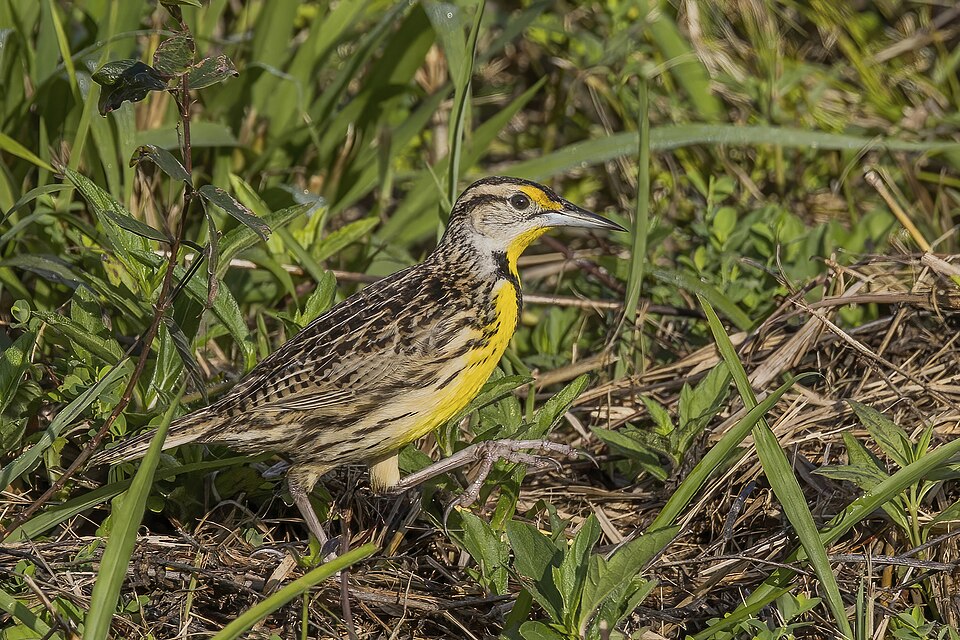
The Eastern Meadowlark is one of those birds that fools people at first glance. Sitting low in the grass it can look drab and sparrow-like, but the moment it turns to face you, that brilliant lemon-yellow breast slashed with a bold black "V" gives the game away. Despite the name, it is not a lark at all but a member of the blackbird family (Icteridae), closely related to grackles, orioles, and bobolinks. It is a true bird of open country: pastures, hayfields, weedy meadows, prairie remnants, roadside grasslands, and reclaimed strip mines across the eastern and central United States.
For many rural birders, the meadowlark's clear, slurred whistle is the soundtrack of a spring morning. Sadly, it has become a quieter soundtrack over the decades. Eastern Meadowlarks have declined sharply across much of their range as hayfields are mowed earlier and more often, grasslands are converted to row crops or development, and pastures disappear. They remain a familiar sight where good grassland survives, but they are an important indicator of how the grassland ecosystem is faring.
Eastern Meadowlarks are chunky, short-tailed, ground-dwelling birds with a flat-headed profile and a long, sharply pointed bill. They are roughly the size of a robin but stockier, and they often perch upright on fence posts, wires, or weed stalks where their yellow underparts catch the light. In flight they show a distinctive pattern: stiff, fluttering wingbeats alternating with short glides, and flashing white outer tail feathers.
| Breast & belly | Bright lemon-yellow with a bold black V-shaped band across the chest |
| Upperparts | Cryptic brown, buff, and black streaking that blends perfectly into dead grass |
| Head | Striped crown with a pale central stripe, dark eye-line, and yellow extending onto the throat |
| Tail | Short and white-edged; the white outer feathers flash conspicuously in flight |
| Bill | Long, straight, and sharply pointed, pale gray with a darker tip |
| Posture | Upright stance on the ground or on perches; often walks rather than hops |
Male vs. female
Males and females look essentially alike in plumage, so you generally cannot sex a meadowlark by sight in the field. Both sexes show the yellow breast and black V. Males average slightly larger and may show marginally brighter, cleaner yellow and a bolder breast band, but the overlap is too great to be reliable. The most useful clue is behavior: in the breeding season it is almost always the male doing the singing from an exposed perch, while females tend to stay lower and quieter near the nest.
Juveniles
Juvenile Eastern Meadowlarks are a washed-out, muted version of the adults. The yellow underparts are paler and more buff-tinged, and the black breast V is reduced to a smudgy, indistinct band rather than the crisp black crescent of a breeding adult. Their streaking can look softer and less defined overall. By their first fall, immatures closely resemble adults in fresh non-breeding plumage, when the black V is partly veiled by pale feather tips on all ages.
The classic song of the Eastern Meadowlark is a clear, plaintive, slurred whistle, often written as see-you, see-yeeer or spring-of-the-yeeer, dropping in pitch at the end with a pure, almost flute-like quality. It carries a long way across open fields and is one of the easiest ways to confirm the species, especially where its range overlaps with the Western Meadowlark.
This is the single most important field mark separating it from the nearly identical Western Meadowlark, whose song is a richer, more complex, gurgling, flute-like jumble of notes. Eastern Meadowlarks also give a sharp, buzzy dzert alarm call and a distinctive dry, rattling chatter, often delivered in flight or when agitated near the nest.
Eastern Meadowlarks breed across the eastern and central United States, from the Great Plains east to the Atlantic coast, and north into southern Canada around the Great Lakes and the St. Lawrence valley. The range extends south through the Gulf states and into Mexico, Central America, and northern South America, where various resident populations occur.
Birds in the northern part of the range are migratory, withdrawing southward in fall and returning in early spring, while populations across the southern U.S. are largely year-round residents. In winter, northern breeders join resident birds in the South, where loose flocks forage together in fields and along roadsides. Where their ranges meet on the Great Plains, Eastern and Western Meadowlarks overlap, and song is the most reliable way to tell which species you are watching.
Eastern Meadowlarks are primarily insectivorous during the breeding season, foraging by walking through grass and probing the soil and vegetation with that long, pointed bill. They are especially fond of grasshoppers, crickets, beetles, caterpillars, grubs, and other invertebrates, making them genuinely valuable to farmers and ranchers as natural pest control.
They use an unusual feeding technique called "gaping," inserting the closed bill into soil or a grass clump and then forcing it open to pry apart the substrate and expose hidden prey. In fall and winter, when insects are scarce, the diet shifts to include weed seeds and waste grain. They forage almost entirely on the ground in open habitat and rarely, if ever, take food from elevated surfaces.
The nest is a well-hidden, domed cup built on the ground in dense grass, woven from dried grasses and stems. The female does the building, often weaving a partial roof and even a covered side entrance or runway through the surrounding vegetation, which makes active nests notoriously difficult to find. The female also handles incubation.
A typical clutch is 3 to 5 white eggs spotted with brown and lavender, incubated for roughly two weeks. The young are altricial, hatching helpless, and leave the nest before they can fly well, hiding in the grass while the parents continue to feed them. Eastern Meadowlarks frequently raise two broods in a season. Because nests are on the ground, they are highly vulnerable to early or repeated hay mowing, a major factor in the species' decline.
The honest answer is that the Eastern Meadowlark is not a backyard or feeder bird in any typical sense. It is a grassland specialist that needs open, undisturbed grassy habitat and forages on the ground for insects and seeds, so it will not visit seed feeders, suet, or hummingbird stations. You attract meadowlarks by managing land, not by hanging a feeder.
- If you own acreage, maintain open grassland, hayfield, or pasture rather than mowing it short or converting it to lawn or crops.
- Delay mowing until after the nesting season (generally late summer) to avoid destroying ground nests and killing flightless young.
- Leave weedy field edges, fence lines, and unmowed buffers that provide both insects and singing perches.
- Avoid broad-spectrum insecticides, which wipe out the grasshoppers, beetles, and crickets meadowlarks depend on.
- Provide scattered perches such as fence posts or short snags at field edges, which males use as song posts.
- Support and participate in grassland conservation and easement programs, since landscape-scale habitat is what this species truly needs.
- Western Meadowlark: Nearly identical in plumage; best separated by song (Western's is a rich, gurgling jumble versus the Eastern's clear, descending whistle). Western often shows yellow extending slightly higher onto the cheek.
- Dickcissel: Much smaller and sparrow-like with a yellow breast and black bib, but it has a chunky finch bill, rusty shoulder patch, and lacks the meadowlark's long bill and white tail flashes.
- Bobolink: Another grassland icterid, but breeding males are boldly black below with a white back and buff nape, nothing like the meadowlark's yellow breast and black V.
- Eastern Bluebird: Often seen in the same open fields and shares a warm-colored breast, but it is blue above with a rusty-orange (not yellow) breast and a small thin bill.
What is the difference between an Eastern and Western Meadowlark?
The two species look almost identical and are best told apart by song: the Eastern gives a clear, plaintive, descending whistle (see-you, see-yeeer), while the Western sings a richer, gurgling, flute-like jumble of notes. Range helps too, but they overlap on the Great Plains, where song is the most reliable clue.
Do Eastern Meadowlarks come to bird feeders?
No. They are grassland birds that forage on the ground for insects and seeds and do not visit seed, suet, or nectar feeders. The way to attract them is to provide or protect open grassy habitat, not to put out feeders.
Why are Eastern Meadowlarks declining?
Their numbers have dropped substantially due to loss of grassland habitat, conversion of pastures and hayfields to row crops and development, and earlier, more frequent mowing that destroys their ground nests and young. They are now considered Near Threatened.
What does an Eastern Meadowlark sound like?
The signature song is a clear, slurred, whistled phrase that drops in pitch, often described as see-you, see-yeeer or spring-of-the-yeeer. They also give a sharp buzzy dzert alarm note and a dry, rattling chatter.
Where do Eastern Meadowlarks build their nests?
On the ground, hidden in dense grass. The female weaves a domed cup of dried grasses, often with a partial roof and a covered side entrance, which makes the nest very hard to spot. They typically lay 3 to 5 eggs and may raise two broods a year.