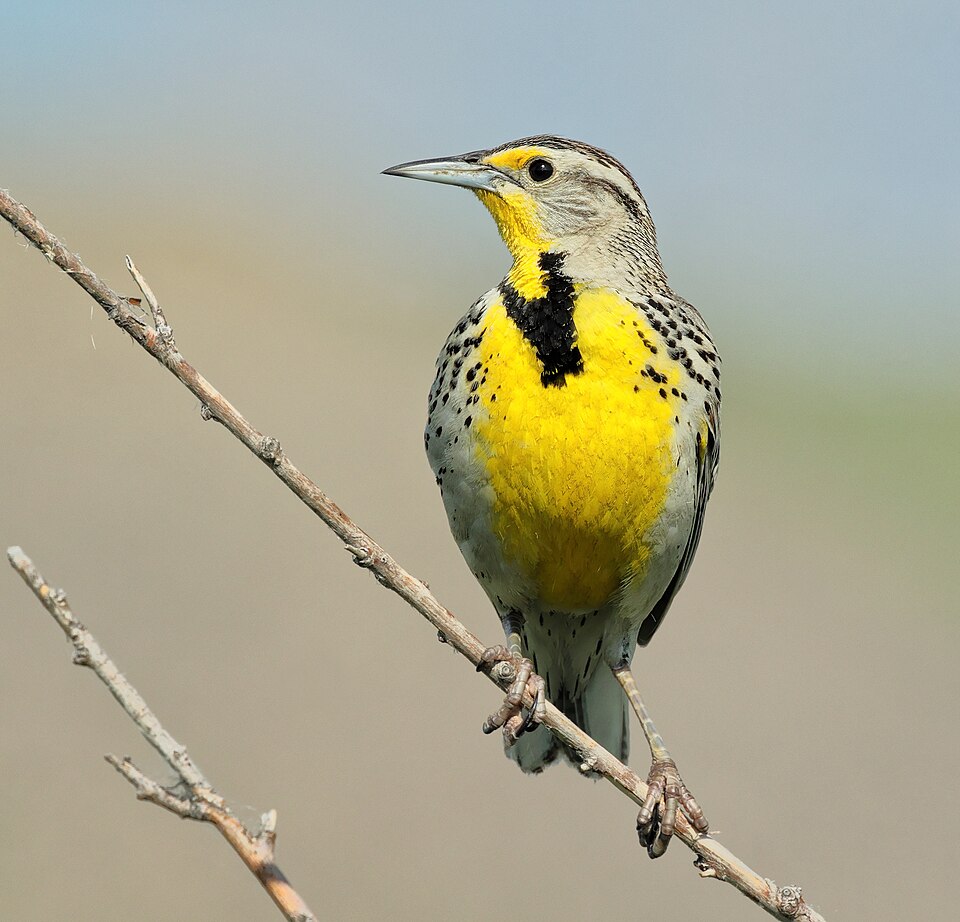
The Western Meadowlark is one of the signature sounds of open country across the western half of North America. Perched on a fencepost or a tall weed stalk, a male throws back his head and pours out a rich, gurgling, flute-like song that carries for hundreds of yards over the grass. That voice is so beloved that six U.S. states have chosen the Western Meadowlark as their official bird, more than almost any other species. Despite the name, it is not a lark at all but a member of the blackbird family (Icteridae), related to grackles, orioles, and bobolinks.
It is a chunky, short-tailed songbird built for life on the ground. The brilliant lemon-yellow underparts and the bold black "V" across the chest make a perched, singing male unmistakable, but the bird is just as often a buff-and-brown shape walking quietly through the stubble, all but invisible until it flushes. Western Meadowlarks favor native prairie, hayfields, grazed pasture, sagebrush flats, and weedy roadsides, and their fortunes rise and fall with the health of these grassland habitats.
Look for a plump, robin-sized bird with a flat-headed, long-billed profile and a short tail that it often flicks open to flash white outer feathers. On the ground it walks rather than hops, and a singing bird usually sits bolt upright on an exposed perch with its bright yellow front fully on display.
| Underparts | Bright lemon-yellow throat, breast, and belly with a bold black V-shaped band across the chest |
| Upperparts | Cryptic buff, brown, and black streaking that blends perfectly into dry grass |
| Head | Striped crown with a pale central stripe, and a yellow patch that reaches up onto the cheek (malar) |
| Tail | Short and white-edged; the white outer tail feathers flash conspicuously in flight |
| Bill | Long, sharply pointed, and bluish-gray, used to probe and pry into the soil |
| Flight | Stiff, shallow wingbeats alternating with short glides, low over the grass |
Male vs. female
Males and females look very similar and share the same yellow underparts, black breast band, and streaked brown backs, so plumage alone rarely separates them in the field. Females average noticeably smaller and tend to show a slightly duller, narrower black V, but the overlap is wide. The most reliable clue is behavior: the bird singing the full, ringing territorial song from an exposed perch is almost always the male, while females stay lower and more secretive, especially during nesting.
Juveniles
Freshly fledged juveniles are a washed-out version of the adults. The yellow underparts are paler and tinged buff, the breast shows fine dusky streaking instead of a clean solid black V, and the overall look is softer and more scaly. By their first fall, after molting, young birds closely resemble adults, though fresh autumn plumage in all ages can partly obscure the black chest band behind buff feather tips that wear away by spring.
The song is the best way to identify this bird and the easiest way to separate it from its eastern cousin. The Western Meadowlark delivers a rich, bubbling, flute-like series of 7 to 10 gurgling notes that tumble downward in pitch, often described as a watery, melodic tloo-tloo-tloo, tlee-tloo-too-tloodle-loo. It sounds liquid and complex, almost like someone playing a wooden flute under water.
This stands in sharp contrast to the Eastern Meadowlark, whose song is a simpler, slurred, clear-whistled see-you, see-yeeer. Western Meadowlarks also give a low, buzzy chuck or chupp call note and a distinctive dry rattle, especially when flushed or alarmed.
Western Meadowlarks breed across the western two-thirds of North America, from the prairies of southern Canada south through the Great Plains, Great Basin, and Southwest, and west to the Pacific coast. Their range overlaps with the Eastern Meadowlark in a broad zone through the central Plains and Midwest, where the two species can be found singing within earshot of each other.
Birds in the northern and high-elevation parts of the range are migratory, pulling south and to lower ground for winter, while populations across much of the West, Southwest, and Pacific states are year-round residents. In winter, flocks gather in stubble fields, pastures, and open desert, sometimes mixing loosely with Horned Larks and other open-country birds.
The Western Meadowlark is mainly a ground forager that walks through grass and stubble probing the soil with its long, pointed bill. It uses a feeding technique called "gaping," inserting the closed bill into the ground or into clumps of vegetation and then forcing it open to expose hidden insects and seeds, a trick most other songbirds cannot manage.
Through spring and summer the diet is heavily insect-based: beetles, grasshoppers, crickets, caterpillars, cutworms, and grubs, which makes the species a genuine ally to farmers and ranchers. In fall and winter it shifts toward weed seeds and waste grain scattered across harvested fields, supplementing with whatever invertebrates it can still find.
Nesting happens entirely on the ground, hidden in dense grass or low vegetation. The female builds a cup of woven grasses and stems set into a shallow depression, and she often adds a domed roof and sometimes a grass-lined runway leading to the entrance, making the nest remarkably well concealed from above.
She lays a clutch of about 3 to 7 eggs, white and heavily spotted with brown and purple, and incubates them alone for roughly two weeks. The young leave the nest after about 10 to 12 days, before they can fly well, scattering into the grass where the parents continue to feed them. Pairs frequently raise two broods in a season, and males commonly mate with more than one female within their territory.
The Western Meadowlark is a bird of wide-open grassland, not a typical feeder visitor, so you will rarely lure one to a backyard seed station in town. If you live near or border open habitat, though, there are real ways to make your property more inviting.
- Protect open grassland. The single best thing you can do is leave native prairie, pasture, or weedy field uncut and unsprayed, especially through the nesting season from late spring into summer.
- Delay mowing. Because they nest on the ground, meadowlarks are highly vulnerable to early or frequent mowing. Hold off on cutting fields until young have fledged.
- Skip the pesticides. Insecticides remove the grasshoppers, beetles, and caterpillars that meadowlarks depend on to feed their chicks.
- Offer scattered grain at the edge of open ground. In rural settings, cracked corn or millet spread on bare ground near a field may draw wintering birds, though feeders themselves are usually ignored.
- Leave singing perches. Fenceposts, tall weed stalks, and lone shrubs give males the exposed song posts they need to hold a territory.
- Eastern Meadowlark: Nearly identical in plumage; best separated by voice (Eastern gives clear slurred whistles, Western a bubbling flute-like song). Eastern shows slightly less yellow on the cheek and more white in the tail.
- Dickcissel: Much smaller with a yellow breast and black bib, but it is a stocky finch-like bird with a heavy pale bill, lacks the long meadowlark bill, and perches rather than walking the ground.
- Bobolink: A related grassland icterid, but breeding males are black below with a buff nape and white back; females are buffy and streaky without yellow underparts or a black V.
What is the difference between a Western and Eastern Meadowlark?
They look almost identical, so birders rely on song. The Western Meadowlark sings a rich, bubbling, flute-like series of gurgling notes, while the Eastern gives a simpler, clear-whistled see-you, see-yeeer. Range helps too: Westerns dominate the western half of the continent, Easterns the east, with overlap through the central Plains. In the hand, Westerns show slightly more yellow extending onto the cheek.
Why is the Western Meadowlark so many states' state bird?
Its gorgeous, far-carrying song and bright yellow plumage made it a sentimental favorite across the West. Six states (Kansas, Montana, Nebraska, North Dakota, Oregon, and Wyoming) chose it as their official state bird, reflecting how deeply tied its voice is to the open prairie landscape.
Is the Western Meadowlark actually a lark?
No. Despite the name, it belongs to the blackbird family (Icteridae), making it a relative of blackbirds, grackles, orioles, and bobolinks. True larks are an entirely different, mostly Old World family. The 'lark' name simply reflects its grassland habits and melodious song.
Will Western Meadowlarks come to a bird feeder?
Rarely. They are ground-foraging grassland birds and generally ignore hanging feeders. If you live near open fields, you may occasionally draw wintering birds by scattering cracked corn or millet on bare ground near a field edge, but they are not a reliable backyard feeder species.
Where do Western Meadowlarks go in winter?
Northern and high-elevation breeders migrate south and downslope, gathering in flocks in stubble fields, pastures, and open desert. Across much of the West, Southwest, and Pacific states, however, meadowlarks are year-round residents and stay put through the winter.
Are Western Meadowlark populations declining?
Yes. Although still common and listed as Least Concern, long-term surveys show steady declines tied to the loss and degradation of native grassland, plus the effects of mowing, plowing, and pesticide use. Conserving open prairie and delaying mowing during nesting season are key to keeping populations healthy.