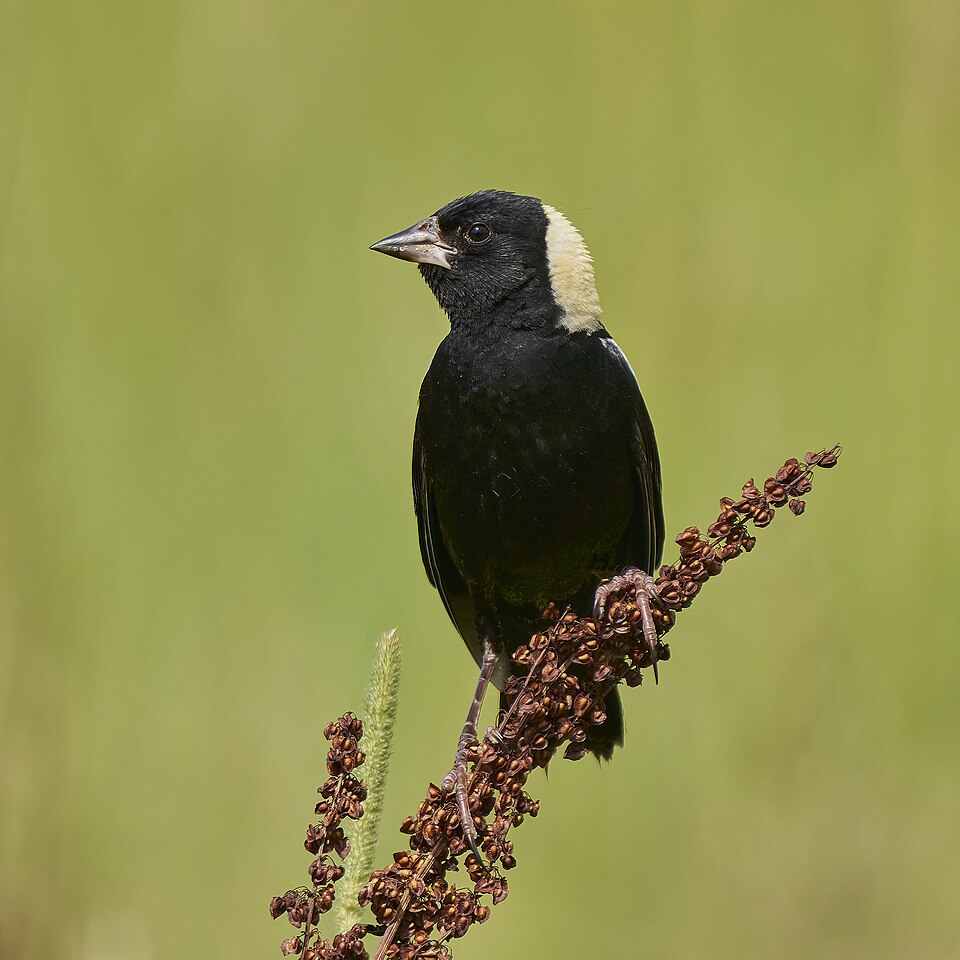
The Bobolink is one of North America's most charismatic grassland birds, a sparrow-sized member of the blackbird family that turns ordinary hayfields and wet meadows into open-air concert halls each spring. The breeding male is unmistakable: jet-black below, with a buttery, straw-colored patch on the back of the head and bold white markings on the back and rump. Birders sometimes describe him as wearing a tuxedo backward, since most birds are dark above and pale below while the Bobolink reverses the pattern. Add to that a tumbling, mechanical, almost electronic song delivered from a fluttering display flight, and you have a bird that announces itself with style.
Beyond looks and song, the Bobolink is a marvel of endurance. Each year it completes one of the longest migrations of any songbird in the Western Hemisphere, traveling from northern grasslands all the way to the grasslands and marshes of central South America and back. It is closely tied to open grassy habitat, which makes it a barometer for the health of meadows and pasturelands. As native prairie and old-fashioned hayfields have given way to development and earlier, more frequent mowing, Bobolink numbers have fallen across much of their range, making this a species many conservation-minded landowners now actively try to help.
Roughly the size of a House Sparrow but a touch longer and more elongated, the Bobolink has a stout, finch-like conical bill, a fairly flat crown, and a short tail with pointed feather tips. On the breeding grounds the singing male is hard to mistake, but females and fall birds are streaky and sparrow-like, so shape, habitat, and behavior matter as much as color.
| Breeding male | All-black underparts and face, pale straw-yellow nape, white scapulars and rump - the 'backward tuxedo' |
| Female & nonbreeding | Warm buff overall, dark crown stripes with a pale central stripe, streaked back and flanks |
| Bill | Short, thick, conical and pinkish to dark, typical of a seed-eating blackbird |
| Tail | Short with sharply pointed (spiky) tail-feather tips, often noticeable in flight |
| Size & shape | About 6-8 in long; chunky body, flattish head, sturdy build |
| Flight | Male sings on fluttering, helicopter-like display flights low over the grass |
Male vs. female
In breeding plumage the sexes look completely different. The male is the striking black-and-white bird with the pale yellow patch on the back of his head, and he is the one singing from grass stems and song flights. The female is dramatically plainer - a warm buff-and-brown bird with crisp dark streaks on the crown and a streaked back and sides, looking much like an oversized, sharply marked sparrow. By late summer the male molts out of his showy outfit and comes to closely resemble the female, so for much of the year the two sexes are nearly identical in the field.
Juveniles
Juvenile and immature Bobolinks look very much like adult females: warm yellowish-buff birds with finely streaked backs, faint streaking on the sides, and a pale crown stripe bordered by darker lines. Young birds tend to show especially rich, unworn buff tones in late summer and fall. Because fall males, females, and juveniles all share this streaky, golden-toned look, these confusing "fall Bobolinks" are best identified by their chunky shape, spiky tail tips, pink bill, and distinctive flight call rather than by plumage alone.
The male's song is the Bobolink's signature: a long, bubbling, joyful jumble of metallic, banjo-like notes that rises and tumbles over itself, often delivered during a buoyant flight display above the grass. Many listeners hear it as the rollicking phrase that gave the bird its name - a rapid bob-o-link, bob-o-link, spink-spank-spink - with an oddly mechanical, almost robotic quality that sounds like a cheerful wind-up toy. Each male strings these notes into an energetic, ever-changing ramble.
The most useful year-round sound is the flight call, a flat, slightly buzzy pink or bink given by birds passing overhead, including during migration. Learning this single note is one of the best ways to detect Bobolinks moving over fields and even cities at night and in early morning, long after the males have gone silent for the season.
Bobolinks breed across the northern United States and southern Canada, favoring grasslands, hayfields, wet meadows, and lightly grazed pastures from the northern Great Plains and prairie provinces eastward through the Great Lakes and into the Northeast, with scattered populations farther west in suitable mountain meadows and irrigated fields. They are birds of open country and avoid forests and developed areas.
Their migration is famously long. In fall, birds funnel south and east, staging in marshes and rice fields, then cross the Gulf and Caribbean to winter in the grasslands, marshes, and farmlands of central South America, including the pampas region. A round trip can cover many thousands of miles, and individuals may repeat this journey year after year over a lifetime, racking up a truly extraordinary cumulative distance. Spring brings them back north, with males typically arriving first to establish territories.
The Bobolink's diet shifts with the seasons. During the breeding season adults eat large numbers of insects and other small invertebrates - caterpillars, beetles, grasshoppers, and spiders - which provide the protein needed to raise a brood. They also take the seeds of grasses and weeds throughout the year, foraging by walking and hopping through dense vegetation and gleaning from stems and the ground.
Outside the breeding season, seeds and grains dominate. On migration and in winter, large flocks feed heavily on wild grass seeds and cultivated grains, and their fondness for ripening rice earned them the old nickname "ricebird" in the southeastern United States, where historically they were considered an agricultural pest. The scientific species name, oryzivorus, literally means "rice-eating," a nod to this habit.
Bobolinks are ground nesters of open grasslands. The female builds a fairly flimsy, cup-shaped nest of grasses and weed stems set in a shallow scrape or natural depression on the ground, well hidden among dense vegetation in a hayfield or meadow. Nests can be remarkably hard to find, as the adults typically land some distance away and walk in through the grass rather than flying directly to the site.
The female lays a clutch of around 4 to 7 eggs, usually 5 or 6, which she incubates. Young hatch helpless and grow quickly, leaving the nest before they can fully fly and skulking through the grass while the parents continue to feed them. Because the nests and flightless young sit right at ground level during early summer, Bobolink broods are extremely vulnerable to hay mowing - a major reason that delaying the first cut until after the young fledge is one of the most effective conservation measures for this species.
The Bobolink is not a backyard feeder bird, so you won't lure one to a tube feeder or suet cake. It is a specialist of open grassland, and the only meaningful way to "attract" it is to provide or protect the kind of habitat it depends on. If you own or manage acreage of meadow, pasture, or hayfield - especially in their breeding range - you can make a real difference for this declining species.
- Protect open grassland: Bobolinks need sizable blocks of grassy meadow or hayfield, not lawns or wooded yards - larger, unfragmented fields are far more attractive than small patches.
- Delay mowing until after young have fledged (often mid-to-late summer in much of their range) to avoid destroying ground nests and flightless chicks.
- Favor grass-and-wildflower fields over intensively managed turf or dense legume monocultures, and avoid heavy pesticide use that wipes out the insects nestlings need.
- If you don't own land, support local grassland and prairie conservation, land trusts, and 'bird-friendly hay' programs that pay farmers to mow later.
- To simply enjoy them, visit hayfields, wet meadows, and grassland preserves on spring and early-summer mornings when males are singing on display flights.
- Learn the flat pink flight call to detect migrating Bobolinks passing over fields and even suburban areas in late summer and fall.
- Red-winged Blackbird: Female red-wings are larger, darker, and heavily streaked below without the warm buff tones and clean crown stripes of a female Bobolink; they favor marshes and have a sharply pointed bill.
- Eastern Meadowlark: Also a grassland bird, but much chunkier with a long pointed bill, bright yellow underparts, and a black 'V' on the chest - nothing like the Bobolink's pattern or bubbling song.
- Savannah Sparrow: Streaky fall Bobolinks recall this sparrow, but Savannahs are smaller and slimmer with a notched (not spiky) tail, often a yellowish brow, and a thin sparrow bill rather than a thick conical one.
- Grasshopper Sparrow: Shares grassland habitat and buffy tones, but is much smaller with a flat head, unstreaked buff breast, and a thin insect-like buzz instead of a rollicking song.
Why is the Bobolink called a 'backward tuxedo' bird?
Because the breeding male reverses the usual bird color scheme. Most songbirds are darker above and paler below, but the male Bobolink is solid black on the face and underparts with white markings across the back and rump and a pale straw patch on the nape - looking like he's wearing a tuxedo turned inside out or back to front.
What does a Bobolink sound like?
The male sings a long, bubbling, metallic jumble of notes that tumbles over itself, often described as a banjo-like, almost robotic ramble - the source of the name 'bob-o-link.' The most reliable year-round sound is a flat, buzzy 'pink' flight call given by birds passing overhead.
Where do Bobolinks go in the winter?
They migrate all the way to central South America, wintering in grasslands, marshes, and farmlands including the pampas region. It's one of the longest migrations of any North American songbird, with round trips covering many thousands of miles each year.
Will Bobolinks come to my bird feeder?
No. Bobolinks are grassland specialists that eat insects and grass seeds out in open meadows and hayfields, and they don't visit yard feeders. The best way to help them is to protect grassland habitat or delay hayfield mowing until their young have fledged.
How can you tell a female Bobolink from a sparrow?
Female and fall Bobolinks are warm buff with streaked backs and bold dark crown stripes around a pale central stripe. Look for a chunkier, blackbird-like body, a thick conical bill, and short tail feathers with spiky pointed tips - sparrows are generally slimmer with thinner bills and notched tails.