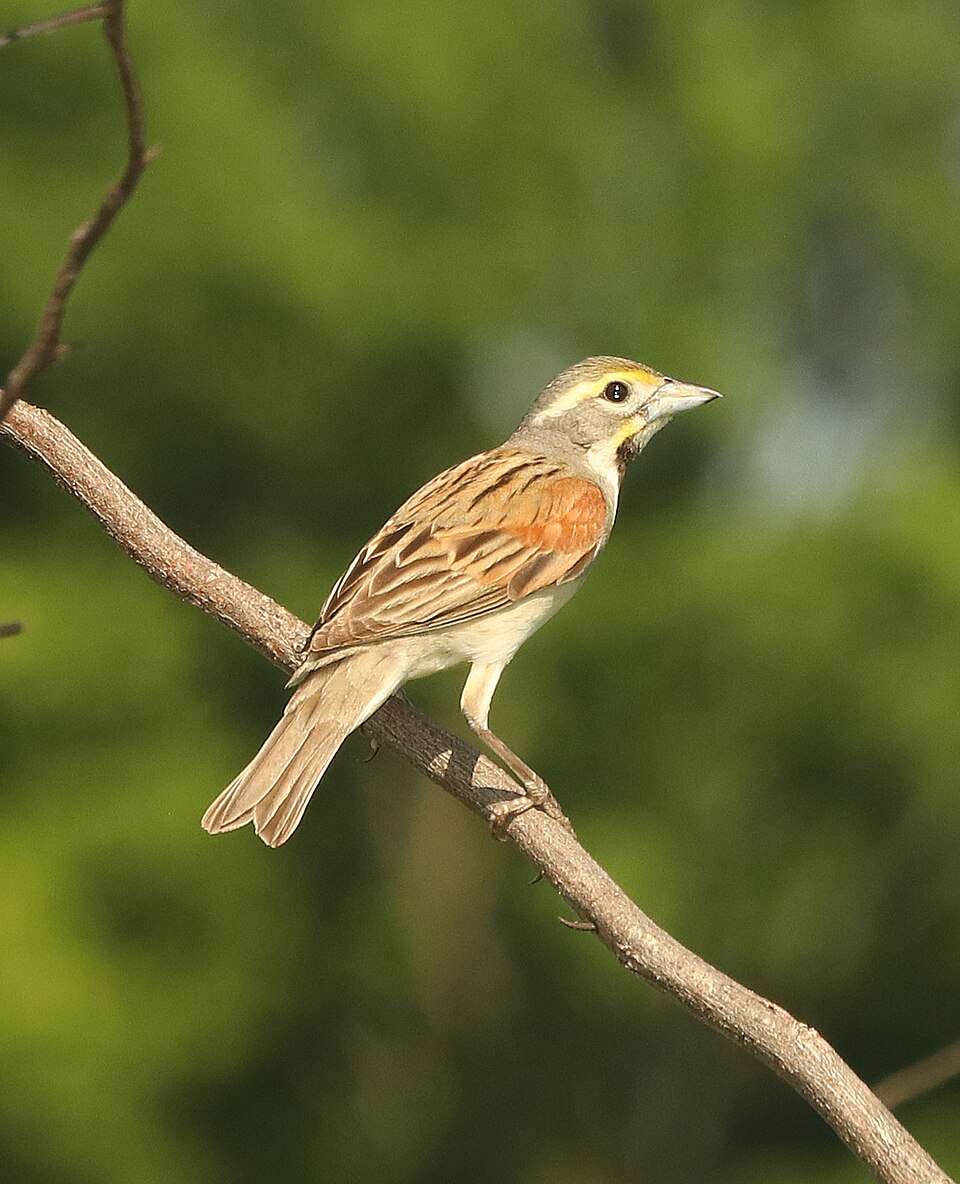
The Dickcissel is a chunky little grassland songbird that looks, at first glance, like a House Sparrow that spent a summer at a meadowlark convention. Breeding males wear a bright yellow chest crossed by a bold black bib, a gray head with a yellow eyebrow stripe, and a warm chestnut shoulder patch. Across the central United States, the Dickcissel is the sound of summer prairie and hayfield, with males singing their own name over and over from fence posts, weed stalks, and roadside wires.
This is a bird of open country rather than the backyard. It nests in tallgrass prairie, restored grasslands, weedy fields, alfalfa, clover, and the margins of croplands. Numbers can swing wildly from year to year and place to place, because Dickcissels are famously nomadic: a field thick with singing males one June may hold almost none the next, as the birds settle wherever spring rains have produced the best grass and insect crops. After breeding, nearly the entire population funnels south to a relatively small wintering area in the grasslands of Venezuela, where enormous flocks gather.
Think of a Dickcissel as a stocky, large-headed finch-like bird with a heavy, conical seed-cracking bill and a fairly short tail. It is a little larger and more thickset than a House Sparrow, and the breeding male's yellow-and-black pattern is a dead giveaway. Females and fall birds are plainer and trickier, so the bill shape, the warm rusty wing patch, and a hint of yellow on the chest become your best clues.
| Black bib | Breeding males show a sharp black throat patch (V-shaped bib) on a bright yellow chest, much like a tiny meadowlark. |
| Yellow eyebrow & chest | A yellow supercilium (eyebrow) and yellow wash across the breast; brightest on males, faint but present on many females. |
| Chestnut shoulder | A rusty, reddish-brown patch on the bend of the wing (lesser coverts) shows in both sexes and is a key field mark. |
| Gray head & nape | Plain gray cheeks and crown set off the yellow eyebrow and (on males) a whitish chin above the bib. |
| Heavy pale bill | Thick, conical, pale bluish-gray finch bill built for cracking seeds. |
| Streaked brown back | Brown, sparrow-like back with dark streaks; underparts otherwise whitish to buff. |
Male vs. female
Breeding males are unmistakable: gray head, bright yellow eyebrow and chest, a clean black bib, chestnut shoulders, and a whitish belly. Females are a muted version of the same plan. They lack the black bib (or show only a faint trace), the yellow is paler and confined mostly to a wash on the breast and eyebrow, and the chestnut shoulder is duller but usually still visible. Many people first mistake a female Dickcissel for a House Sparrow, but the yellowish chest tinge, the rusty wing patch, and the heavier bill give her away. After the breeding season, even males molt into a duller plumage with the black bib largely veiled by pale feather tips, so late-summer and fall birds of both sexes look much more similar.
Juveniles
Juvenile Dickcissels are streaky and sparrow-like, brownish above and buffy-white below with fine dark streaking across the breast and flanks. They lack the yellow chest and black bib of adult males and show little or no chestnut on the shoulder at first. With their streaked underparts they can look a lot like young sparrows, so the heavy conical bill, large head, and the company of plainer adult Dickcissels are the best clues. Immatures gradually acquire adult-like features through their first fall and winter.
The Dickcissel is named for its song, and it is one of the easiest grassland birds to learn by ear. The male delivers a dry, mechanical phrase that sounds like a sharp "dick dick" followed by a buzzy "cissel" or "see-see-cissel", often written as dick-dick-cissel. It is insect-like and slightly electric, repeated tirelessly from an exposed perch through the heat of the day when many other birds fall silent.
The common flight call is a distinctive low, flat, buzzy "brrrrt" or electric-buzzer note given as the bird flies overhead, and it is so consistent that birders pick out migrating Dickcissels by this sound alone, sometimes at night. The combination of the named song and that buzzy flight note makes this a bird you often hear before you see.
Dickcissels breed across the central United States, with the core of their range in the tallgrass and mixed-grass prairie of the Great Plains and Midwest, from the Dakotas and Nebraska south through Kansas, Oklahoma, and Texas, and east into the prairie states. The breeding range expands and contracts year to year, and in good years birds spill well east and even into the Northeast. They are notorious wanderers: a single rainy spring can shift large numbers of birds to wherever conditions favor lush grass and abundant insects.
This is a long-distance migrant. In late summer and fall, the vast majority of the population leaves North America and travels to a concentrated wintering region in the llanos grasslands of Venezuela and nearby northern South America, where they form huge, dense flocks. A small number of birds turn up at feeders in the eastern and southeastern U.S. in fall and winter, often mixed in with House Sparrows, far from the breeding range.
Dickcissels eat a mix of seeds and insects, and the balance shifts with the season. During the breeding season they take large numbers of insects, including grasshoppers, crickets, caterpillars, and beetles, which provide the protein needed to raise young. They glean prey from grass and forb stems and pluck it from the ground in fields and prairie.
Outside the breeding season, and especially on migration and in winter, seeds dominate the diet, particularly grass and grain seeds. On the wintering grounds in South America the species can gather in enormous flocks and feed in cultivated grain, where it is sometimes considered an agricultural pest. The heavy conical bill is well suited to husking these seeds.
Dickcissels nest low in dense grassland vegetation, building a bulky cup of grasses, weed stems, and leaves lined with finer grasses and rootlets. The nest is placed on or near the ground in thick grass or low in a shrub, alfalfa, or weedy tangle. The female builds the nest and does the incubating on her own.
A typical clutch is around three to five pale blue, unmarked eggs, and pairs may raise more than one brood in a season where the grass holds up. Males are often polygynous, with a single dominant male defending a territory that may include the nests of several females. Because Dickcissels nest right in the grass, mowing, early haying, and the loss of native grassland are major threats to their nesting success, and they are frequent hosts to Brown-headed Cowbird parasitism.
The Dickcissel is not a typical backyard or feeder bird, and most people will only see one if they live near or visit open grassland. That said, there are real ways to give yourself a chance, and a few feeders host wandering Dickcissels in fall and winter.
- Look in the right habitat: scan fence posts, weed stalks, and roadside wires along prairies, hayfields, alfalfa, clover, and weedy field edges in the central U.S. from late May through July.
- Use your ears. Learn the buzzy "dick-dick-cissel" song and the electric flight buzz; in summer males sing all day from exposed perches.
- If you have acreage, delay mowing or haying until after the nesting season and leave native grasses and forbs standing to support breeding birds and their insect prey.
- At feeders, offer small seeds and millet on or near the ground; rare fall and winter Dickcissels usually turn up mixed in with House Sparrow flocks, so check sparrow gangs carefully.
- Watch during fall migration for that distinctive buzzy flight call overhead, often the first sign one is passing through.
- House Sparrow: Female and non-breeding Dickcissels look much like House Sparrows but show a yellowish chest wash, a rusty shoulder patch, and a slightly heavier build; House Sparrows lack any yellow.
- Eastern Meadowlark: Shares the yellow chest and black bib pattern but is far larger, with a long spear-like bill and white outer tail feathers; the Dickcissel is sparrow-sized.
- Western Meadowlark: Also yellow-breasted with a black V, but big, long-billed, and flute-voiced; no chance of confusion by size once seen well.
- Bobolink: Another prairie songbird; breeding male Bobolink is black below with a buffy nape and white back, very different, but plain fall Bobolinks and female Dickcissels both skulk in grass.
How did the Dickcissel get its name?
It is named for its song. Males repeat a dry phrase that sounds like "dick dick cissel," and the name is simply a written version of that sound.
Is a Dickcissel just a fancy House Sparrow?
No. They are unrelated and only superficially similar. House Sparrows are Old World sparrows; Dickcissels are New World birds in their own genus. Look for the Dickcissel's yellow chest, chestnut shoulder patch, and (on males) a black bib.
Where do Dickcissels go in winter?
Almost the entire population migrates to the grasslands of Venezuela and nearby northern South America, where they gather in huge flocks. Only a few stragglers winter at feeders in the eastern and southeastern U.S.
Why do Dickcissels appear in a field one year and vanish the next?
They are nomadic. Each spring they settle wherever rainfall has produced the best grass and insect supply, so local numbers can swing dramatically from year to year and field to field.
Will Dickcissels come to a backyard feeder?
Rarely. They are grassland birds, not feeder regulars. The best chance is in fall or winter, when an occasional wanderer joins House Sparrow flocks at ground feeders with millet and small seeds, so check sparrow groups carefully.