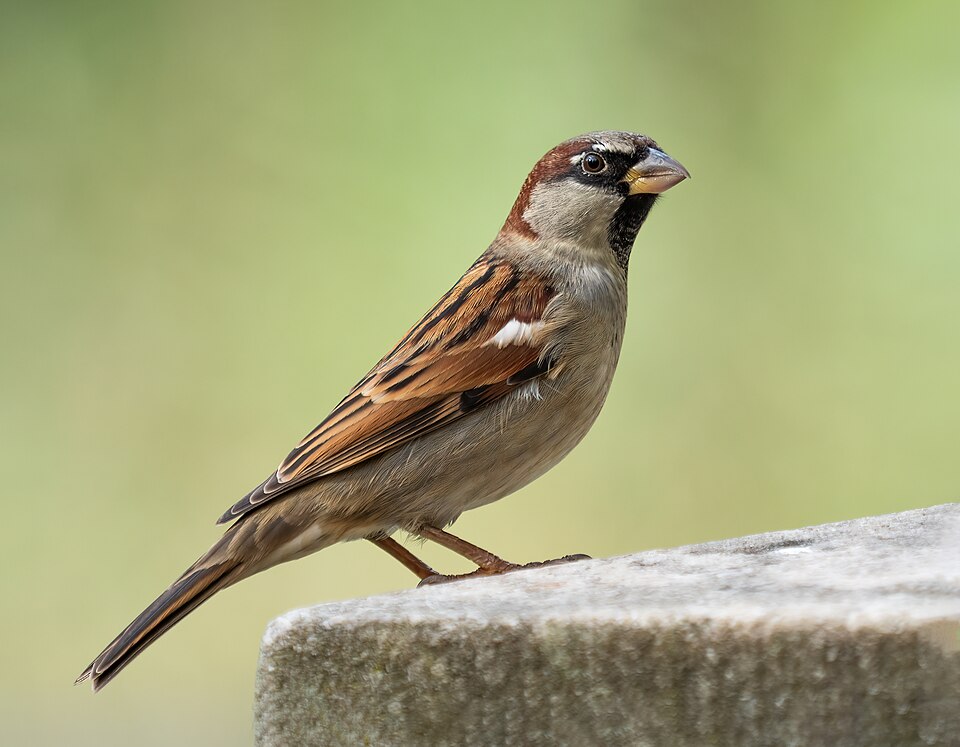
Few birds are as tied to human life as the House Sparrow. Chunky, social, and endlessly chatty, it bustles around sidewalks, parking lots, farmyards, and backyard feeders almost everywhere people live. It is so familiar that many beginning birders overlook it entirely, yet a close look reveals a handsome bird, especially a breeding male with his black bib, gray crown, and chestnut nape. Where there are crumbs, spilled grain, or a busy bird feeder, there are almost always House Sparrows squabbling cheerfully nearby.
Despite the "house" in its name, this is not a true North American sparrow at all. It belongs to the Old World sparrow family (Passeridae) and was introduced to the United States in the 1850s, after which it spread across the continent with remarkable speed. Today it is one of the most widely distributed wild birds on Earth, thriving on six continents. Ironically, in much of its native Europe its numbers have fallen sharply in recent decades, making this commonplace bird a subject of real conservation concern in places where it was once taken for granted.
The House Sparrow is a small, stocky, full-chested bird with a large rounded head, a short tail, and a stout, conical seed-cracking bill. It looks heavier and "blockier" than the slim native American sparrows, and it rarely strays far from buildings or other human structures. Plumage differs strongly between the sexes, which is unusual among the little brown birds people lump together.
| Size & shape | Small and chunky with a big head, thick neck, short tail, and heavy conical bill |
| Breeding male | Gray crown, chestnut sides and nape, white cheeks, and a bold black throat-and-chest bib |
| Female | Plain dusty brown with a pale buff eyebrow stripe behind the eye and a streaked brown back |
| Bill color | Black on breeding males, dull yellowish-horn on females and non-breeding males |
| Wing | Single thin white wingbar; back is streaked black and warm brown |
| Behavior cue | Hops on the ground in noisy flocks, dust-bathes, and stays close to buildings |
Male vs. female
The sexes look quite different, which makes this one of the easier backyard birds to sex. The breeding male is the showy one: a clean gray crown, rich chestnut running from behind the eye down the sides of the neck, pale gray-white cheeks, and a black bib that spreads from the chin across the throat onto the upper breast. His bill turns glossy black in the breeding season. The female and immature are much plainer, an overall warm dusty brown with no bib and no gray cap; her best mark is a pale buff line that curves back behind the eye, set against a streaky brown back. In winter the male's bib is partly hidden by pale feather tips and his bill fades to horn, so off-season males look duller and a bit more female-like.
Juveniles
Juveniles closely resemble adult females, plain and buffy-brown with a streaked back and an indistinct pale eyebrow, so they are easily mistaken for grown hens. Young males begin showing a faint smudgy bib and traces of gray on the crown as they molt into adult plumage in late summer and fall. Freshly fledged young often have slightly fluffy plumage, a faint yellow gape at the corners of the mouth, and they beg loudly with quivering wings while a parent shoves food into their bills.
The House Sparrow is no songster, and its "song" is really just an enthusiastic, repetitive series of chirps. The classic sound is a steady, monotonous cheep... chirrup... cheep... chirrup delivered from a perch, gutter, or hedge, often by a male advertising a nest site. Strung together by a flock, these chirps create the cheerful background chatter heard around city squares and farmyards everywhere.
Calls include a sharp chip or chirrup used in contact and excitement, a rapid scolding rattle when alarmed, and a churring, quarrelsome chatter during the constant squabbles over food and perches. Displaying males may give a soft, nervous-sounding series while bobbing and drooping their wings near a female.
The House Sparrow is native to Europe, much of Asia, and parts of North Africa and the Middle East. Through deliberate introductions and self-spread it now lives across North and South America, southern Africa, Australia, New Zealand, and many islands, making it one of the most cosmopolitan birds in the world. In North America it occurs from coast to coast and from southern Canada to Central America, wherever towns, farms, and feedlots provide food and nest sites.
It is essentially non-migratory. Birds stay near their breeding areas year-round, forming larger roving flocks in fall and winter that gather at reliable food and shelter. They are absent only from truly wild, building-free landscapes such as dense forest, high mountains, and open desert away from human settlement.
House Sparrows are generalist seed-eaters with a sweet tooth for almost any human food scrap. The bulk of the adult diet is grain and seeds, including waste grain, weed seeds, and cracked corn and millet at feeders, supplemented by buds, fruit, and a great deal of opportunistic foraging on crumbs, fries, and discarded bread around outdoor cafes and parking lots. They feed mainly on the ground, hopping along and hammering seeds open with that thick bill.
During the breeding season they add a surprising amount of animal food. Adults catch insects, caterpillars, beetles, and aphids, and protein-rich insects make up most of what nestlings are fed in their first days. This dietary flexibility, combined with a willingness to nest in any nook, is a big reason the species succeeds so well alongside people.
House Sparrows are cavity and crevice nesters, and they are famously unfussy about location. They will pack a bulky, messy nest of grass, straw, feathers, string, and scavenged trash into building eaves, vents, signs, traffic lights, dryer outlets, nest boxes, and the abandoned holes of other birds. They readily take over bluebird and swallow boxes, sometimes aggressively, which makes them a frequent headache for people managing nest boxes for native cavity-nesters.
The female lays a clutch of usually 4 to 5 eggs, pale and speckled with gray and brown, and both parents incubate over roughly 10 to 14 days. The young fledge about two weeks after hatching. Pairs are prolific, often raising two or three broods in a single season and reusing the same nest site year after year. They are largely monogamous and frequently nest in loose colonies, with several pairs occupying the same building.
You rarely need to try to attract House Sparrows, they tend to find feeders on their own and arrive in noisy groups. The more common question is how to enjoy them without letting them dominate your feeder or evict native birds. If you do want to host them, a few simple choices make them feel at home.
- Offer cracked corn, millet, and mixed seed spread on the ground or in a low platform feeder, which suits their ground-hopping habit
- Provide dense shrubs, hedges, or thick vines near the feeding area; they love communal cover to dive into and chatter from
- Keep a shallow birdbath or dust-bathing patch available, as sparrows bathe in both water and dry dirt
- If you want to discourage them, switch to nyjer (thistle) and straight black-oil sunflower in tube feeders with short perches, which they handle poorly compared to finches
- To protect native cavity-nesters, use nest boxes with the correct entrance hole size and monitor them, removing House Sparrow nests where bluebirds or swallows are the goal
- Eurasian Tree Sparrow: Both sexes have a chestnut crown and a distinctive black cheek spot; sexes look alike, unlike the House Sparrow
- House Finch: Males are red, not chestnut-and-gray; both sexes are slimmer with a notched tail and a smaller, more curved bill
- Song Sparrow: A true native sparrow, slimmer with a long rounded tail, heavy breast streaking, and a far more musical song
- Chipping Sparrow: Slimmer and cleaner-looking with a rusty cap, gray underparts, and a black eyeline; favors open woods and lawns over buildings
Is the House Sparrow a real sparrow?
Not in the North American sense. It belongs to the Old World sparrow family (Passeridae) and is more closely related to weaver finches than to native American sparrows like the Song or Chipping Sparrow. It was introduced to North America in the 1850s.
How do I tell a male House Sparrow from a female?
The breeding male has a gray crown, chestnut nape, white cheeks, a black bib on the throat and chest, and a black bill. The female is plain dusty brown with no bib, a pale buff stripe behind the eye, and a yellowish-horn bill.
Are House Sparrows bad for other birds?
They can be. They aggressively compete for nest cavities and will sometimes destroy eggs or take over boxes meant for bluebirds, swallows, and other native cavity-nesters. Many box monitors actively manage them to protect native species.
Why are House Sparrows declining if they're so common?
In much of their native Europe, populations have dropped substantially, likely from changes in farming, fewer nesting nooks in modern buildings, less spilled grain, and reduced insect food for chicks. They remain abundant in North America even as numbers slowly slip in some areas.
How do I keep House Sparrows away from my feeders?
Switch to feeders and foods they handle poorly: tube feeders with short perches, nyjer (thistle) seed, and straight black-oil sunflower instead of cheap mixes with millet and cracked corn. Removing ground-scattered seed also reduces their numbers.