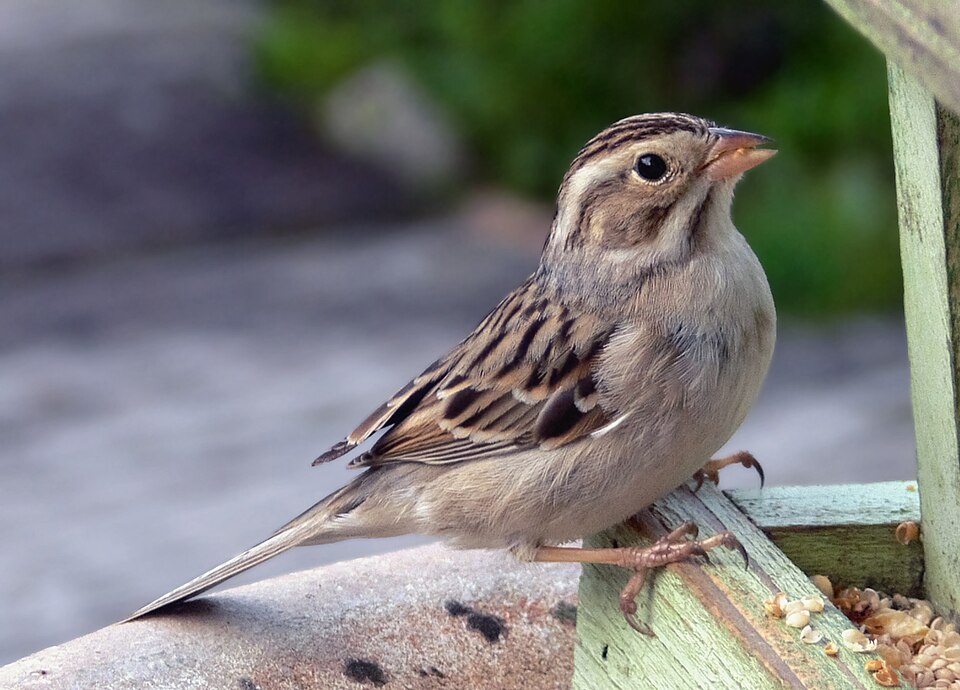
The Clay-colored Sparrow is a small, neatly marked songbird of the northern Great Plains and prairie-parkland of central North America. At first glance it looks like a plain brown sparrow, but a careful look reveals a beautifully clean head pattern and an overall pale, frosty appearance that sets it apart from its closer relatives. It belongs to the genus Spizella, the same group that includes the Chipping Sparrow and Field Sparrow, and like them it is slim, long-tailed, and active.
For many birders the Clay-colored Sparrow is known less by sight than by sound. Its song is one of the most distinctive on the prairie: a flat, dry, insect-like buzz that carries across brushy fields on summer mornings. It nests in the shrubby grasslands of the Canadian Prairies and the north-central United States, then migrates to winter mostly in Mexico and the borderlands. Where its range overlaps with similar sparrows, telling them apart is a classic birding challenge, which makes this unassuming little bird a satisfying one to learn.
This is a small, slender sparrow with a relatively long, notched tail and a small, conical pinkish bill. The overall impression is of a clean, pale, almost colorless bird with a strongly patterned face. Compared to a Chipping Sparrow it looks frostier and less contrasty, and the crispness of the head markings is the key to a confident identification.
| Crown | Brown and finely streaked, split by a pale buffy or whitish central stripe down the middle |
| Face | Clean pale cheek (ear patch) outlined by a dark border, with a distinct pale eyebrow and a thin dark line behind the eye |
| Nape | Plain, unstreaked gray nape that contrasts with the streaky back - a key mark |
| Underparts | Whitish to pale buff below, unstreaked, with buffy wash across the breast and flanks |
| Mustache stripe | A bold dark malar (jaw) stripe framing the pale throat |
| Size & shape | Small and slim with a long, slightly notched tail and small pink conical bill |
Male vs. female
Male and female Clay-colored Sparrows look essentially alike, and they cannot be reliably told apart in the field by plumage. Both sexes show the same crisp head pattern and pale, frosty body. Males do the singing on the breeding grounds, often from an exposed perch atop a low shrub, so a bird belting out the buzzy song is almost certainly a male, but the bird itself offers no visible clue to its sex.
Juveniles
Juveniles, seen in late summer near the breeding grounds, are buffier overall and show fine streaking across the breast and sides, which adults lack. They retain the basic face pattern - the outlined cheek and pale crown stripe - but it is muddier and less crisp. As they molt into first-winter plumage they become richer buff overall, and this warm, buffy first-fall plumage is actually when the species looks its most colorful and is often easiest to separate from the grayer fall Chipping Sparrow.
The song is the species' signature and is unlike that of almost any other songbird: a series of low, flat, mechanical buzzes, usually two to five of them, rendered as bzzz... bzzz... bzzz. It is dry and insect-like, easily mistaken for a grasshopper or a distant cicada, and lacks any musical or sweet quality. Each buzz is delivered on one pitch with a slight pause between, and a singing male will repeat the sequence steadily from a shrub top.
Call notes are typical of the genus - thin, high tsip or chip notes given in flight and while foraging. On migration the buzzy song is rarely heard, so flocks are usually picked out by sight and by their soft contact calls rather than by sound.
Clay-colored Sparrows breed across the northern Great Plains and prairie provinces, with a core range stretching from the Canadian Prairies of Alberta, Saskatchewan, and Manitoba south into the Dakotas, Montana, Minnesota, and parts of the upper Midwest and Great Lakes region. The breeding range has shifted and expanded eastward over the decades as shrubby, second-growth and abandoned-field habitat has become available.
It is a long-distance migrant. In fall, birds funnel south through the central United States, and most of the population winters in Mexico, especially the interior and Pacific slope, with smaller numbers in the southernmost United States near the Texas border. During migration it can turn up well outside its normal range, and it is a regularly anticipated rarity for sharp-eyed birders along both coasts in fall.
Like most sparrows, the Clay-colored Sparrow has a seasonal, two-part diet. Through the breeding season it feeds heavily on insects and other small invertebrates - caterpillars, beetles, grasshoppers, and the like - which provide the protein needed for raising young. Outside the breeding season it shifts to small seeds from grasses and weeds, which make up the bulk of its diet in fall, winter, and on migration.
It forages mostly on or near the ground, hopping through grass and low vegetation and picking food from the soil and stems. In winter and migration it often joins loose flocks, sometimes mixing with other sparrows, and the birds scatter through brushy edges and weedy fields to feed.
The Clay-colored Sparrow nests in shrubby, semi-open habitat - brushy grasslands, prairie thickets, young conifer plantings, shelterbelts, and the edges of fields and clearings. The nest is a compact open cup built of grasses, weed stems, and rootlets and lined with finer material such as fine grass, rootlets, and animal hair. It is placed low, typically in a small shrub or clump of grass within a few feet of the ground.
The female builds the nest and incubates the eggs, which are pale blue-green with dark spotting, mostly concentrated at the larger end. Incubation lasts on the order of about two weeks, and the young leave the nest a little over a week after hatching, before they can fly well. Pairs often raise two broods in a season where conditions allow. Like many open-country songbirds, the species is a fairly frequent host to Brown-headed Cowbird parasitism.
The Clay-colored Sparrow is generally not a backyard feeder bird across most of its range, and few people will host one at a typical suburban feeder. That said, there are honest ways to encounter or even attract them depending on where you live.
- If you live within the breeding range, the best draw is habitat: leaving brushy field edges, hedgerows, and shrubby thickets intact gives them the low cover they need to nest.
- During spring and fall migration, weedy, brushy yards near open country can attract passing flocks - let a corner go wild with native grasses and seed-bearing weeds.
- Ground-scattered or low-platform feedings of small seeds like white millet are more likely to interest sparrows than tube feeders full of large seeds.
- Provide a low, clean source of water; brushy birds will use a ground-level bath or shallow dish set near cover.
- Keep some low shrubs and dense cover close to any feeding area - sparrows want an escape route within a quick hop.
- In most of the country your realistic chance is finding one in open brushy habitat rather than at the feeder, so learn the buzzy song and check sparrow flocks carefully.
- Chipping Sparrow: Breeding adult Chipping has a bright rufous cap, white eyebrow, and dark eyeline through the eye; it lacks the clean outlined cheek and pale crown-stripe. Fall and immature Chippings are the real confusion, but they look grayer-rumped and lack the contrasting plain gray nape.
- Brewer's Sparrow: A western counterpart that is even plainer and grayer, with a finely streaked crown lacking a bold central stripe and a less contrasting face; ranges overlap on the western edge of the prairies.
- Field Sparrow: Field Sparrow has a plain face with a bold white eyering, a pink bill, and a rusty cap, giving it a 'blank-faced' look very different from the strongly outlined cheek of the Clay-colored.
- American Tree Sparrow: A winter visitor with a rufous cap, gray face, and a dark central breast spot; larger and more boldly marked, unlikely to be confused once seen well.
What does a Clay-colored Sparrow sound like?
Its song is a series of two to five low, flat, dry buzzes - bzzz... bzzz... bzzz - that sound more like an insect or a grasshopper than a bird. It is delivered on one pitch with brief pauses and is one of the most distinctive sounds on the northern prairie in summer.
How do I tell a Clay-colored Sparrow from a Chipping Sparrow?
Look at the head and nape. The Clay-colored has a clean, pale cheek patch outlined in dark, a pale stripe down the center of the crown, and a plain gray nape that contrasts with its streaky back. A breeding Chipping Sparrow has a bright rufous cap and a dark line through the eye. Confusing fall birds are best told apart by the Clay-colored's frostier, buffier look and contrasting gray nape.
Where do Clay-colored Sparrows live?
They breed in shrubby grasslands across the Canadian Prairies and the north-central United States, from Alberta and Saskatchewan south into the Dakotas, Montana, and Minnesota. Most of the population migrates to winter in Mexico, with small numbers near the southern Texas border.
Will Clay-colored Sparrows come to a backyard feeder?
Usually not. They are birds of open, brushy country rather than typical feeder visitors. If you live within their range or along a migration corridor, you can improve your odds by keeping brushy cover, native seed-bearing weeds, and small seeds like white millet scattered low near shrubs.
Are Clay-colored Sparrow populations declining?
The species is currently considered of Least Concern and remains common within its core range. Its breeding range has even expanded eastward over time as shrubby, regenerating habitat became available, though like many grassland and shrubland birds it depends on the continued presence of brushy nesting cover.