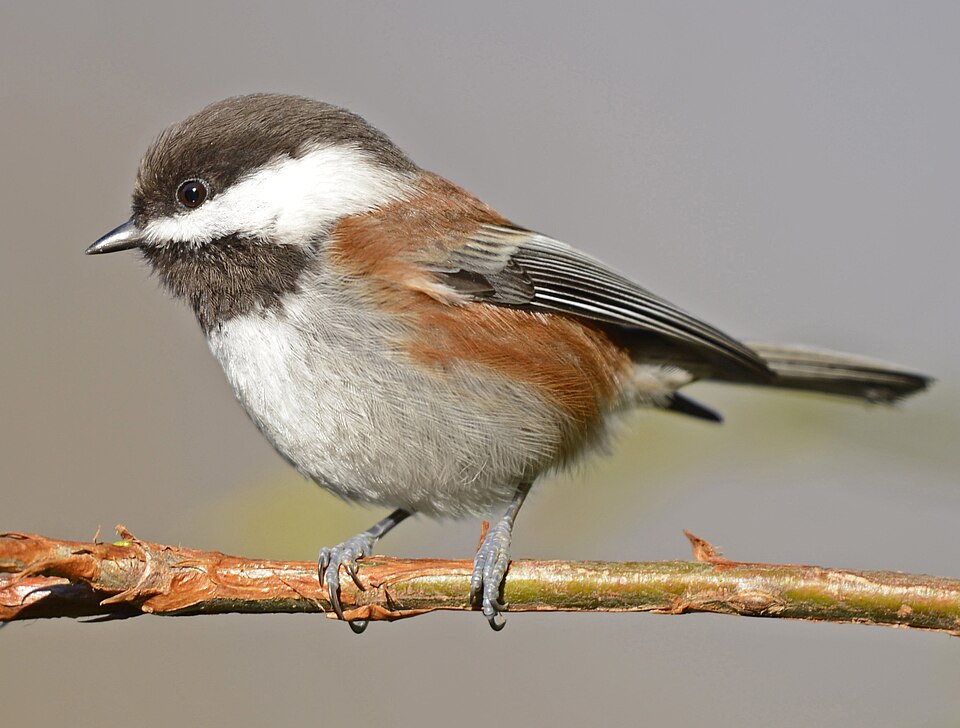
The Chestnut-backed Chickadee is the most colorful of North America's chickadees and a signature bird of the damp, evergreen forests along the Pacific coast. While its cousins wear muted grays, this little bird sports a warm, almost rusty chestnut back and flanks that glow against the dark conifers it calls home. It is a bundle of energy, working its way through Douglas-fir, hemlock, and redwood branches in mixed flocks, often hanging upside down to pick insects from needles and bark.
For anyone living from coastal Alaska down through Washington, Oregon, and into central California, this is one of the friendliest and most approachable backyard birds. It readily joins feeder traffic alongside other chickadees, nuthatches, and kinglets, and its high, fast, slightly buzzy calls are a constant soundtrack in the wet woods. Compact even by chickadee standards, it makes up in personality and color what it lacks in size.
This is a tiny, round-bodied songbird with the classic chickadee shape: a large head, short neck, stubby bill, and a relatively short tail. At a glance it reads as a chickadee, but the warm reddish-brown tones across the back and sides set it apart instantly from any other member of the family.
| Cap | Dark sooty-brown to blackish cap that extends down to the eye, giving a hooded look |
| Cheeks | Bright white cheek patches contrasting sharply with the dark cap and throat |
| Throat | Black bib on the chin and upper throat, like other chickadees |
| Back | Rich chestnut to rusty-brown back and shoulders - the standout field mark |
| Flanks | Chestnut or pinkish-rufous sides; intensity varies by region (brightest in the north) |
| Size | Smallest of the western chickadees, noticeably tiny and compact |
Male vs. female
Males and females look essentially identical in the field, both showing the same chestnut back, dark cap, white cheeks, and black bib. Males average very slightly larger, but this is not something you can reliably judge by eye. There is no seasonal plumage change, so a Chestnut-backed Chickadee looks the same year-round whether you see it in spring or midwinter.
Juveniles
Juveniles look much like adults but with softer, less crisply defined markings. The chestnut on the back and flanks tends to be duller and more washed-out, the black bib can appear slightly fuzzy or sooty rather than sharp, and the overall plumage has a looser, fresher texture. By their first fall, young birds are difficult to tell from adults in the field.
Unlike most chickadees, the Chestnut-backed Chickadee does not give the clear whistled fee-bee song that Black-capped and Mountain Chickadees are famous for. Instead, its vocal repertoire is dominated by calls. The signature sound is a fast, high, scratchy chick-a-dee that is thinner, faster, and more hoarse than the Black-capped's version - often rendered as a rapid tsick-a-zee-zee or buzzy seedy-seedy.
You'll also hear very high, thin tseet and see notes used as contact calls within foraging flocks, plus an excited buzzy scolding when a predator like an owl or hawk is spotted. The overall impression is hurried and wheezy, lacking the slow musical clarity of other chickadees.
The Chestnut-backed Chickadee is a strictly western bird with a range hugging the Pacific coast. It occurs from south-central and southeastern Alaska down through coastal British Columbia, western Washington, and Oregon, and along the California coast as far south as the Santa Cruz and Monterey areas. A separate population follows the moist forests inland through northern Idaho and western Montana.
It is largely a year-round resident and does not undertake true long-distance migration. Birds in the mountains and far north may drift to slightly lower elevations in winter, and flocks wander more widely outside the breeding season, but you can expect to find this species in the same coastal forests in every month of the year.
Like all chickadees, this species is an active, acrobatic forager that eats a mix of animal and plant food. During the breeding season the diet leans heavily on insects and spiders - caterpillars, beetles, wasps, leafhoppers, and the eggs and larvae of many small arthropods - which it gleans from conifer needles, twigs, and bark while hanging at every possible angle.
In fall and winter it shifts toward more seeds and plant matter, including conifer seeds and small fruits, and it readily visits feeders. Like other chickadees, it caches food, tucking individual seeds and insect bits into bark crevices and lichen to retrieve later when food is scarce.
Chestnut-backed Chickadees are cavity nesters. They use natural cavities, old woodpecker holes, and readily accept nest boxes, and the pair will often excavate or enlarge a hole in soft, rotting wood themselves. The nest is built low to fairly high in a tree and is lined with a soft cup of moss, fur, feathers, and plant down - frequently with a thick mat of mammal hair, which is characteristic of the family.
The female lays a clutch of typically 5 to 8 white eggs marked with fine reddish-brown spots. She does the incubating, which lasts roughly two weeks, while the male brings food. Both parents then feed the nestlings, which fledge after about 18 to 21 days in the nest.
Yes - within its Pacific coast range, this is a reliable and eager backyard visitor that takes well to feeders and nest boxes. If you live in the right region, a few simple steps will bring them in.
- Offer black-oil sunflower seeds and shelled peanuts in a tube or hopper feeder - their year-round favorites
- Put out suet, especially in fall and winter, which they relish for quick high-energy food
- Install a nest box with a small (about 1 1/8 inch) entrance hole mounted on a tree or post; they readily use them
- Keep conifers and native shrubs nearby - they prefer feeders with cover close by for quick retreats
- Provide a shallow bird bath or moving water source for drinking and bathing
- Avoid pesticides so the insects and spiders they need for feeding their young stay available
- Black-capped Chickadee: Gray back instead of chestnut, jet-black cap, and a clear whistled fee-bee song; overlaps in parts of the Northwest.
- Mountain Chickadee: Gray-backed with a distinctive white eyebrow stripe through the black cap; favors drier mountain conifer forests.
- Boreal Chickadee: Brown cap and brownish flanks but a gray-brown (not chestnut) back, and a much more northern, boreal range with little overlap.
- Bushtit: Similar tiny size and flocking habit but plain gray-brown overall, long tail, and no dark cap or chestnut color.
How do I tell a Chestnut-backed Chickadee from a Black-capped Chickadee?
The easiest mark is the back. A Chestnut-backed Chickadee has a warm rusty-brown back and flanks, while a Black-capped Chickadee is plain gray. The cap is also browner and the calls are faster and buzzier, lacking the Black-capped's clear whistled fee-bee song.
Where do Chestnut-backed Chickadees live?
They live along the Pacific coast in moist evergreen forests, from southern Alaska through British Columbia, Washington, Oregon, and coastal California, plus an inland population in northern Idaho and western Montana. They are year-round residents and do not truly migrate.
Will Chestnut-backed Chickadees come to bird feeders?
Yes. Within their range they are common, confident feeder birds. They especially like black-oil sunflower seeds, shelled peanuts, and suet, and they often visit in mixed flocks with nuthatches, kinglets, and other chickadees.
Do Chestnut-backed Chickadees use nest boxes?
They do. As cavity nesters they readily accept nest boxes with a small entrance hole of about 1 1/8 inches. Mount the box on a tree or post in or near conifers, and add a bit of wood shavings inside to encourage them.
Why does this chickadee have a reddish back when others are gray?
The rich chestnut coloring is simply this species' distinctive plumage, and it is the only North American chickadee with a rusty back and flanks. The warm tones blend surprisingly well with the reddish bark and lichen of the wet coastal forests where it lives.