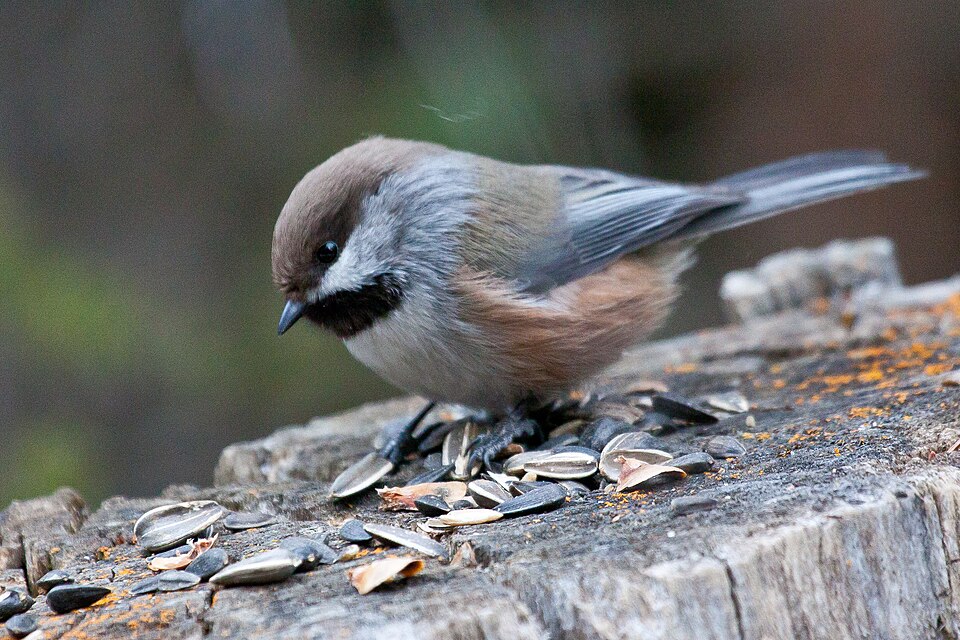
The Boreal Chickadee is the chickadee of the far north, a small, brown-toned songbird that spends its life in the dense conifer forests stretching across Canada and Alaska. Where the familiar Black-capped Chickadee is a bird of backyards and woodlots, the Boreal Chickadee keeps to spruce and fir country, often well away from people. It is a hardy little bird, staying put through brutal northern winters by caching food and fluffing its dense plumage against the cold. For many birders, finding one means a trip into the boreal forest or a winter wait near the southern edge of its range.
Once known by the charming old name "brown-capped chickadee," this species trades the crisp black-and-white look of its relatives for warmer, softer colors that blend into the shadowy interior of evergreen woods. It is more often heard than seen, giving a slow, wheezy, almost lazy version of the classic chickadee call from somewhere deep in the spruces. Patient birders who learn that voice have a far better chance of tracking one down.
This is a small, round-bodied, big-headed chickadee with the typical short bill and longish tail of its family. In silhouette it looks much like any other chickadee, so color and voice are the keys. Overall it appears warm and dusky rather than clean and contrasty, with brown tones replacing the black-and-gray crispness of more familiar species.
| Cap | Dull grayish-brown (not glossy black), extending down the nape |
| Bib | Small black throat patch, less crisp than a Black-capped Chickadee's |
| Cheeks | White face that grays toward the back, lacking bright clean white |
| Flanks | Rich rusty-brown wash along the sides, a key field mark |
| Back | Soft grayish-brown, with no bold white edging in the wings |
| Overall tone | Warm and muted brown rather than black, white, and gray |
Male vs. female
Males and females look alike in the field. There is no plumage difference a birder can reliably use, and the sexes are essentially identical in size and color. Behavior during the breeding season, such as a male singing or a female on the nest, is usually the only practical clue to which bird is which.
Juveniles
Juveniles closely resemble adults but look slightly softer and fluffier, with a duller, less defined cap and somewhat looser plumage overall. By the end of their first summer and fall they have molted into adult-like feathering, so by winter young birds are essentially impossible to separate from adults in the field.
The Boreal Chickadee does not have a clear whistled song like the Black-capped Chickadee's "fee-bee." Instead, its signature sound is a husky, nasal, drawled call often written as tsik-a-day-day or chick-a-zee-zee. Compared with other chickadees, the notes are slower, wheezier, and more buzzy, as if the bird is too cold to put much effort into it. Many birders describe the quality as lazy or sleepy.
You may also hear thin, high see notes and a variety of soft gargles and chatters as birds move through the canopy. Because the bird is often hidden in dense conifers, learning that distinctive drawn-out, raspy call is by far the most reliable way to detect it.
The Boreal Chickadee is a year-round resident of the boreal forest, the great band of spruce, fir, and tamarack that runs across Alaska and Canada and dips into the northern United States in parts of New England, the upper Great Lakes, and the northern Rockies. It is a permanent fixture of these northern woods and does not undertake a true seasonal migration.
In most winters birds simply stay near where they bred. Occasionally, however, when northern food supplies run low, small numbers push farther south in what birders call an irruption. In those years a lucky observer in southern New England, New York, or the upper Midwest might turn one up at the edge of its normal range, though such southward appearances are unpredictable and never guaranteed.
Boreal Chickadees feed heavily on insects and spiders during the warmer months, gleaning caterpillars, insect eggs, and other small invertebrates from spruce and fir needles and bark. They forage actively through the conifers, often hanging upside down at the tips of branches to probe clusters of needles, and they will hover briefly to snatch prey from foliage.
In winter the diet shifts toward conifer seeds along with stored food. Like other chickadees, this species is an industrious food-cacher, tucking seeds and insect prey into bark crevices and lichen during times of plenty and relying on those hidden stores to survive the long northern cold. That caching habit, combined with their dense insulating plumage, lets them endure winters that would kill most small birds.
Boreal Chickadees are cavity nesters. They will use natural cavities and old woodpecker holes, but they are also capable of excavating or enlarging their own cavity in soft, rotting wood, typically in a dead spruce, fir, birch, or other tree at low to moderate height. The female does much of the cavity work and lines the nest with soft material such as moss, fur, feathers, and plant down.
A typical clutch is several eggs, white and finely speckled with reddish-brown, and the female does the incubating while the male brings food to her. After hatching, both parents feed the young. Pairs generally raise a single brood per season in the short northern summer, with the family group sometimes staying loosely together into late summer and fall.
For most people the Boreal Chickadee is not a backyard bird. It lives in remote northern conifer forests, rarely near homes, so it is far more of a "go find it" species than a "wait at the feeder" one. That said, there are still ways to improve your odds.
- If you live within or near the boreal forest, feeders with sunflower seeds and suet near spruce or fir cover give you the best chance, especially in winter.
- Spend time in mature spruce-fir forest and listen for the slow, husky tsik-a-day-day call rather than scanning for the bird itself.
- Watch mixed winter flocks of Black-capped Chickadees, kinglets, and nuthatches in northern woods; Boreal Chickadees sometimes travel with them.
- In irruption winters, check feeders and conifer stands at the southern edge of the range, where wandering birds occasionally turn up.
- Keep dead and dying conifers standing where safe; the soft wood provides the nesting cavities this species depends on.
- Black-capped Chickadee: Has a glossy black cap, clean white cheeks, and gray (not rusty-brown) flanks; gives a clear whistled fee-bee and a crisp chick-a-dee-dee-dee.
- Mountain Chickadee: Gray and white with a black cap broken by a bold white eyebrow stripe; a western mountain bird that lacks the warm brown tones of the Boreal.
- Chestnut-backed Chickadee: Also brown-toned but has a bright chestnut back and a dark brown cap; ranges along the Pacific Northwest coast rather than the interior boreal forest.
- Gray-headed Chickadee: A rare far-northern bird with a longer white cheek patch and grayer, less rusty flanks; ranges into Alaska but is extremely hard to find.
How do I tell a Boreal Chickadee from a Black-capped Chickadee?
Look at color and listen to the voice. The Boreal Chickadee has a dull grayish-brown cap, grayish cheeks, and rusty-brown flanks, giving it a warm, muddy look. The Black-capped Chickadee is crisper, with a glossy black cap, bright white cheeks, and gray flanks. The Boreal's call is a slow, husky tsik-a-day-day, while the Black-capped gives a clearer chick-a-dee-dee and a whistled fee-bee song.
Where can I see a Boreal Chickadee?
They live year-round in the boreal forest of Alaska and Canada, dipping into parts of northern New England, the upper Great Lakes, and the northern Rockies. Look in mature spruce and fir forest. They rarely come to typical suburban yards, so most birders find them by visiting conifer country and listening for the call.
Do Boreal Chickadees come to bird feeders?
Sometimes, but only if you live within or near their northern forest range. Feeders with sunflower seeds and suet placed near spruce or fir cover can attract them, especially in winter. For people outside the boreal zone, they are essentially a bird you have to travel to find rather than one that visits the yard.
Why is it sometimes called the brown-capped chickadee?
That was an older common name reflecting its most obvious feature: a brown cap instead of the black cap of most chickadees. The name fell out of formal use, but it remains a handy reminder of how to separate this species from its black-capped relatives in the field.
Do Boreal Chickadees migrate?
Not in the usual sense. They are permanent residents that tough out northern winters by caching food and relying on dense, insulating plumage. In some years, when food is scarce, small numbers wander south in irregular movements called irruptions, which is when birders south of the normal range occasionally find one.