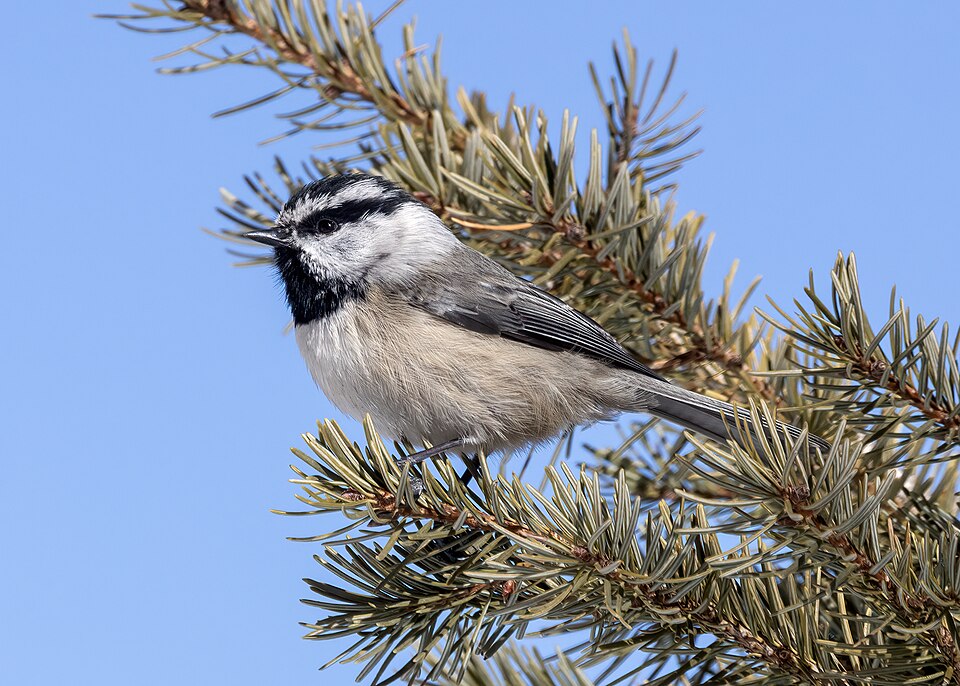
The Mountain Chickadee is the cheerful little gray-and-white bird that greets hikers throughout the conifer forests of the American West. From the ponderosa pines of the Rockies to the lodgepole and fir of the Sierra Nevada and Cascades, this is the chickadee you are most likely to meet at elevation. It is tame, busy, and endlessly curious, often working through the branches just overhead while it scolds, gleans insects, and stashes seeds for leaner days.
What makes it instantly recognizable among North America's chickadees is the crisp white eyebrow stripe slashing across its otherwise black cap. No other widespread chickadee wears this mark, and once you learn it, you will never confuse a Mountain Chickadee for anything else. A hardy resident of cold, high country, it survives brutal winters by caching thousands of food items and remembering where it hid them, a feat of memory that has made this unassuming bird a favorite subject of cognitive research.
This is a small, round-bodied songbird with a short bill, a relatively long tail, and the typical hyperactive chickadee posture, often hanging upside down to inspect a needle cluster. At a glance it looks like a plain gray chickadee, but the head pattern is the key to a confident identification.
| White eyebrow | A bold white supercilium (eyebrow stripe) cuts through the black cap, the single best field mark and unique among common chickadees. |
| Head pattern | Black cap and black bib separated by white cheeks; the cap looks divided by the white brow. |
| Body color | Soft gray above, paler gray to grayish-white below, with little to no buff or rufous on the flanks. |
| Bill and size | Small black bill on a compact, sparrow-sized body roughly 5-6 inches long. |
| Wings and tail | Plain gray wings without strong wing bars; longish gray tail flicked constantly while foraging. |
Male vs. female
Male and female Mountain Chickadees look alike and cannot be reliably separated in the field by plumage. Both sexes show the same black cap, white eyebrow, black bib, and gray body. Males average very slightly larger and tend to sing more, but size overlap makes this useless for identification in the wild. In the hand, breeding females develop a bare brood patch on the belly, the only consistent way to sex them.
Juveniles
Juveniles look much like adults but appear softer and slightly duller, with the black areas of the head a bit sootier and less crisp, and the white eyebrow sometimes faint or smudged in very young birds. By late summer, after the post-juvenile molt, young Mountain Chickadees are essentially indistinguishable from adults, showing the clean white brow that defines the species.
The song is a clear, whistled series of three to four notes that drop in pitch, often written as fee-bee-bee or fee-bee-bay. Compared with the simpler two-note whistle of the Black-capped Chickadee, the Mountain Chickadee's song is usually longer, more hoarse or buzzy, and frequently includes that extra descending note.
Its calls are even more familiar to mountain visitors. The namesake chick-a-dee-dee-dee is huskier and more nasal than other chickadees, often described as raspy or wheezy. Birds keep up a constant scratchy tsick-a-zee-zee as they move through the canopy, and the number of dee notes increases when they are agitated or mobbing a predator.
The Mountain Chickadee is a year-round resident of montane coniferous forests across western North America, from the southern interior of British Columbia and Alberta south through the Rocky Mountains, Great Basin ranges, Sierra Nevada, and Cascades into the highlands of the American Southwest and northern Baja California. It favors pine, fir, spruce, and pinyon-juniper woodlands at middle to high elevations.
Most birds are non-migratory, but they undertake altitudinal movements: in harsh winters many drift downslope to lower valleys, foothills, and even desert edges, sometimes appearing well outside breeding habitat. In occasional irruption years, larger numbers wander to the lowlands when high-country food is scarce, briefly bringing them to feeders far from the mountains.
Mountain Chickadees eat a mix of insects and plant material that shifts with the seasons. Through spring and summer they hunt caterpillars, beetles, spiders, aphids, and other small arthropods, along with insect eggs and larvae gleaned from needles, bark crevices, and twig tips. These protein-rich invertebrates are especially important for feeding nestlings.
In fall and winter the diet leans heavily on conifer seeds, supplemented by other seeds and nuts. Like other chickadees, this species is an avid food-cacher, hiding individual seeds and insects in bark and lichen and relying on remarkable spatial memory to recover them through the cold months. Birds in colder, snowier mountains have been shown to cache more and remember locations better, a striking example of how environment shapes brain and behavior.
Mountain Chickadees are cavity nesters. They use natural tree hollows, old woodpecker holes, and readily accept nest boxes, sometimes excavating or enlarging soft, rotten wood themselves. The female builds the nest inside the cavity, lining it with fur, hair, moss, feathers, and plant down to form a warm cup well insulated against mountain cold.
A typical clutch is about 5 to 9 white eggs, usually lightly speckled with reddish-brown, though some are unmarked. The female does almost all of the incubation over roughly two weeks while the male brings her food, and both parents then feed the nestlings until they fledge a few weeks later. Most pairs raise one brood per year, occasionally attempting a second in favorable conditions.
If you live in or near western mountains, the Mountain Chickadee is a willing and entertaining feeder visitor. It is bold around people and quick to investigate new food sources, often becoming a year-round regular once it discovers a reliable yard.
- Offer black-oil sunflower seeds, which are the top draw; chickadees grab one seed, fly off to hammer or cache it, then return for another.
- Put out suet and peanut pieces in winter for high-energy fat and protein, especially valuable in cold mountain climates.
- Use tube or hopper feeders with perches; chickadees are agile and happily cling while larger birds dominate trays.
- Mount a nest box with a roughly 1 1/8 inch entrance hole on a tree trunk in or near conifers to invite a breeding pair.
- Provide a clean water source such as a heated birdbath, which can be a magnet in freezing high-country winters.
- Keep conifers and snags on your property when possible, since they supply natural food, cover, and nesting cavities.
- Black-capped Chickadee: Lacks the white eyebrow, has buffier flanks, and gives a clearer, less raspy chick-a-dee call; ranges overlap mainly at lower or northern edges.
- Mexican Chickadee: No white eyebrow and shows an extensive black bib and gray flanks; found only in a tiny U.S. range in southeastern Arizona and southwestern New Mexico.
- Chestnut-backed Chickadee: Easily told by its rich chestnut back and flanks and dark brown cap; prefers wetter coastal and lower-elevation forests.
- Boreal Chickadee: Has a brown cap, brown-washed flanks, and no white brow; a bird of northern spruce forests with little range overlap in the West.
How do I tell a Mountain Chickadee from a Black-capped Chickadee?
Look at the head. The Mountain Chickadee has a bold white eyebrow stripe slicing through its black cap, while the Black-capped Chickadee has a solid black cap with no eyebrow. Mountain Chickadees are also grayer overall with less buff on the flanks, and their calls sound huskier and more nasal.
Where do Mountain Chickadees live?
They are year-round residents of coniferous mountain forests across western North America, from British Columbia and the Rockies through the Great Basin, Sierra Nevada, Cascades, and the Southwest. They favor pine, fir, spruce, and pinyon-juniper at middle to high elevations.
Do Mountain Chickadees come to bird feeders?
Yes. In or near their mountain range they readily visit feeders, especially for black-oil sunflower seeds, suet, and peanuts. They are tame and curious, often grabbing one seed at a time and caching it nearby before returning for more.
What does a Mountain Chickadee sound like?
Its song is a clear, whistled, descending fee-bee-bee, and its call is a husky, raspy chick-a-dee-dee-dee that sounds wheezier than other chickadees. The number of dee notes increases when the bird is alarmed or mobbing a predator.
Will Mountain Chickadees use a nest box?
They will. As cavity nesters they readily accept nest boxes with an entrance hole around 1 1/8 inches, especially when mounted on or near conifers. The female lines the cavity with fur and plant down and typically lays 5 to 9 eggs.