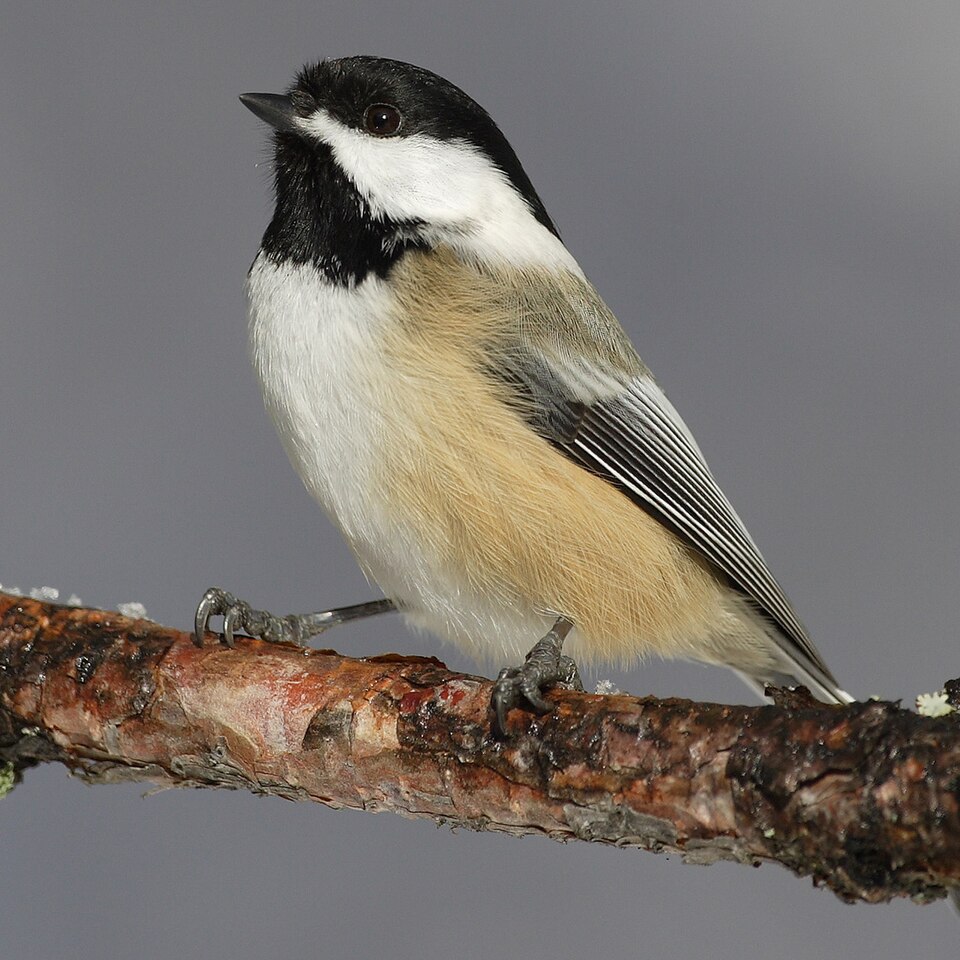
Few birds win over backyard birders as quickly as the Black-capped Chickadee. Tiny, round, and almost absurdly tame, it is often the first species to discover a new feeder and the boldest about using it, sometimes snatching a sunflower seed from a patient hand. Its trademark black cap and bib, white cheeks, and buffy sides make it instantly recognizable across the northern half of the continent, and its cheerful chickadee-dee-dee call gives the whole family its name.
Beyond its charm, this is a remarkable little survivor. Black-capped Chickadees stay put through brutal northern winters, dropping their body temperature at night to save energy and relying on hundreds of food items they cached weeks earlier. They are also the social glue of the winter woods: in the cold months they form roving flocks that other species, from nuthatches to kinglets to downy woodpeckers, follow for safety. Learn the chickadee's alarm calls and you start to hear the whole forest differently.
The Black-capped Chickadee is a very small, large-headed, short-necked songbird with a long, narrow tail and a tiny stubby bill. Its plump, fluffed-up silhouette and constant restless movement, hopping, hanging upside down, and flitting between branches, are as good a clue as any single field mark.
| Cap and bib | Solid glossy black cap extends down to the eye, plus a neat black throat patch (bib). |
| Cheeks | Crisp white cheeks separating the black cap from the black bib, giving a clean two-toned face. |
| Underparts | Whitish below with warm buff washing the flanks and sides. |
| Wings | Gray wings with pale, frosty edges to the wing feathers (especially the greater coverts and flight feathers), forming a soft whitish wing panel. |
| Back and tail | Soft gray above with a long-ish gray tail. |
| Bill and size | Very short black bill; overall a tiny, round, big-headed bird about the size of a kinglet. |
Male vs. female
Males and females look essentially identical in the field; the sexes cannot be reliably told apart by plumage. Males average very slightly larger with a marginally larger bib, but this overlaps so much it is not useful for everyday identification. In the breeding season, behavior is your best clue, the singing bird defending territory is usually the male, and only the female develops a brood patch and does the incubating.
Juveniles
Juvenile Black-capped Chickadees look much like adults soon after fledging, with the same black cap, white cheeks, and dark bib, so they are hard to age in the field. Freshly fledged young can appear slightly fluffier and looser-feathered, with a duller, sootier black cap and bib and softer body plumage. They beg with quivering wings and a high begging call, and by late summer they molt into adult-like plumage and are essentially indistinguishable from their parents.
The bird is named for its call: a bright, scolding chick-a-dee-dee-dee. This call is surprisingly sophisticated, the number of dee notes tacked on the end signals the level of threat, with more dees meaning a more dangerous nearby predator. Other birds eavesdrop on this code, which is part of why so many species flock with chickadees in winter.
The song is different and easy to learn: a clear, sweet, whistled fee-bee (sometimes written hey-sweetie), with the first note higher than the second. You will hear it most on late-winter and early-spring mornings as males begin defending territory. Chickadees also give soft tsee-deet contact notes, a fast scolding dee-dee-dee when mobbing an owl or hawk, and various gargles during squabbles within the flock.
Black-capped Chickadees are year-round residents across a broad northern band of North America, from Alaska and most of Canada south through the northern two-thirds of the United States, roughly from the Pacific Northwest across the northern Plains and Great Lakes to New England and the northern Appalachians. They generally do not migrate, holding the same home range through the seasons.
In some years, however, northern populations stage irregular fall and winter movements called irruptions, pushing somewhat farther south when food is scarce or numbers are high. Along the southern edge of their range they meet the very similar Carolina Chickadee, and the two hybridize in a narrow contact zone that shifts slightly over time.
Black-capped Chickadees are omnivores with a strongly seasonal diet. In the warmer months they are voracious insectivores, gleaning caterpillars, spiders, insect eggs, and other small invertebrates from twigs, buds, and the undersides of leaves, often while hanging acrobatically upside down. This insect protein is especially important for feeding nestlings. In fall and winter they shift toward seeds, berries, and other plant matter, supplemented by any invertebrates and dormant insect eggs they can find.
They are famous food-cachers, hiding thousands of individual seeds and insects in bark crevices, under lichen, and among conifer needles, then relying on an extraordinary spatial memory to relocate them later. Their brain even grows new memory neurons in fall to help track all those hiding spots. At feeders, watch how they grab a single sunflower seed and fly off to wedge it in bark and hammer it open, rather than lingering to eat in place.
Black-capped Chickadees are cavity nesters. They favor soft, rotten wood and will excavate their own hole in a dead snag or branch, often a birch or other decaying stub, with both members of the pair chipping out wood and carrying the chips away to hide the site. They also use abandoned woodpecker holes, natural cavities, and readily take to nest boxes. The female builds the cup inside, using moss as a foundation topped with soft material such as animal fur, plant down, and feathers.
The female lays a clutch of roughly six to eight tiny white eggs marked with fine reddish-brown speckles, and she alone incubates them for about two weeks while the male brings her food. Both parents then feed the nestlings a steady supply of caterpillars and other insects until the young fledge after roughly another 16 days. Pairs typically raise a single brood per year.
The Black-capped Chickadee is one of the easiest and most rewarding feeder birds to attract, and it is often the first to arrive at a new setup. A little patience can even coax them to feed from your hand.
- Offer black-oil sunflower seeds, their clear favorite, along with hulled sunflower hearts, peanuts, and peanut butter blends.
- Put out suet, especially in cold weather; chickadees cling readily to suet cages for high-energy fat.
- Use tube feeders, hopper feeders, or small platform feeders, they are agile and unfussy about feeder style.
- Provide nest boxes with a 1 1/8 inch entrance hole and a few inches of wood shavings inside; leave dead snags standing where safe, since they like to excavate soft, rotting wood.
- Add a water source such as a birdbath, ideally heated in winter, for drinking and bathing.
- Plant native trees and shrubs (birches, oaks, and berry producers) and skip pesticides so caterpillars and other insects remain available for nestlings.
- Carolina Chickadee: Nearly identical but slightly smaller with a faster, four-note song; ranges mostly south of the Black-capped, with less frosty white edging on the wing and a tidier-edged bib. Range is often the best clue.
- Mountain Chickadee: Has a bold white eyebrow stripe through the black cap, which the Black-capped lacks; a western mountain bird of coniferous forests.
- Boreal Chickadee: Has a brown cap (not black), browner flanks, and grayer cheeks; a bird of far-northern boreal spruce-fir forest with a wheezier call.
- Tufted Titmouse: A close relative in the same family but larger, all gray, and crested, with a black forehead and rusty flanks rather than a black cap and bib.
What is the difference between a Black-capped Chickadee and a Carolina Chickadee?
They look almost the same, and range is your most reliable clue: Black-capped occupies the northern U.S. and Canada, Carolina the southeastern U.S. Black-capped is slightly larger with more frosty white edging on the wing feathers and a less crisp lower border to its black bib. By voice, Black-capped sings a two-note fee-bee whistle while Carolina typically sings a faster four-note song. Where their ranges meet they hybridize, making some individuals impossible to identify with certainty.
Do Black-capped Chickadees migrate or stay all winter?
They are year-round residents and generally do not migrate, toughing out cold northern winters in the same area where they breed. To survive, they cache food, fluff up for insulation, roost in cavities, and lower their body temperature at night to conserve energy. In some years northern birds make irregular southward movements called irruptions when food is short.
How do I get a chickadee to eat from my hand?
Chickadees are among the most likely birds to hand-feed. Start by reliably stocking a feeder with black-oil sunflower seeds so the birds know your yard. Then stand quietly near the feeder, with the feeder empty and sunflower seeds in your open palm, holding still for long stretches over several days. Once a bold individual takes the risk, others often follow. Patience and stillness matter far more than any trick.
What do Black-capped Chickadees eat?
Their diet shifts with the seasons. In spring and summer they eat mostly insects and spiders, including caterpillars, which are crucial for feeding nestlings. In fall and winter they rely more on seeds and berries. At feeders they love black-oil sunflower seeds, sunflower hearts, peanuts, and suet, usually grabbing one seed at a time and flying off to open or cache it.
Will chickadees use a nest box?
Yes. Black-capped Chickadees readily accept nest boxes with about a 1 1/8 inch entrance hole. They like a few inches of wood shavings or sawdust inside, which mimics the soft, rotten wood they would otherwise excavate themselves. Mount the box in a quiet spot, and leaving dead snags standing nearby also gives them natural cavity options.