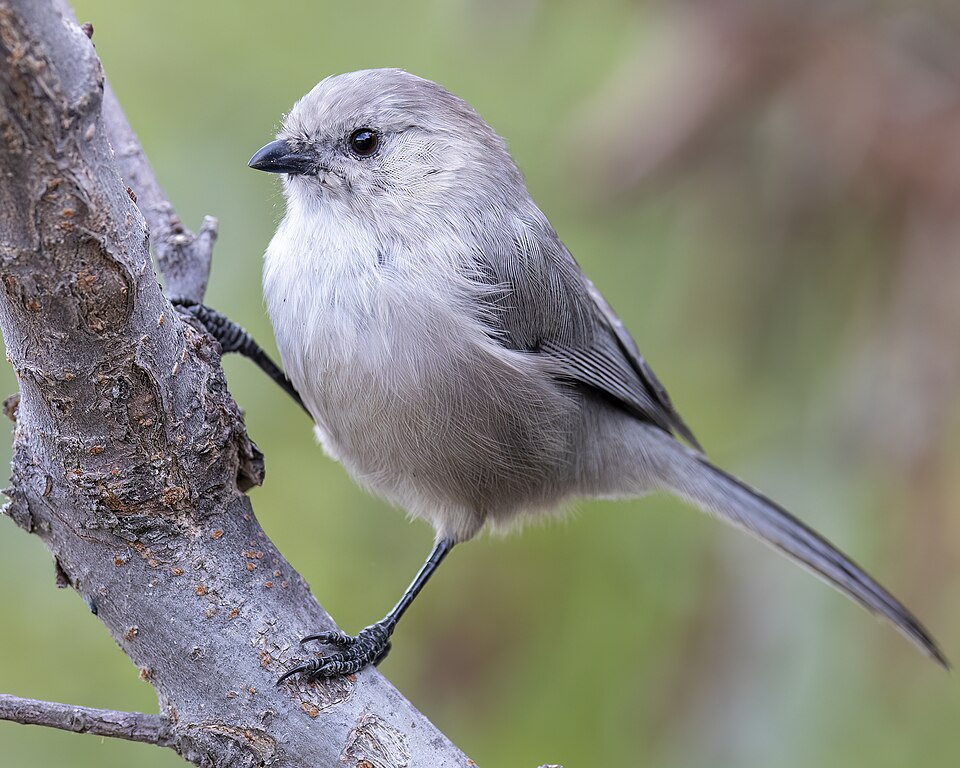
The Bushtit is one of the smallest songbirds in North America, a plump, long-tailed scrap of soft gray that weighs little more than a nickel. What it lacks in size and color it makes up for in personality: Bushtits are almost never alone. Outside the breeding season they travel in restless, chattering flocks of a dozen to forty birds, pouring through shrubs and small trees in a loose conga line, each bird flicking from twig to twig before the whole troupe flutters on to the next bush. Birders often hear the gentle, twittering contact notes long before they spot the gray confetti drifting through the foliage.
This is a bird of the American West, found from southern British Columbia down through the Pacific states, the Great Basin, the Southwest, and well into Mexico and Central America. It thrives in oak woodland, chaparral, pinyon-juniper, riparian thickets, and increasingly in suburban yards with dense shrubbery. Bushtits matter to gardeners because they are voracious, acrobatic insect-eaters that comb leaves and bark for aphids, scale, and tiny caterpillars. They are also famous for one of the most remarkable nests of any North American songbird: a hanging, sock-like pouch woven from spiderweb, lichen, and plant down.
Think tiny, round, and long-tailed. A Bushtit is a fluffy gray ball barely larger than a hummingbird's body, with a stubby triangular bill, a comparatively long tail it often holds cocked, and a plain, almost featureless plumage that makes the bird's shape and behavior more useful for ID than any single mark.
| Size | Smaller than a chickadee; one of North America's tiniest songbirds at under 4 inches and roughly 5-6 grams. |
| Overall color | Drab gray to gray-brown above, paler dingy gray below, with no wing bars, streaks, or bold patterns. |
| Head | Coastal Pacific birds show a warm brownish-tan cap; interior and Southwest birds tend to have a grayer crown and a browner ear patch (the former 'lead-backed' type). |
| Bill | Very short, stubby, and dark, a tiny triangular point well suited to picking small insects. |
| Tail | Long for the body size and frequently held up or flicked, exaggerating the bird's lollipop shape. |
| Eye | Adult females have pale yellow or whitish eyes; adult males and juveniles have dark eyes, a handy close-range field mark. |
Male vs. female
Males and females look nearly identical in plumage, but there is one reliable giveaway at close range: eye color. Adult female Bushtits have pale, creamy-yellow to whitish irises that can look startlingly bright against the gray face, while adult males have dark, almost black eyes. This is one of the few small songbirds where a quick look at the eye sexes the bird in the field. Otherwise both sexes share the same plain gray body, short bill, and long tail.
Juveniles
Juvenile Bushtits look much like the adults, small, gray, and long-tailed, but are even softer and fluffier in appearance just after fledging. Both young males and young females start life with dark eyes, so a pale-eyed bird is reliably an adult female; females acquire the pale iris as they mature. Some young birds in the Southwest interior also show a slightly more contrasting dark mask through the eye. Begging juveniles travel with the family group and add a stream of high, insistent twitters to the flock's chatter.
Bushtits don't really sing in the way a sparrow or warbler does; their vocal life is built around constant, soft contact calls that keep the flock together as it moves. The typical sound is a thin, high tsit tsit or pit, often run together into a light, twittering jumble, an almost continuous, tinkling chatter that seems to come from all directions when a flock is feeding.
The most distinctive vocalization is a sharp, trilled alarm note, sometimes described as a quavering tsi-tsi-tsi-tsi or a high, insect-like trill. When a hawk or other predator passes over, the whole flock may freeze and give this shrill, confusing trill in unison, a sound that is hard to pinpoint and seems to throw predators off the trail. Learn the gentle twitter and you will start detecting Bushtit flocks you would otherwise walk right past.
The Bushtit is a year-round resident across most of its range and does not undertake true long-distance migration. It is found from southwestern British Columbia south through Washington, Oregon, and California, eastward across the Great Basin and Rocky Mountain foothills, through the Southwest and Texas hill country, and on into much of Mexico and Guatemala. Coastal populations tend to be browner-capped, while interior and southwestern birds are grayer overall.
Rather than migrating, Bushtits make seasonal and altitudinal movements: birds breeding higher in the mountains often drift downslope in winter, and flocks wander widely in search of food once the breeding season ends. The species has also expanded into suburban and urban gardens where shrub plantings provide cover and insect prey, so it can turn up reliably in many western backyards.
Bushtits are overwhelmingly insectivores, and they are tireless ones. They glean small arthropods from leaves, twigs, and bark, aphids, scale insects, leafhoppers, tiny caterpillars, beetles, spiders, and insect eggs, often hanging upside down chickadee-style to reach the undersides of foliage. Their constant, methodical picking through shrubbery makes them genuinely useful natural pest control in gardens and orchards.
They feed as a coordinated flock, spreading through a bush and working it thoroughly before moving on together. In fall and winter they will also take some small fruits and seeds, and they readily visit suet, suet-dough, peanut butter blends, and sometimes finely chopped nuts at feeders. Because they are so small, they often cling several at a time to a suet cake, a charming sight when a whole flock descends at once.
The Bushtit builds one of the most extraordinary nests of any North American bird: a soft, hanging pouch shaped like a long sock or gourd, sometimes a foot in length, suspended from a branch in a shrub or small tree. Both members of the pair build it over many days, weaving together spider silk, moss, lichen, leaves, and plant down into a stretchy, insulating bag with a small entrance hole near the top that leads down into a cozy chamber. The web-and-lichen construction lets the nest expand as the chicks grow.
Females lay roughly 5 to 7 tiny white eggs, and both parents incubate, unusually, the pair often roosts together inside the nest at night. Bushtits are also notable for cooperative breeding: extra adult helpers, often related males, sometimes assist a pair in feeding the young. Pairs frequently raise two broods in a season, and the warm, sheltered pouch may be used for roosting even outside the nesting period.
Yes, Bushtits are very much a backyard bird across the West, and with the right setup a roving flock will become a regular visitor. They come for two things above all: dense shrubby cover and food, both insect prey and high-energy feeder offerings.
- Offer suet, suet-dough, or peanut-butter blends, Bushtits love them and will cling several at a time to a suet cage.
- Plant dense native shrubs and small trees (oak, manzanita, ceanothus, willow) to provide foraging cover and nesting sites.
- Avoid pesticides. Bushtits eat aphids, scale, and tiny caterpillars, so a chemical-free yard keeps their food supply intact and lets them do your pest control for you.
- Provide a shallow, gently moving water source such as a birdbath with a dripper, small birds are drawn to the sound and the shallow edge.
- Be patient and watch in fall and winter, when Bushtits roam in flocks; if one bird finds your feeder, the whole troupe usually follows within minutes.
- Skip seed-only feeders for them, Bushtits rarely take large seeds, so focus on suet and protein-rich offerings.
- Verdin: Also a tiny desert songbird, but Verdins have a bright yellow head and a chestnut shoulder patch, lack the long flicking tail, and are far less flocking than Bushtits.
- Ruby-crowned Kinglet: Similar size and restless feeding, but kinglets show bold white wing bars, a broken white eye-ring, and constant wing-flicking, Bushtits are plain gray with no wing bars.
- Blue-gray Gnatcatcher: Shares the long tail and tiny size but is bluer-gray above with a white eye-ring and a long black-and-white tail it often cocks; gnatcatchers are slimmer and more sharply marked.
- Mountain Chickadee: Travels in similar winter flocks and gleans the same way, but chickadees are larger with a bold black cap, white eyebrow, and black bib, nothing like the Bushtit's plain face.
What is the smallest songbird in my western backyard?
If it's a tiny, plain gray bird with a long tail traveling in a chattering flock, it's almost certainly a Bushtit. At under 4 inches and about 5-6 grams, it's one of the smallest songbirds in North America, smaller even than a chickadee or kinglet.
Why do Bushtits travel in flocks?
Outside the breeding season Bushtits move in flocks of roughly 10 to 40 birds for safety and foraging efficiency. More eyes spot predators sooner, and the flock can comb a bush thoroughly together. They keep in touch with constant soft twittering contact calls.
How can I tell a male Bushtit from a female?
Check the eye color. Adult females have pale yellow or whitish irises, while adult males have dark eyes. Their gray plumage is otherwise identical, so the eye is the most reliable field mark at close range.
What does a Bushtit nest look like?
It's a remarkable hanging pouch, a soft, sock- or gourd-shaped bag up to about a foot long, woven from spiderweb, lichen, moss, and plant down and suspended from a branch. The entrance is a small hole near the top. Both parents build it and often sleep inside together.
How do I attract Bushtits to my feeder?
Offer suet, suet-dough, or peanut-butter blends rather than seed, plant dense native shrubs for cover, provide shallow moving water, and avoid pesticides so insect prey stays available. Once one bird finds your suet, the whole flock usually follows.