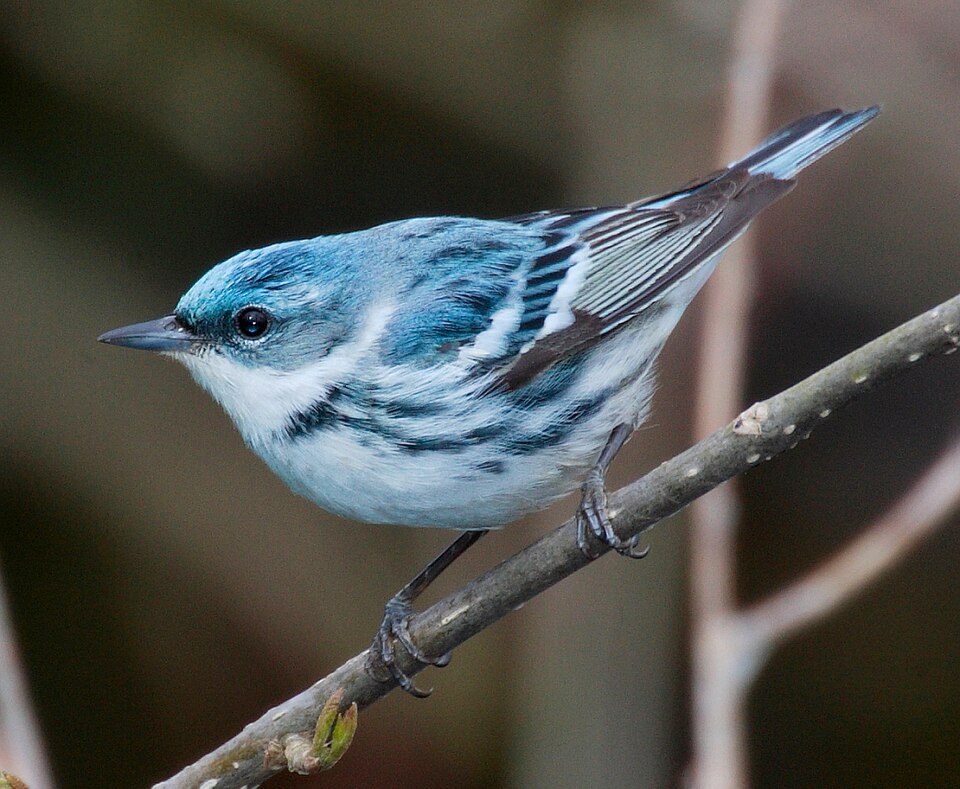
The Cerulean Warbler is the kind of bird that makes a seasoned birder's neck ache. A male is the color of a clear morning sky, a soft, glowing blue you rarely see on any North American songbird, and he spends nearly all his time at the very tops of tall trees, singing down at you. Small even by warbler standards, he is a chunk of canopy turned to feathers, and finding one is often a matter of patience, a good ear, and a willingness to crane upward until something gives.
Beyond its beauty, the Cerulean Warbler carries a heavier story. It is one of the fastest-declining songbirds in eastern North America, a bird whose fortunes are tied to large, unbroken tracts of mature deciduous forest on its breeding grounds and to threatened mountain forests on its wintering grounds in the northern Andes. Birders treasure it not only for its color but because every sighting feels a little precious, a reminder of what intact forests still hold, and what we stand to lose.
This is a small, compact, short-tailed warbler with a relatively thin, pointed bill and a habit of staying high in the canopy. Its silhouette is rounder and stubbier than many warblers, and its movements are quick and businesslike as it forages along outer branches. Color is the giveaway when you can see it well, but a high, buzzy song usually announces the bird long before you spot it.
| Male color | Bright sky-blue above, clean white below, with a distinct dark blue-black band across the upper breast |
| Wing bars | Two bold white wing bars on both sexes, a reliable mark even in poor light |
| Streaking | Male shows blue-black streaks down the sides of the flanks below the breast band |
| Female & immature | Blue-green to turquoise-tinged above, pale yellowish-white below, with a pale eyebrow stripe |
| Shape | Small and stocky with a notably short tail, often appearing front-heavy |
| Underparts | White to creamy below with no breast band in females; males have the clean white throat and that crisp dark necklace |
Male vs. female
Males and females look clearly different. The breeding male is unmistakable when seen well: vivid cerulean blue upperparts, a snowy white throat and belly, a dark blue-black band crossing the upper breast like a necklace, and blue-black streaks along the sides. The female is altogether softer, washed in blue-green or turquoise above rather than pure blue, with pale yellowish or buffy-white underparts, no dark breast band, and a distinct pale eyebrow (supercilium) that males show only faintly. Both sexes share the two white wing bars, which is a handy anchor when a backlit female has you guessing.
Juveniles
Immature and first-fall birds resemble the female but are even greener and more washed-out, often showing more yellow on the face and underparts and a stronger greenish tone to the back. Young males begin to show hints of blue, especially on the crown and rump, but lack the crisp breast band of an adult male. The white wing bars and pale eyebrow remain the most dependable field marks on these tricky autumn birds, which can be confused with several other young warblers in fall migration.
The male's song is the best way to detect this bird, since you'll usually hear it from the canopy before you see it. It's a rising, buzzy series, typically a few short, accelerating notes that climb to a higher, drawn-out buzz at the end, often written as zray zray zray zray zzzeee or zee zee zee zizizi zeeee. The whole phrase has a hurried, insect-like quality and rises in pitch, ending on that thin, ascending trill.
The song carries surprisingly well through the forest but is high enough that birders with reduced high-frequency hearing may struggle to pick it up. The call note is a sharp, slightly metallic chip, and in flight birds give a thin, high seet.
Cerulean Warblers breed across the eastern United States, concentrated in the Appalachian region, the Ohio and Mississippi River valleys, and parts of the upper Midwest and Mid-Atlantic, with scattered populations reaching into southern Ontario. They favor large blocks of mature deciduous forest, often on slopes and in river-bottom hardwoods with a broken, layered canopy.
This is a long-distance migrant. In fall the birds funnel south, crossing the Gulf of Mexico and Central America to winter in the northern Andes of Colombia, Venezuela, Ecuador, Peru, and Bolivia, where they favor mid-elevation montane forest and shade-coffee plantations. Spring migration brings them back early relative to many warblers, with males arriving on the breeding grounds in late April and May.
The Cerulean Warbler is an insectivore that gleans small caterpillars, beetles, flies, true bugs, and other arthropods from leaves and twigs high in the canopy. It forages actively along the outer branches of tall trees, frequently moving out toward the tips where fresh foliage and the insects that feed on it are most abundant.
Birds typically work the middle and upper canopy, hopping and reaching to glean prey from leaf surfaces, and will occasionally make short hovering sallies or flycatch a passing insect. On the wintering grounds the diet remains insect-based, supplemented at times by small fruits in Andean forests.
The female builds a remarkably small, shallow, neatly woven cup nest, usually saddled high on a horizontal branch well out from the trunk of a tall deciduous tree. She constructs it from fine bark strips, grasses, and plant fibers, binding it together and to the branch with spider silk and decorating the outside with lichen and bark for camouflage, a tiny, well-hidden structure that can be exceptionally hard to find from the ground.
She typically lays 3-5 eggs and does the incubating, with the male helping to feed the young once they hatch. Pairs generally raise a single brood per season. Because the species depends on extensive, intact forest, nesting success suffers in fragmented woodlots where nest predators and Brown-headed Cowbird parasitism increase along forest edges.
This is not a backyard or feeder bird, and there's no realistic way to draw one to a suet cake or seed tray. It's a canopy insectivore of large, mature forests, so the way to "attract" it is to find and support the habitat it needs.
- Seek it where it lives: visit large tracts of mature deciduous forest, especially on Appalachian slopes and in river-bottom hardwoods, during late spring and early summer.
- Bird by ear and look up: learn the rising buzzy song, then scan the outer canopy, a male singing from a treetop is your best shot.
- Go early in the season: migrating and territorial males are most vocal and easiest to find in May and June before the chorus quiets down.
- Support forest conservation: protecting large, unbroken forest blocks (and shade-grown coffee on the wintering grounds) does far more for this bird than any backyard setup.
- Drink bird-friendly coffee: shade-grown, certified coffee helps preserve the Andean montane forests where Cerulean Warblers spend the winter.
- Black-throated Blue Warbler: Male is darker, deep blue above with a black face and throat and a white wing patch (handkerchief), not a sky-blue bird with a white throat and breast band.
- Northern Parula: Also bluish above with white wing bars, but smaller-billed with yellow on the throat and breast and a greenish back patch; lacks the clean white underparts and dark necklace of a male Cerulean.
- Blackburnian Warbler: Another high-canopy warbler, but breeding males show flaming orange throats; fall females and immatures can confuse, though Blackburnians show striped backs and a bolder face pattern.
- Tennessee Warbler: Drab fall Tennessees overlap with female/immature Ceruleans but are plainer, lack bold white wing bars, and have a sharper plain face with a thin eyeline.
Why is the Cerulean Warbler so hard to see?
It spends almost all its time at the very top of tall trees, foraging along the outer canopy branches. Combined with its small size, the bird is easy to hear and hard to lay eyes on. The trick is to learn its rising, buzzy song, locate the singing male by ear, then patiently scan the treetops where the sound is coming from.
Is the Cerulean Warbler endangered?
It is not formally listed as endangered in the U.S., but it is considered Near Threatened and is one of the fastest-declining warblers in eastern North America. Populations have dropped sharply over recent decades, driven largely by loss and fragmentation of mature forest on both its breeding and Andean wintering grounds.
Where can I find a Cerulean Warbler?
Look in large blocks of mature deciduous forest in the eastern U.S. during late spring and early summer, the Appalachians, the Ohio and Mississippi River valleys, and bottomland hardwoods are strongholds. They favor forested slopes and river valleys with tall, broken canopy, so big intact woods give you the best odds.
How do I tell a male from a female Cerulean Warbler?
The male is bright sky-blue above with clean white underparts and a dark blue-black band across the breast. The female is softer blue-green or turquoise above, pale yellowish below, has no breast band, and shows a distinct pale eyebrow. Both share two bold white wing bars.
What does the Cerulean Warbler eat?
It's an insect-eater, gleaning small caterpillars, beetles, flies, and other arthropods from leaves high in the canopy. It forages actively along outer branches and occasionally hovers or flycatches. It will not visit feeders, since it relies on canopy insects rather than seeds or suet.