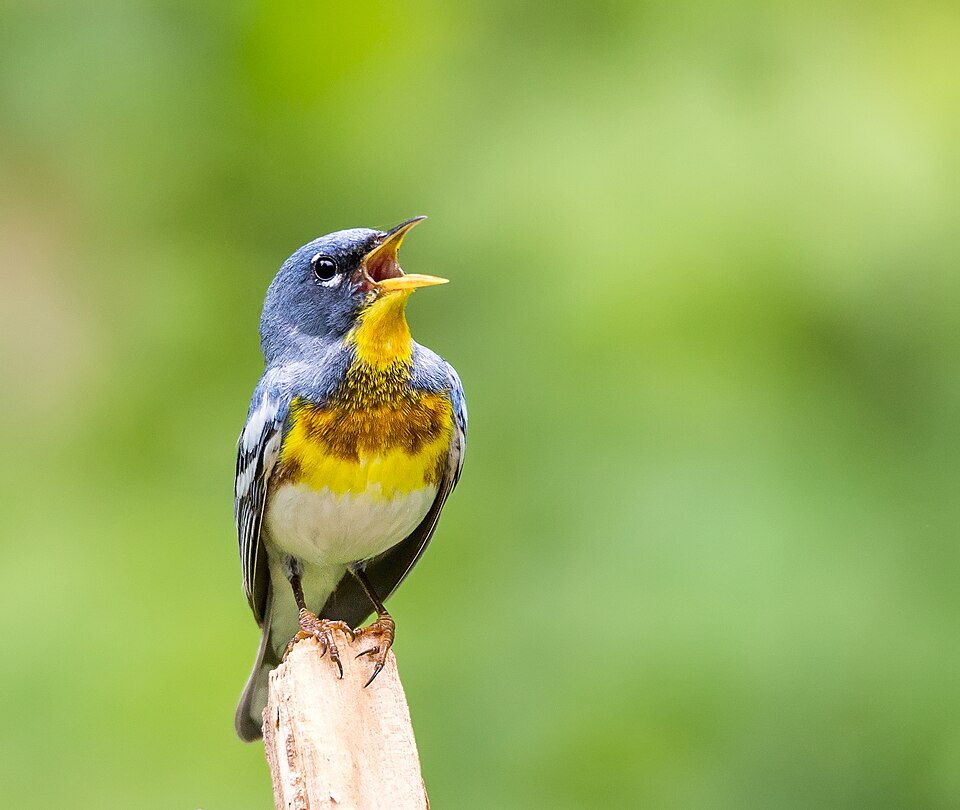
The Northern Parula is one of the smallest wood-warblers in North America, a stub-tailed little gem that often gives away its presence with sound long before you spot it. Bluish-gray above with a striking lime-green patch on its back and a sunny yellow throat and chest, it spends most of its time high in the leafy canopy, gleaning insects from the tips of branches. It is easy to overlook and surprisingly easy to fall in love with once you learn its buzzy, ascending song.
This warbler has a special relationship with hanging vegetation. In the Southeast it tucks its nest into clumps of Spanish moss, while in the North it favors the wispy beard lichen (often called old man's beard) that drapes spruce and fir branches. Because of this, the parula's breeding distribution closely follows where these mosses and lichens grow well, leaving a curious gap across parts of the heavily farmed and air-polluted middle of its range.
Think tiny, compact, and short-tailed. The Northern Parula is noticeably smaller than most warblers, with a stubby silhouette and a fine, sharp bill. Its color combination is distinctive: blue-gray hood and wings, a yellow-green saddle on the upper back, two bold white wing bars, white crescents above and below the eye, and a bright yellow throat and breast.
| Size | Very small and compact, one of the tiniest warblers, with a notably short tail |
| Upperparts | Blue-gray overall with a distinctive yellow-green patch on the upper back (the "saddle") |
| Throat & breast | Bright yellow; males show a chestnut-and-blue-black band across the chest |
| Wing bars | Two clean white wing bars, easily seen against the gray wing |
| Eye marks | Broken white eye-ring (white arcs above and below the eye) |
| Bill | Thin and pointed; upper bill dark, lower bill yellowish-orange |
Male vs. female
Sexes look broadly similar but differ in the chest. The adult male shows a crisp double band across the upper breast: a dark blue-black bar with a rufous-chestnut wash behind it, cutting across the otherwise yellow chest. The female is plainer and softer, usually lacking the bold breast bands or showing only a faint, washed-out hint of them; her colors overall are a touch duller and grayer. Both sexes share the yellow-green back patch, white wing bars, and broken eye-ring.
Juveniles
Immature birds in fall resemble adult females but are even more subdued. They tend toward grayer, greener tones with a yellow throat and breast, two visible wing bars, and the telltale white eye crescents and greenish back patch. Young males may show only a faint smudge where the adult's breast band will eventually develop. The combination of small size, short tail, yellow throat, and contrasting back patch usually clinches the identification even on these plain-looking individuals.
The classic song is a buzzy trill that climbs steadily in pitch and then trips over a little step at the very end, often written as zeeeeeee-up or buzzz-zip. That final upward snap is the giveaway. A second song type rolls or ripples upward in a series of broken buzzes before the same terminal flourish. Once learned, it is one of the more recognizable warbler songs of eastern woodlands.
Calls include a sharp, sweet chip note and a thin, high tsip given in flight or while foraging. Males sing persistently through the breeding season, often from high, hidden perches, which is why birders frequently hear far more parulas than they see.
The Northern Parula breeds across much of the eastern United States and into southeastern Canada, with two main strongholds: the moist, lichen-draped boreal and mixed forests of the Northeast and upper Midwest, and the moss-hung bottomland and swamp forests of the Southeast. Its range thins or disappears across parts of the agricultural and historically polluted mid-section of the continent, where suitable hanging vegetation is scarce.
It is a long-distance migrant. After breeding, parulas head south to winter in the Caribbean, Mexico, and Central America, with some lingering in southern Florida. They pass through much of the East and Gulf Coast during spring and fall migration, when they can turn up well outside the breeding range, including as scarce vagrants to the West.
Northern Parulas are insectivores that forage actively in the canopy and outer foliage, hopping along twigs and hover-gleaning at the tips of branches and leaf clusters. Spiders and small caterpillars are favorites, along with beetles, true bugs, flies, ants, wasps, and other small arthropods. They often forage at the very ends of branches, hanging chickadee-style to reach prey hidden among buds and new leaves.
Their feeding behavior is busy and acrobatic but easy to miss because it happens high overhead. In winter and on migration they will also take some berries and may visit flowering trees for the insects drawn to the blooms.
The nest is the parula's most charming trait. Rather than building a freestanding cup, the female (sometimes with help from the male) hollows out a pocket inside a hanging clump of Spanish moss in the South or beard lichen in the North, lining it with fine grasses, plant fibers, and bits of vegetation. Where these draping plants are absent, parulas occasionally use other hanging debris, flood trash caught in branches, or pine needle clusters.
The female typically lays 3 to 5 eggs, white or creamy and speckled with reddish-brown, and incubates them. After hatching, both parents feed the young. Pairs often raise one to two broods per season depending on latitude and conditions.
The Northern Parula is not a feeder bird. It eats insects and spiders gleaned from the treetops, so it will not come to seed, suet, or nectar feeders. That said, you can absolutely attract it to your property or neighborhood with the right habitat and a little luck during migration.
- Keep mature trees on your property; parulas need leafy canopy and forage high, so wooded lots and tree-lined creeks are most likely to host them.
- If you live within its range and climate, preserve any Spanish moss or beard lichen in your trees, this is exactly what they nest in.
- Avoid spraying insecticides; a healthy population of caterpillars, spiders, and small insects is the food that draws them in.
- Provide water, a dripper or shallow birdbath at the woodland edge can pull migrating parulas down from the canopy.
- Plant or protect native trees and shrubs that support insect life, especially along streams and wet woodland edges they favor.
- Watch and listen during spring and fall migration, when parulas move through yards and parks far beyond their breeding areas.
- Tropical Parula: Closely related and very similar, but lacks the white eye crescents and shows more extensive yellow on the face and underparts; range barely overlaps, mainly in south Texas.
- Yellow-throated Warbler: Also yellow-throated with white wing bars, but larger and longer-billed, with bold black-and-white face streaking and gray (not blue-gray with a green back patch) upperparts.
- Magnolia Warbler: Yellow underparts and white wing bars too, but heavily streaked black below, with a longer tail showing a distinctive white-then-black banded pattern from underneath.
- Nashville Warbler: Gray head and yellow throat can suggest a parula, but it has a complete eye-ring, no wing bars, and greenish (not blue-gray) upperparts.
What does a Northern Parula look like?
It is a very small, short-tailed warbler that is blue-gray above with a yellow-green patch on its back, two white wing bars, white crescents around the eye, and a bright yellow throat and breast. Males add a chestnut-and-blue band across the chest.
What is the Northern Parula's song?
A buzzy trill that rises steadily in pitch and then snaps up at the very end, often written as zeeeeee-up or buzzz-zip. That little upward flick at the finish is the best way to recognize it.
Will Northern Parulas come to my bird feeder?
No. They are insect eaters that forage high in trees for spiders and caterpillars, so they ignore seed, suet, and nectar feeders. To attract them, offer mature trees, water, and an insect-friendly, pesticide-free yard during migration.
Where do Northern Parulas build their nests?
They tuck their nests inside hanging vegetation, usually Spanish moss in the South or beard lichen in the North, hollowing out a pocket rather than building an open cup. Where those plants are missing, they occasionally use clusters of debris or pine needles.
Where do Northern Parulas live and migrate?
They breed across the eastern U.S. and southeastern Canada, favoring moist forests rich in moss or lichen. They migrate south for winter to the Caribbean, Mexico, and Central America, with some staying in southern Florida.