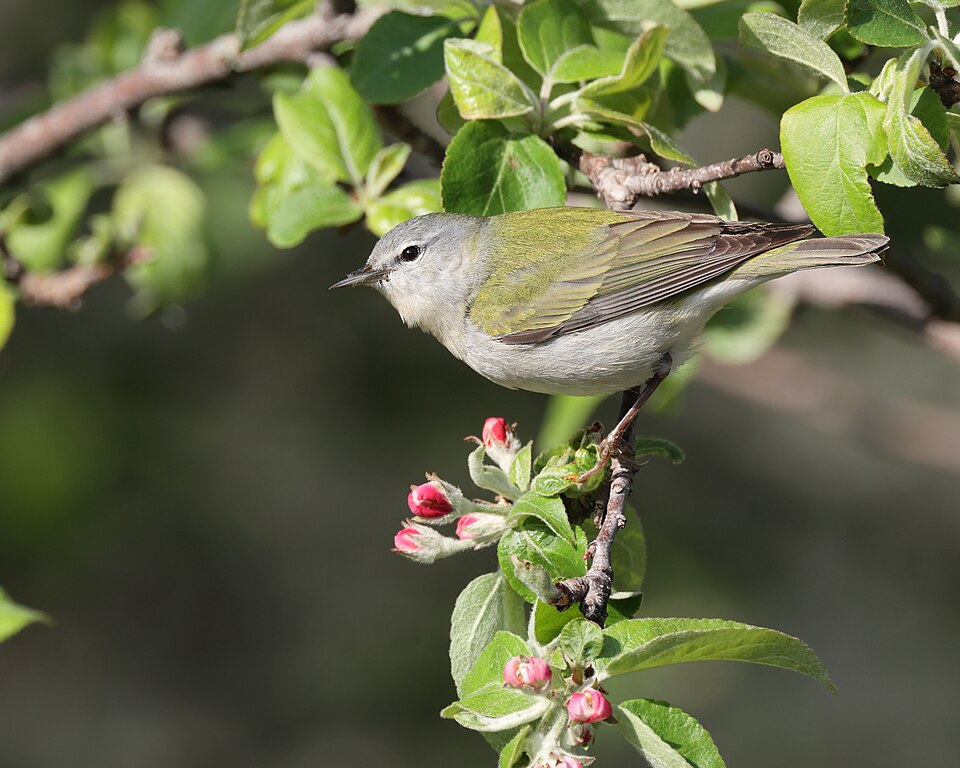
The Tennessee Warbler is one of those birds whose name tells you almost nothing useful. It was named for a single specimen collected along the Cumberland River in Tennessee in 1811, but the state is merely a stopover; the bird neither nests there nor winters there. Its real home is the vast spruce-fir forests and bogs of Canada and the far northern United States, and its real winter address is the shade-coffee plantations and forest edges of southern Mexico and Central America. To most birders south of the boreal zone, it is purely a bird of migration, a small green-and-white sprite that pours through the treetops in waves each spring and fall.
It is also, frankly, a plain bird, and that plainness is part of its identity. There are no flashy wing bars, no bold face pattern, no streaking on the breast to seize on. Instead, you learn it by a combination of subtle clues: a thin, sharp bill, a clean white undertail, a faint dark eyeline, and a habit of feeding actively high in the canopy. What it lacks in plumage it makes up for in voice and abundance. In a good budworm year, when its favorite caterpillar prey erupts across the northern forest, Tennessee Warbler numbers can swell dramatically, and its loud, staccato song becomes one of the defining sounds of the northwoods summer.
This is a small, slim, sharp-billed warbler built for working leaves and flower clusters. The silhouette is compact with a relatively short tail, and the fine, pointed bill is one of the best structural clues, separating it from chunkier-billed warblers and from vireos. Plumage is understated and changes with season, so focus on the clean underparts and the contrast between a grayish or greenish head and the green back.
| Bill | Notably thin, straight, and sharply pointed, finer than most warblers' bills |
| Underparts | Clean and largely unmarked; whitish below with no streaking, often whitest on the undertail coverts |
| Head | Grayish cap contrasting with a greener back (brightest in spring males); thin dark line through the eye and a pale eyebrow |
| Upperparts | Plain olive-green back and wings; lacks bold wing bars (sometimes a faint single bar) |
| Undertail coverts | Bright white, a key mark separating it from the similar Orange-crowned Warbler, which is yellowish below |
| Size & shape | Small and slim with a short tail; active, often feeding high in the canopy |
Male vs. female
In spring, males are the crispest: a clean blue-gray head sets off the green back, the white eyebrow and dark eyeline are distinct, and the underparts are bright white. Females and immatures are washed with more olive and yellow overall, especially on the head and breast, making them look softer and greener, closer to an Orange-crowned Warbler. The sexes are similar in pattern, and outside of bright spring males the difference is one of degree rather than a clean field mark; many fall birds cannot be reliably sexed in the field.
Juveniles
Fall immatures are the version most southern birders see in autumn, and they are decidedly yellow-green: a yellowish wash across the face and breast, a greener head with little gray, and often a faint pale wing bar. The clinching marks remain the thin sharp bill and, crucially, the contrastingly white undertail coverts beneath an otherwise yellow-tinged body. That white "vent" against a green-and-yellow bird is the detail that saves the day when separating confusing fall warblers.
The song is loud, emphatic, and surprisingly big for such a small bird. It is typically delivered in two or three accelerating parts that build to a dry, machine-gun trill, often written as ticka-ticka-ticka, swit-swit-swit, chew-chew-chew-chew-chew. The final section runs together into a rapid staccato rattle that carries well across the forest. Once learned it is hard to confuse, though distant or partial songs can recall a Nashville Warbler or even a chipping sparrow-like trill.
The common call note is a sharp, high tsip or chip, thinner and less rich than a chickadee's note. In migration and on the wintering grounds you mostly hear these short call notes rather than full song.
Tennessee Warblers breed across the boreal forest belt, from the interior of Alaska and the Yukon east through the spruce woods of Canada to the Maritimes, dipping into the northern edges of states like Minnesota, Michigan, Maine, and Montana. They favor young spruce-fir forest, bog edges, and disturbed second growth, and their breeding numbers rise and fall with outbreaks of spruce budworm, a caterpillar they feast on.
They are long-distance migrants. In spring they funnel north through the eastern and central United States, often appearing in big numbers in late April and May, while fall passage runs through August into October. Wintering birds settle in southern Mexico, Central America, and into northern South America, where they are common in shade-coffee plantations, forest edges, and gardens. For the majority of U.S. birders, this is strictly a migration bird, present for a few weeks twice a year.
During the breeding season the Tennessee Warbler is a dedicated insectivore, and caterpillars, particularly spruce budworm larvae, make up a huge share of its diet. It gleans actively through spruce and fir foliage, picking prey from needles and twigs, and its population booms in years when budworm is abundant. It also takes beetles, flies, true bugs, and spiders.
What sets this species apart is its behavior in winter and migration: it becomes a heavy nectar drinker and fruit eater. On the wintering grounds it is a familiar sight probing flowers, where its thin bill lets it pierce blossoms for nectar, and it readily takes small fruits and berries. This dietary flexibility is one reason it thrives in coffee plantations and edge habitats far from its boreal home.
The nest is built on the ground, well hidden in moss, sedge tussocks, or low vegetation at the edge of a bog or in damp open woodland. The female does the construction, weaving a cup of fine grasses, stems, and plant fibers lined with finer material. Ground nesting makes this a notoriously hard species to study on the breeding grounds.
A typical clutch is five to six eggs, white speckled with brown and reddish markings, with usually a single brood per season in the short northern summer. The female incubates, and both parents feed the nestlings. As with many boreal warblers, nesting success and overall numbers swing with food supply, peaking during budworm outbreak years.
The Tennessee Warbler is not a feeder bird, and you will not lure it with seed or suet. It is an insect-, nectar-, and fruit-eater that passes through most of the country only during migration. That said, you can absolutely improve your odds of hosting one in your yard during spring and fall passage by making the habitat appealing to migrating warblers in general.
- Plant and keep native trees and shrubs that host caterpillars and other insects; migrating warblers follow the bugs, not the feeders.
- Offer water, especially a moving or dripping source like a small fountain or mister; warblers are drawn to the sound during migration.
- Avoid pesticides so your yard supports the insect prey these birds need to refuel.
- Let part of the yard grow a little wild; brushy edges and flowering plants attract both insects and, in some regions, nectar opportunities.
- Watch the canopy in late April-May and August-October, when this species moves through; scan flowering trees where it feeds actively and check the white undertail to confirm an ID.
- Orange-crowned Warbler: Most confusing lookalike, especially in fall. Orange-crowned is yellowish below all the way through the undertail coverts and shows faint breast streaking; Tennessee has clean white undertail coverts and a sharper, finer bill.
- Warbling Vireo: Similar plain, pale look but is bulkier with a thicker, hook-tipped bill, moves more sluggishly, and has a sweeter rolling song rather than the Tennessee's staccato trill.
- Nashville Warbler: Shares a thin bill and active habits but has a bold complete white eyering, a gray head contrasting with yellow underparts, and yellow on the breast that the white-bellied Tennessee lacks.
- Philadelphia Vireo: Plain greenish bird that can suggest a Tennessee, but is heavier-billed, slower-moving, and shows yellow on the throat and breast rather than clean white underparts.
Why is it called a Tennessee Warbler if it doesn't live in Tennessee?
The name comes from where the bird was first collected for science, along the Cumberland River in Tennessee in 1811. The bird only passes through the state briefly during migration; it actually breeds in Canada's boreal forest and winters in Mexico and Central America. The name stuck despite being geographically misleading.
How do I tell a Tennessee Warbler from an Orange-crowned Warbler?
Check the undertail coverts. A Tennessee Warbler is clean white under the tail even when the rest of the body looks greenish-yellow, while an Orange-crowned Warbler is yellowish all the way through, including the undertail. The Tennessee also has a finer, sharper bill and usually cleaner, less streaky underparts.
Will a Tennessee Warbler come to my bird feeder?
No. It eats insects, nectar, and small fruits, not seeds or suet, so it is not a feeder bird. Your best chance of seeing one in the yard is during spring or fall migration, especially if you have native trees, flowering plants, and a water source that attract migrating insectivores.
What does a Tennessee Warbler sound like?
Its song is loud and staccato, typically in two or three accelerating parts that end in a fast, dry, machine-gun trill, often written as ticka-ticka, swit-swit, chew-chew-chew-chew. The call note is a sharp, high tsip. The driving, mechanical quality of the song makes it fairly distinctive once learned.
When and where can I see a Tennessee Warbler?
Most people see them during migration: roughly late April through May in spring and August through October in fall, when they move through the eastern and central U.S. Look high in the canopy of leafy or flowering trees, where they feed actively. To see breeding birds you would need to visit the spruce-fir forests and bogs of Canada and the far northern states.
Are Tennessee Warblers rare or declining?
They are considered common and are listed as Least Concern, but their numbers swing dramatically from year to year with outbreaks of spruce budworm, their favorite caterpillar prey. In big budworm years populations surge; in lean years they drop. Like many boreal birds, long-term trends are tied to the health of northern forests.