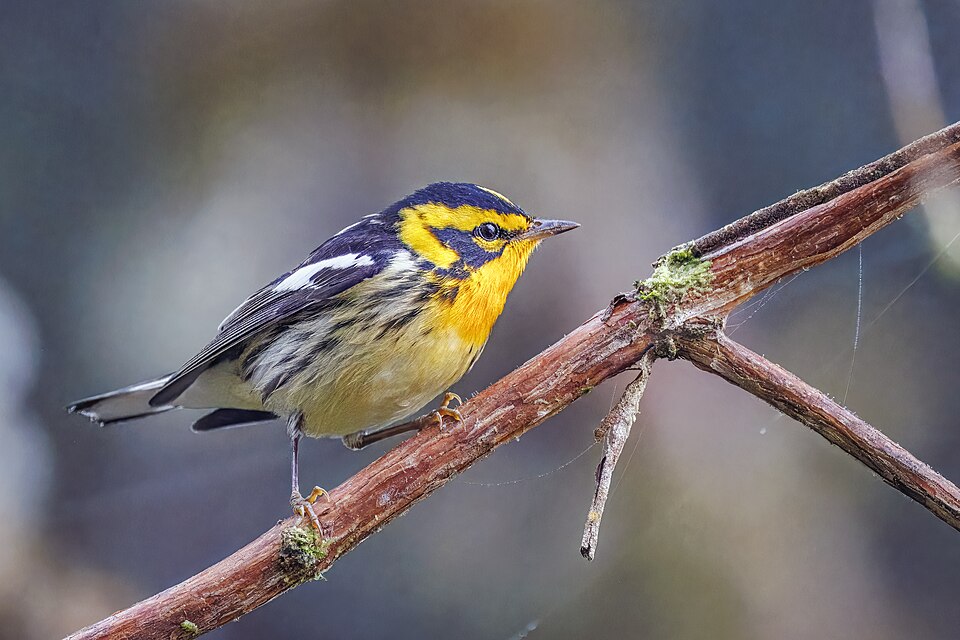
Few North American songbirds stop birders in their tracks quite like a male Blackburnian Warbler in spring. The throat and upper breast glow an almost impossible orange, so vivid it seems to catch fire against the green of a backlit spruce. Old-timers nicknamed it the "firethroat," and once you have seen one high in the canopy, the name needs no explaining. It is a small, slim wood-warbler that spends most of its life near the tops of tall conifers and mixed forests, which means birders often crane their necks and earn a case of "warbler neck" trying to track it down.
Despite its showy looks, the Blackburnian Warbler is a creature of the high branches and is easy to overlook if you do not know its thin, wiry song. It breeds across the cool forests of the northeastern United States and Canada and winters far to the south in the mountains of Central and South America, making one of the longer migrations of any eastern warbler. For many birders, catching that burst of orange during May migration is one of the great rewards of the spring warbler wave.
This is a small, compact warbler with a fairly sharp, pointed bill and a relatively short tail. Even when the diagnostic orange is hard to see, the bold black-and-white pattern of the head and the white wing markings help separate it from other treetop warblers. Look for a strikingly patterned face with a dark triangular ear patch surrounded by bright color.
| Throat & face | Breeding male shows a blazing orange throat, face, and eyebrow stripe, framed by a black crown and a black triangular cheek patch |
| Back | Black back with white streaks; male's pattern is bold and high-contrast |
| Wings | Large white wing patch (or two bold white wingbars in duller birds) visible from a distance |
| Underparts | Whitish to pale belly with black streaking along the flanks |
| Female & fall birds | Same head pattern but in soft yellow and gray rather than orange and black |
| Size & shape | Tiny and slim with a pointed bill, often foraging at the very top of tall conifers |
Male vs. female
The breeding male is unmistakable: a flaming orange throat and face set off by jet-black crown, back, and cheek patch, with crisp white wing patches. Females and immatures wear the same overall pattern but in a much gentler palette, the orange replaced by warm yellow to yellow-orange and the black areas softened to dusky gray or olive. On a female, look for the pale yellow eyebrow and throat, the dark triangular cheek patch, and two whitish wingbars. The face pattern is the key, the colors just turn down in brightness.
Juveniles
Juvenile and first-fall Blackburnians are the dullest of all, showing pale buffy-yellow throats, grayish-olive upperparts with faint pale streaking on the back, and two thin whitish wingbars. They can be tricky, but the same triangular dark cheek patch outlined in pale yellow, plus a pale stripe down the center of the back, gives them away. By the following spring, young males begin showing hints of the adult fire.
The primary song is exceptionally high and thin, a series of notes that climbs and ends with a very high, sometimes nearly inaudible flourish often written as zip-zip-zip-zip-titi-tseeeee. The final note rises so high in pitch that many birders past a certain age simply cannot hear it. There is also a simpler two-part song used commonly during migration and on territory.
The common call note is a sharp, high chip or tsip, similar to many other warblers and not especially distinctive. Learning the wiry, ascending song is by far the most reliable way to detect this bird, since it spends so much time hidden among the highest needles.
Blackburnian Warblers breed across southeastern Canada and the northeastern United States, south through the Appalachian Mountains, favoring mature spruce, fir, hemlock, and mixed conifer-hardwood forests. The Appalachian breeding population reaches as far south as Georgia at high elevations.
They are long-distance migrants, wintering primarily in the Andes and foothills of Colombia, Ecuador, Peru, Venezuela, and into Central America, where they often join mixed flocks in highland coffee plantations and montane forest. During spring and fall migration they pass through much of the eastern United States, and migration is the season when most birders south of the breeding range get their looks.
The Blackburnian Warbler is an insectivore, feeding heavily on caterpillars, beetles, flies, ants, aphids, and other small arthropods, with spiders also on the menu. It is a notable predator of spruce budworm and tends to thrive when budworm outbreaks boom in northern forests.
It forages high in the canopy, gleaning prey from the tips of conifer branches and the undersides of leaves, often hovering briefly to pluck an insect or making short flights to snap up flying prey. In winter it adds some small fruits and may visit flowering trees, but insects remain the core of its diet year-round.
Nesting takes place high in conifers, typically well out on a horizontal branch and often near the top of a tall spruce, fir, or hemlock. The female builds an open cup nest of twigs, bark, and plant fibers, lined with softer material such as lichen, moss, hair, and fine rootlets, frequently camouflaged with bits of lichen on the outside.
A typical clutch is 3 to 5 eggs, usually 4, whitish to pale greenish with brown markings. The female does the incubating for roughly two weeks, and both parents feed the nestlings. Most pairs raise a single brood per season, an arrangement well suited to their short northern summers and long migration.
The Blackburnian Warbler is not a feeder bird and will not be tempted by seed, suet, or nectar. It is a canopy insect-eater of mature forests, so the way to "attract" it is really to make your property and region friendlier to migrating and breeding warblers.
- Plant and protect tall trees, especially conifers like spruce, hemlock, and fir, which this species depends on for both food and nesting.
- Go pesticide-free. These warblers eat caterpillars and other insects, so a chemical-free yard means more food and safer foraging.
- Offer water. A clean birdbath or a dripper can pull migrating warblers down out of the canopy for a drink or bath.
- Keep cats indoors and reduce window collisions with screens or decals to protect exhausted migrants.
- Bird during the May migration wave and learn the high, thin song, your best chance to detect one passing through.
- Support native plants that host native insects, fueling the entire migratory food web.
- Bay-breasted Warbler: Fall birds can resemble dull Blackburnians, but lack the pale stripe down the back and bold face pattern; breeding males have chestnut, not orange, on the throat and flanks.
- Cape May Warbler: Also a treetop conifer warbler with yellow and streaking, but shows a chestnut cheek patch and heavy breast streaking rather than the Blackburnian's clean triangular face pattern.
- Blackpoll Warbler: Drab fall blackpolls can confuse, but they have a streakier, greener look and orange legs, and lack the bright throat and bold back stripe.
- Townsend's Warbler: A western lookalike with a similar black-and-yellow face pattern, but yellow rather than orange and largely separated by range.
How do I identify a Blackburnian Warbler?
In spring, look for the unmistakable blazing orange throat and face on the male, framed by a black crown and a black triangular cheek patch, with white wing patches. Females and fall birds show the same pattern in softer yellow and gray. They are tiny, slim, and almost always high in the treetops.
Why is it called a Blackburnian Warbler?
The name honors Anna Blackburne, an 18th-century English botanist whose brother sent her bird specimens from North America. It is not a description of the bird, though the black-and-orange male certainly looks fiery enough to suggest a flame.
Where do Blackburnian Warblers live?
They breed in mature conifer and mixed forests across southeastern Canada, the northeastern U.S., and down the Appalachians at high elevation. In winter they migrate to the Andes and mountains of Central and South America.
Will Blackburnian Warblers come to my feeder?
No. They are canopy insect-eaters and do not eat seed, suet, or nectar. The best way to see one is to bird mature forests during spring migration, offer water for migrants, and keep tall trees on your property.
What does a Blackburnian Warbler sound like?
Its main song is a very high, thin, wiry series that climbs to an almost inaudible note at the end, often written as zip-zip-zip-titi-tseeeee. The high final note is so high-pitched that some people cannot hear it at all.