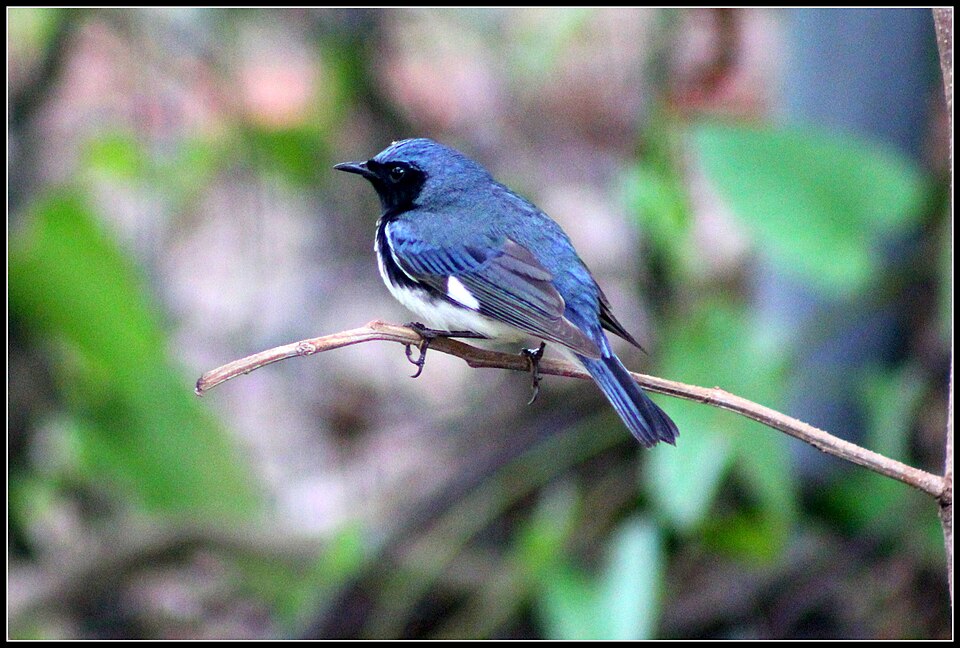
The Black-throated Blue Warbler is one of the most rewarding birds of the eastern hardwood forest, partly because the male is so unmistakable and partly because the species breaks a frustrating warbler rule: the male and female look so different that early naturalists once described them as separate species. The male is a crisp, almost formal combination of deep slate-blue above, a velvety black face and throat, and clean white underparts. The female, by contrast, is a quiet olive-brown bird that can leave beginners baffled. Both sexes share one tiny, reliable clue, and learning it is a small rite of passage for new birders.
This is a bird of the interior forest understory rather than the treetops. It breeds in cool, shady deciduous and mixed woodlands across the northeastern United States and southeastern Canada, with a separate population in the southern Appalachians, and it spends winters mostly in the Caribbean. Because it favors dense shrubby layers beneath mature trees, it is a species you usually hear before you see, and a species whose presence says a lot about the health of a large, undisturbed forest.
A small, compact, fairly short-tailed warbler that forages low and deliberately in the understory. The two sexes look strikingly different, but in both plumages the bird shows a small white square at the base of the primaries (the folded wing) that birders call the "pocket handkerchief" or "wing kerchief", the single most useful mark for nailing the dull female.
| Adult male upperparts | Deep slate-blue from crown to tail, unmarked and clean |
| Adult male face and throat | Solid velvety black on the face, throat, and down the sides, sharply set off from white belly |
| Female overall | Plain olive-brown to grayish above, buffy below, with a pale eyebrow stripe and dark cheek |
| Wing pocket (both sexes) | Small white patch at the base of the primaries, diagnostic, present even on dull females and immatures |
| Size and shape | Small, stocky warbler with a relatively short tail and thin, pointed bill |
| Behavior | Forages low and slowly in shrubs and saplings, often staying within a few feet of the ground |
Male vs. female
The sexes are about as different as warblers get. The male is boldly patterned: blue back, black face and flanks, white underparts, a tuxedo of a bird that is hard to mistake for anything else. The female is drab and easily overlooked: olive-brown above, dingy buff below, with a thin pale eyebrow and a darker ear patch giving her a faintly "masked" look. The detail that ties them together is the small white wing patch at the base of the primaries. Most females show it clearly, and it is the fastest way to separate a female Black-throated Blue from the various other plain warblers and vireos she might be hiding among.
Juveniles
Juveniles and first-fall immatures resemble adult females, looking soft and brownish overall. First-fall males often show a hint of their adult colors, a bluish wash on the wings and tail and some dusky mottling on the throat and sides, but they can be subdued. Reassuringly, even most young birds, including immature females, show at least a trace of the white wing pocket, so that mark remains your anchor across nearly every plumage of the species.
The male's song is a lazy, buzzy, rising series usually rendered as zur-zur-zur-zweee? or I-am-so-laaa-zy, with the final note slurring upward like a question. It is husky and unhurried, and the upward inflection at the end is a great identifier once you have it in your ear. Birds in different regions vary the number of introductory buzzes, but the rising, drawled finish is consistent.
The common call note is a sharp, flat ctuk or tip, somewhat junco-like and easy to overlook. Migrants and foraging birds give this note frequently, and learning it will help you pick the species out of a mixed flock in the understory.
Black-throated Blue Warblers breed across the northeastern U.S. and adjacent southeastern Canada, through New England, New York, the upper Great Lakes region, and the Maritimes, with a distinct southern population running down the higher elevations of the Appalachian Mountains into northern Georgia. They need large blocks of mature forest with a well-developed shrub layer, so they are most common in extensive, unfragmented woodlands.
They are long-distance migrants. In fall they head for the Greater Antilles, wintering heavily in Cuba, Jamaica, Hispaniola, and Puerto Rico, with smaller numbers along the Caribbean rim. During spring and fall migration they pass through the eastern and central states, where they can turn up in woodlots, parks, and even wooded yards far from any breeding habitat.
Through the breeding season the diet is overwhelmingly insects and other small invertebrates: caterpillars, moths, beetles, flies, spiders, and the like. Birds glean methodically from the undersides of leaves in shrubs and low branches, often hovering briefly to pick prey from foliage, and they tend to work an area slowly and thoroughly rather than flitting rapidly.
On the wintering grounds and during migration they add fruit and berries to the menu, and they will occasionally take nectar from flowers. This dietary flexibility helps them through the leaner non-breeding months in the Caribbean.
The female builds the nest low in the forest understory, usually within a few feet of the ground in a dense shrub, sapling, or rhododendron or mountain laurel thicket. The nest is a tidy open cup of bark strips, fine plant fibers, and spider silk, lined with soft material and often decorated on the outside with bits of bark and rotten wood.
She typically lays 3 to 4 eggs, creamy white with brownish speckles, and does the incubating herself for roughly two weeks. Both parents feed the nestlings, which leave the nest after about 8 to 10 days. Pairs in the core of the range may attempt a second brood when the season allows.
This is not a feeder bird, and you should set expectations accordingly: it eats insects and forages in shaded understory, so it will not come to seed or suet. That said, you can absolutely host one during migration, and your yard's habitat is what matters.
- Plant and keep dense native shrubs and a shaded understory, the leafy low layer is exactly the foraging zone this warbler prefers.
- Add a clean, shallow water source such as a ground-level bath or a dripper; migrants readily come to moving water even when they ignore feeders.
- Avoid pesticides so caterpillars, spiders, and other insects remain abundant, these are the bird's actual food.
- Grow native fruiting plants; on migration the species will take small berries to fuel its journey.
- If you have the space, value mature trees with a brushy layer beneath rather than a manicured open yard.
- Watch closely during spring and fall migration, when birds wander far from breeding forests and pause in wooded yards and parks.
- Black-throated Green Warbler: Shares the 'black-throated' name but the male is yellow-faced and green-backed, not blue-and-black; no white wing pocket.
- Cerulean Warbler: Male is paler sky-blue with a thin dark breast band and white wing bars, and forages high in the canopy rather than low.
- Tennessee Warbler: A plain female Black-throated Blue can suggest this drab warbler, but Tennessee lacks the white wing pocket and is greener and cleaner below.
- Philadelphia Vireo: Dull females are sometimes confused with this vireo, but the vireo has a thicker, hooked bill, slower movements, and no wing pocket.
Why do the male and female Black-throated Blue Warblers look so different?
They are one of the most sexually dimorphic warblers in North America. The male is blue, black, and white, while the female is plain olive-brown. The difference is so extreme that early naturalists once mistook them for two separate species. Look for the small white wing patch, both sexes share it.
What is the white spot on the wing?
It is a small white square at the base of the primary feathers, often called the 'pocket handkerchief' or 'wing kerchief.' It is the single most reliable field mark, especially for identifying the otherwise drab female and immature birds.
Will Black-throated Blue Warblers come to my feeder?
No. They are insect-eating, understory foragers and will not visit seed or suet feeders. Your best chance is to offer good shrubby habitat and a shallow water source, and to watch during spring and fall migration.
What does the Black-throated Blue Warbler's song sound like?
A husky, buzzy, rising series often written as 'zur-zur-zur-zweee?' or 'I-am-so-laaa-zy,' with the last note slurring upward like a question. The call note is a sharp, flat 'ctuk.'
Where do Black-throated Blue Warblers go in winter?
They migrate to the Caribbean, wintering mainly in the Greater Antilles, Cuba, Jamaica, Hispaniola, and Puerto Rico, where they add fruit and berries to their usual insect diet.