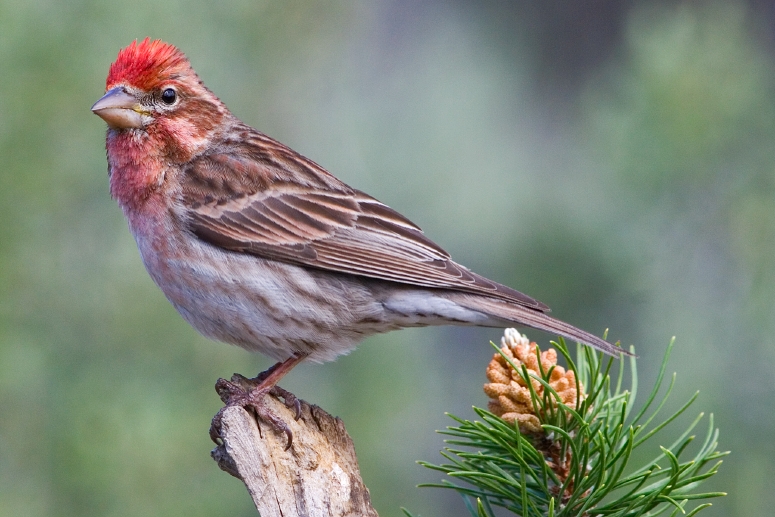
Cassin's Finch is a trim, crisply marked finch of the high conifer forests of western North America. It belongs to the same trio of red-tinged North American finches as the House Finch and Purple Finch, and the three can be a genuine puzzle where their ranges overlap. Cassin's is the bird of the mountains: in summer it favors open pine, fir, and spruce forests, often at elevations where the air is thin and the trees are widely spaced. Males wear a bright raspberry-red crown that contrasts with a browner nape and back, a feature that gives the species its tidy, "peak-capped" look once you learn to see it.
For backyard birders in the Rockies, the Sierra, and the interior West, Cassin's Finch is one of the rewards of living at altitude. It is a sociable, wandering bird that travels in loose flocks, turns up at mineral seeps and salt sources, and sings a long, rich warble that carries through the pines. Named for the 19th-century American ornithologist John Cassin, it is a species many lowland birders only meet on mountain trips, which makes a feeder visit at a high-country cabin feel like a small event.
Cassin's Finch is a medium-sized, sturdy finch with a notably long, straight-sided, sharply pointed bill and a short, distinctly notched tail. Compared with the rounder House Finch and the chunkier Purple Finch, it looks a touch larger, longer-billed, and more "clean-cut," often holding the crown feathers raised into a small peak. The streaked back and crisp underparts give it a frostier, more contrasting appearance than its relatives.
| Bill | Long and straight with a pointed tip; the upper edge (culmen) is nearly straight, unlike the curved bill of House Finch |
| Male color | Bright rose-red restricted mostly to the crown (peaked cap), with a paler pinkish wash on the breast and a brown-streaked back |
| Female | Brown and white with crisp, fine dark streaking below; sharply defined face pattern with a pale eyering and pale submoustachial stripe |
| Tail | Short with a deep notch at the tip |
| Undertail | Often shows faint streaks on the undertail coverts (a useful separator from Purple Finch, which is usually unstreaked there) |
| Size & shape | About 6 inches; sturdy body, large head often peaked, longer-tailed and longer-billed look than House Finch |
Male vs. female
Males and females look different. The adult male shows a vivid rose-red crown that stands out against a browner face and back, with pink fading down onto the throat and breast and whitish, lightly streaked flanks and belly. The red is more concentrated and "capped" than in House or Purple Finch. Females are brown above and whitish below with crisp, narrow dark streaks; they show a cleaner, more patterned face than female House Finches, including a pale eyering and a neat pale stripe below the cheek. Young males can resemble females for their first year, which is a common source of confusion.
Juveniles
Juveniles and first-year birds are brown and streaky, much like adult females. First-year males are particularly tricky: they retain female-like brown plumage through their first breeding season and may sing and breed while still looking "female," so a streaky brown bird belting out a rich warble is very likely a young male. Full red crown coloration develops with the molt into adult plumage. On all immatures, look for the long straight bill and crisp underpart streaking to confirm the species.
The song is a long, fast, rich warble - bright, varied, and noticeably tumbling, often described as more energetic and "jumbled" than the steadier song of the Purple Finch. It frequently weaves in mimicked snippets of other birds' calls, which adds to its complexity. Males sing from high, exposed perches at the tops of conifers.
The most distinctive vocalization is the flight and contact call: a sharp, rising, two- or three-note tee-dee-yip or kee-up given as birds fly overhead or move through a flock. Once learned, this call is one of the best ways to pick out Cassin's Finch passing over a mountain forest. Birds in a flock keep up a constant soft chatter while feeding.
Cassin's Finch is a western specialty, breeding in the mountains from southern British Columbia and the northern Rockies south through the Cascades, Sierra Nevada, Great Basin ranges, and the central and southern Rockies into the high country of the Southwest and northern Mexico. It is a bird of montane conifer forest, generally above the elevations where House Finches dominate.
Movements are irregular and elevation-driven rather than a tidy north-south migration. In winter many birds simply drop to lower elevations and foothills, and in some years flocks wander well out of the breeding range in classic "irruptive" fashion, appearing at feeders and in valleys where they are otherwise scarce. Numbers at any one site can swing a lot from year to year.
Cassin's Finch feeds mainly on seeds, buds, and berries. It is especially fond of the buds and seeds of conifers and the seeds of weeds and forbs, and it readily eats berries and the buds of trees like quaking aspen in spring. In summer it adds insects, which are particularly important for feeding nestlings. The heavy, pointed bill is well suited to working seeds out of cones and seed heads.
This finch has a notable craving for mineral salts and will gather at natural mineral seeps, road salt, and salty soil - one of the more reliable places to find a feeding group. Birds forage both high in the canopy, where they nip buds and extract conifer seeds, and on the ground, where they glean fallen seeds, frequently in loose, mobile flocks.
Cassin's Finches nest in conifers, typically placing the nest well out on a horizontal branch fairly high in a pine, fir, or other evergreen. The female builds an open cup of twigs, rootlets, fine grasses, and lichens, lined with softer material. They sometimes nest in loose, semi-colonial clusters where several pairs occupy the same stand.
The female lays a clutch of usually 3 to 5 pale blue-green eggs marked with fine dark speckling, and she does the incubating, which lasts roughly twelve to fourteen days. The male helps feed her on the nest and later helps feed the young. Pairs generally raise a single brood per season, in keeping with the short high-mountain summer.
If you live at the right elevation in the West, Cassin's Finch absolutely can be a feeder bird - it just won't visit lowland yards the way House Finches do. The key is being near or up in montane conifer country and offering the right food and, especially, minerals.
- Offer black oil sunflower seeds in a tube or hopper feeder - the heavy, pointed bill handles them easily and they are a favorite.
- Add a platform or tray feeder; Cassin's Finches feed comfortably in flocks and will use open surfaces and even the ground beneath feeders.
- Provide a reliable source of water and, if you can, a mineral or salt source - these finches are strongly drawn to mineral seeps and salty soil.
- Location matters most: feeders in or near mountain conifer forest have a real shot, while low-elevation yards rarely do.
- Expect year-to-year swings - in irruption years birds may pour in, while other winters they stay scarce.
- Plant or preserve conifers and aspens nearby for natural buds, seeds, and nesting cover.
- Purple Finch: More uniformly raspberry-washed over the head and back (not a sharp red cap), with a shorter, more curved bill and usually unstreaked undertail coverts; females show a stronger, broader face pattern.
- House Finch: Smaller and rounder with a short, curved bill; male's red is on the forehead, throat, and rump with blurry brown streaks on the flanks; far more common at low elevations and in towns.
- Red Crossbill: Shares conifer forests and red male plumage but has the unmistakable crossed bill tips and lacks the streaked, peaked-cap look of Cassin's.
- Pine Grosbeak: Much larger and plumper with a stubby, rounded bill and bold white wingbars; a slower, gentler bird of the high country.
How do I tell a Cassin's Finch from a Purple Finch?
Look at the head and bill. A male Cassin's has bright red concentrated in a peaked cap on the crown that contrasts with a browner face and back, while a Purple Finch is more evenly washed raspberry over the head and back. Cassin's also has a longer, straighter bill and often shows faint streaks on the undertail coverts, which Purple Finch usually lacks. Females are best separated by Cassin's crisper, finer streaking and cleaner face pattern.
Where do Cassin's Finches live?
They are western birds of montane conifer forests, breeding in the mountains from southern British Columbia south through the Cascades, Sierra Nevada, Great Basin ranges, and the Rockies into the Southwest and northern Mexico. In winter many move to lower elevations and foothills, and in irruption years they wander more widely.
Will Cassin's Finches come to backyard feeders?
Yes, but mainly at higher elevations within or near their mountain forest range. Black oil sunflower seeds in tube, hopper, or platform feeders work well, and a water or mineral source is a strong draw. Low-elevation yards rarely attract them, and visits can vary a lot from year to year.
Why is a brown, streaky bird singing like a male Cassin's Finch?
First-year male Cassin's Finches keep female-like brown plumage through their first breeding season and will sing and even breed while still looking brown and streaky. So a streaky bird delivering a rich, tumbling warble is very likely a young male that hasn't yet molted into its red adult plumage.
What does a Cassin's Finch sound like?
The song is a long, fast, rich warble, brighter and more jumbled than a Purple Finch's, and it often mixes in imitations of other birds. The signature call is a sharp, rising two- or three-note flight call, often written as tee-dee-yip or kee-up, given as birds pass overhead.