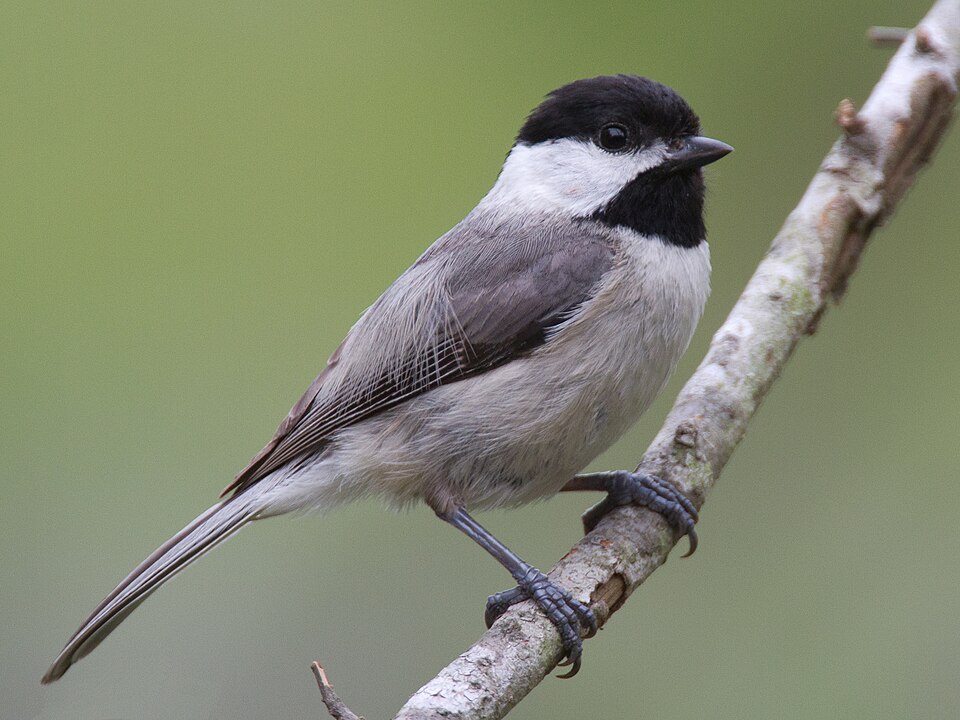
The Carolina Chickadee is one of the friendliest faces at a southern bird feeder. This tiny, round-bodied songbird wears a crisp black cap and bib over soft gray upperparts, and it bustles through trees and shrubs with the kind of fearless energy that makes it a favorite of backyard birders. Despite weighing only about as much as a couple of nickels, it has an outsized personality, often the first bird to investigate a new feeder and frequently calling out its scolding chickadee-dee-dee as it goes.
Across the Southeast, this is the chickadee. It fills the same ecological niche that the Black-capped Chickadee occupies farther north, and where their ranges meet the two are nearly impossible to separate by sight alone. A year-round resident, the Carolina Chickadee is a familiar presence in deciduous woods, wooded suburbs, parks, and swampy bottomlands. In winter it often leads mixed flocks of titmice, nuthatches, kinglets, and small woodpeckers through the trees, acting as a kind of sentinel that other birds rely on for alarm calls.
Chickadees are compact and distinctive: a large rounded head on a small body, a short neck, a stubby bill, and a fairly long, narrow tail. The Carolina Chickadee is the smallest of the eastern chickadees, looking like a tidy little ball of feathers as it clings to twigs and hangs upside down to forage.
| Cap & bib | Solid black cap covering the crown and nape, plus a neat black throat patch (bib); the bib edge is fairly crisp and clean-cut. |
| Cheeks | Bright white cheeks separating the black cap from the black bib, giving a masked, two-toned face. |
| Upperparts | Soft gray back, wings, and tail with little contrast; wing feathers show only faint, dull edging. |
| Underparts | Whitish breast and belly washed with pale buff or grayish-buff on the flanks. |
| Size & shape | Very small and round, with a big head, short neck, stubby bill, and a moderately long tail. |
| Bill | Short, thin, and black, suited for picking insects and cracking small seeds. |
Male vs. female
Males and females look alike, so you cannot reliably tell them apart in the field. Both sexes have the same black cap, white cheeks, black bib, and gray body. Males average very slightly larger, but the difference is far too small to judge by eye. During the breeding season, behavior is your best clue: the male tends to do more singing, while the female does the incubating and may beg for food from her mate at the nest.
Juveniles
Juvenile Carolina Chickadees look much like adults, which can make them tricky to age. Fresh juveniles have slightly looser, fluffier plumage and a duller, less sharply defined black bib, and their fresh feathers can look a touch cleaner than the worn plumage of adults late in summer. By the time young birds disperse and join winter flocks, they are essentially indistinguishable from adults in the field.
The classic call is the bird's namesake: a buzzy, scolding chick-a-dee-dee-dee. Carolina Chickadees tend to deliver this call faster and higher-pitched than the Black-capped Chickadee, and the number of dee notes rises with the bird's level of alarm, more dees can signal a more dangerous predator nearby.
The song is different from the call. Carolina Chickadees typically sing a clear, whistled four-note phrase often written as fee-bee fee-bay (high-low-high-low), compared with the simpler two-note fee-bee of the Black-capped. You'll hear singing most in late winter and spring as pairs establish territories. They also give soft tseet contact notes and a thin, high see that warns of aerial predators like hawks.
The Carolina Chickadee is a bird of the southeastern United States. Its range stretches from roughly New Jersey and southern Pennsylvania south through the Atlantic and Gulf states to central Florida, and west through the Ohio Valley and lower Midwest into Texas, Oklahoma, and Kansas. It is essentially non-migratory, holding the same territory all year.
Along the northern edge of its range, it meets the Black-capped Chickadee in a narrow contact zone that runs across states like New Jersey, Pennsylvania, Ohio, and Missouri. In this zone the two species sometimes interbreed, and the hybrids can sing confusing, intermediate songs. The boundary has shifted slowly northward over recent decades, a change researchers link to warming winters.
Carolina Chickadees are insectivores at heart. Through the warmer months they glean caterpillars, spiders, beetles, aphids, and insect eggs from leaves, bark, and twigs, often acrobatically hanging upside down to reach the undersides of branches. Caterpillars are especially important during the breeding season, when parents must deliver hundreds of soft, protein-rich larvae to feed a hungry brood.
In fall and winter the diet shifts toward seeds, berries, and other plant matter, supplemented by any insects and dormant insect eggs they can find. Like other chickadees, they are scatter-hoarders: they cache individual seeds in bark crevices and other hiding spots and remember the locations to retrieve later. At feeders they are quick, decisive visitors, typically grabbing a single sunflower seed and flying off to a perch to hammer it open rather than lingering at the feeder.
Carolina Chickadees are cavity nesters. A pair will excavate or enlarge a hole in soft, rotting wood, take over an old woodpecker hole, or readily accept a nest box. The female builds the nest inside the cavity, starting with a foundation of moss and bark strips and lining the cup with soft material such as plant down, fur, and feathers. She often pulls this lining over the eggs to conceal them when she leaves.
The female lays a clutch of typically 5 to 8 eggs, white with fine reddish-brown speckling, and incubates them alone for about 12 to 15 days while the male brings her food. After hatching, both parents feed the nestlings, which leave the nest around 16 to 19 days old. Pairs usually raise a single brood per year. If a person or predator disturbs the incubating female, she may produce a startling snake-like hiss and a sudden movement, a defense thought to scare off intruders.
This is one of the easiest and most rewarding feeder birds to attract within its southeastern range. Carolina Chickadees are bold, curious, and quick to learn where reliable food is, often among the first birds to find a new feeder and frequent visitors year-round.
- Offer black-oil sunflower seeds, their hands-down favorite, along with hulled sunflower hearts and peanut pieces in a tube or hopper feeder.
- Put out suet, especially in fall and winter, for a high-energy boost they'll visit eagerly.
- Mount a nest box with a small entrance hole (about 1 1/8 inches) on a pole with a baffle; chickadees will use boxes for both nesting and winter roosting.
- Add some peanuts or a peanut feeder, chickadees will cache extras for later.
- Plant native trees and shrubs, especially oaks, that host the caterpillars they depend on to raise their young.
- Keep a clean, shallow source of fresh water, a birdbath with a dripper is a strong draw, and let a dead snag or two stand for natural cavities.
- Black-capped Chickadee: Nearly identical; slightly larger with bolder white wing-feather edges and a buffier flank. Best separated by range (Black-capped is northern) and song: a slow two-note fee-bee versus the Carolina's faster four-note fee-bee fee-bay.
- Tufted Titmouse: A close relative that often travels with chickadees, but larger, plain gray with a pointed crest, big dark eyes, and rusty flanks, and it lacks the black cap and bib.
- Mountain Chickadee: A western species not normally overlapping in range; distinguished by a bold white eyebrow stripe cutting through the black cap, which the Carolina never shows.
- Blackpoll Warbler: A breeding-plumage male can look superficially black-and-white-capped, but it is a slimmer warbler with a thin pointed bill, streaked sides, and white cheeks bordered differently; it is a migrant, not a feeder regular.
What is the difference between a Carolina Chickadee and a Black-capped Chickadee?
They look almost identical, so the most reliable clue is location: Carolina Chickadees live in the Southeast, while Black-capped live across the North. Song helps too, the Carolina sings a faster four-note fee-bee fee-bay and the Black-capped a slower two-note fee-bee. The Black-capped is also slightly larger with bolder white edges on its wing feathers. Where their ranges overlap, even experts can struggle, and hybrids occur.
Are Carolina Chickadees friendly to humans?
They are remarkably bold and curious for such a small bird. While they're not truly tame, they often feed only a few feet from people and may be among the first birds to investigate a new feeder. In some areas, with patience, they can be trained to take seeds from an outstretched hand.
What do Carolina Chickadees eat at feeders?
Their favorite is black-oil sunflower seed, but they also love sunflower hearts, peanut pieces, and suet. They typically grab one seed at a time and fly to a nearby perch to crack it open, and they often cache extra food to eat later.
Do Carolina Chickadees use birdhouses?
Yes. They are cavity nesters and readily accept nest boxes with a small entrance hole around 1 1/8 inches, which also keeps out larger competitors. They may also use boxes as warm roosting spots on cold winter nights.
Do Carolina Chickadees migrate?
No, they are year-round residents that hold the same territory in all seasons. In winter they form and lead mixed-species flocks but generally stay within their home range rather than migrating south.