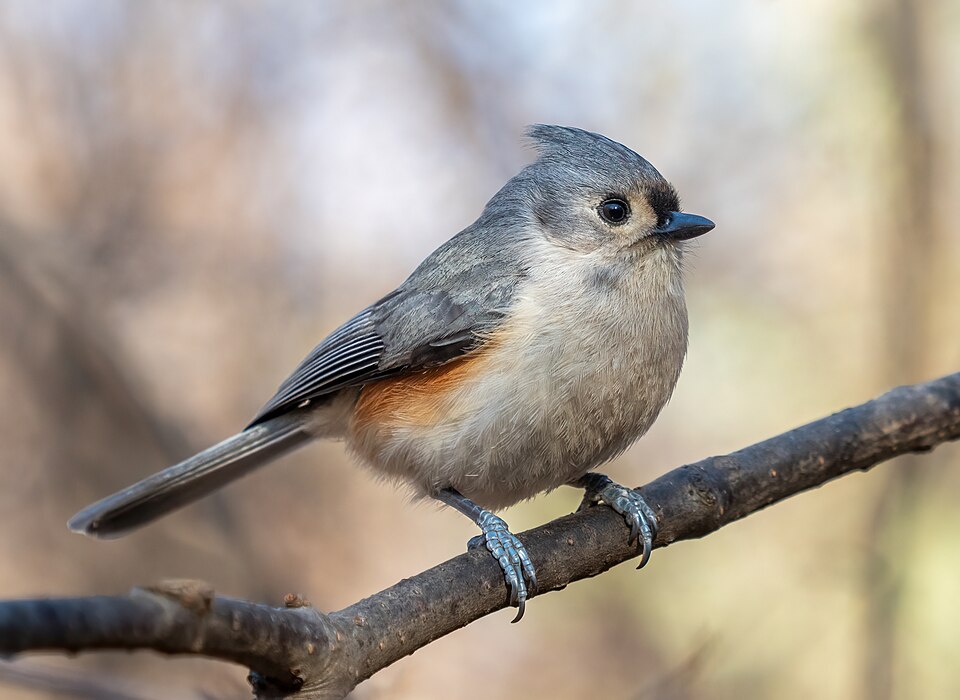
The Tufted Titmouse is one of the most familiar and endearing birds of the eastern United States, a small, soft-gray songbird with an upright crest, oversized black eyes, and an outsized personality. About the size of a chickadee but a touch stockier, it is a year-round resident across woodlands, parks, and suburban yards, and it rarely passes a feeder without making its presence known. Bold and curious, titmice are often the first birds to investigate a new feeder and among the noisiest, scolding cats, hawks, and birdwatchers alike with a buzzy, fussing chatter.
Once largely confined to the southeastern states, the Tufted Titmouse has expanded steadily northward over the past century, helped along by maturing forests, warmer winters, and the spread of backyard bird feeding. Today it is a fixture from Florida to southern New England and the upper Midwest. Closely related to chickadees, it shares their acrobatic foraging, their habit of caching seeds, and their tendency to lead mixed-species flocks through the winter woods.
This is a compact, big-headed songbird with a pointed crest that it raises and lowers with its mood. The silhouette alone, a small gray bird with a peaked cap, is usually enough to clinch the identification within its range.
| Crest | Pointed gray crest, often raised, giving a distinctive peaked head shape |
| Upperparts | Soft, plain silvery-gray back, wings, and tail with no wing bars or streaking |
| Underparts | Pale grayish-white belly washed with peachy or rusty buff along the flanks |
| Face | Whitish face with large, dark eyes and a small black patch on the forehead just above the bill |
| Bill | Short, stout, black bill suited to cracking seeds |
| Size | Chickadee-sized but stockier, roughly 6 inches long |
Male vs. female
Male and female Tufted Titmice look alike, with no reliable plumage differences visible in the field. Both sexes share the gray crest, peachy flanks, and black forehead patch. Males average very slightly larger, but the difference is not something you can judge by eye. The clearest clue to sex is behavior during the breeding season, when the male sings persistently and the female does most of the incubating.
Juveniles
Recently fledged young resemble adults but look softer and more washed-out, with a shorter, fluffier crest and a duller, paler black forehead patch that may be barely visible. Their flank color is fainter and their overall plumage looks loose and downy. By late summer, after their first molt, young titmice are essentially indistinguishable from adults.
The signature song is a clear, whistled peter-peter-peter, repeated several times with a ringing, full-throated quality that carries well through the woods. It is one of the easiest bird songs to learn and is often the first sound that announces a titmouse before you see it. Males sing year-round but most insistently from late winter into spring.
Beyond the song, titmice are vocal scolders. Their calls include a fast, buzzy, chickadee-like tsee-day-day-day and a harsh, nasal, fussing scold delivered when an intruder or predator is near. They also give thin, high see notes. Each bird has a small repertoire of song variations, and you may hear an individual switch its peter phrasing through the morning.
The Tufted Titmouse is a permanent, non-migratory resident throughout the eastern United States, from the Gulf Coast and Florida north through the Midwest and into the Northeast. Its range has crept steadily northward over the last hundred years and now reaches southern Ontario, New England, and Minnesota, with a few birds pushing into southern Canada.
Because it does not migrate, you can expect to find the same individuals in your neighborhood across all four seasons. In winter, titmice join roving mixed flocks with chickadees, nuthatches, kinglets, and Downy Woodpeckers, ranging through the woods in loose, chattering bands. In the southern and south-central parts of its range it overlaps and occasionally hybridizes with the closely related Black-crested Titmouse.
Tufted Titmice are omnivores that shift with the seasons. In spring and summer they eat large numbers of insects and other invertebrates, including caterpillars, beetles, true bugs, wasps, spiders, and snails, gleaning them from leaves, bark, and twig tips. Caterpillars are an especially important food for feeding nestlings. In fall and winter they rely more heavily on seeds, nuts, acorns, and berries.
Like chickadees, titmice are active cachers, hiding seeds and nuts in bark crevices and other hiding spots to retrieve later, usually within a day or so. At feeders they typically grab a single large sunflower seed, carry it to a nearby branch, and hammer it open while holding it under their feet, then return for the next one. This one-seed-at-a-time, grab-and-go habit is a good behavioral fingerprint for the species.
Tufted Titmice are cavity nesters but cannot excavate their own holes. Instead they use natural cavities, old woodpecker holes, and nest boxes. The female builds the nest inside the cavity, constructing a cup of moss, leaves, bark strips, and grass and lining it with soft material such as animal hair, fur, and plant down. Titmice are famous for plucking hair directly from living mammals, including pet dogs, squirrels, and even people, to line the nest.
Females lay a clutch of about 5 to 7 eggs and do nearly all of the incubation, which lasts roughly 12 to 14 days, while the male brings her food. Young leaormonth the nest around 15 to 18 days after hatching. Pairs usually raise a single brood per year in the north, occasionally two in the south. Notably, young from a previous year sometimes stay with their parents and help feed the next brood, a relatively unusual behavior among North American songbirds.
The Tufted Titmouse is an enthusiastic and reliable backyard bird that takes readily to feeders, especially in winter. With the right food and a little cover, you can almost count on having titmice as regular visitors anywhere within their range.
- Offer black-oil sunflower seeds, which are the single most reliable way to draw titmice; they will pick out sunflower from mixed seed.
- Put out peanuts (shelled or in the shell) and suet, both favorites that titmice will visit repeatedly through cold weather.
- Provide a nest box with about a 1.25-inch entrance hole, mounted 5-15 feet up at the edge of trees, to encourage a pair to breed.
- Keep native trees and shrubs, especially oaks and other nut and berry producers, which supply natural food and the caterpillars titmice feed their young.
- Add a birdbath or shallow water source, as titmice drink and bathe regularly year-round.
- Place feeders near cover such as a hedge or tree so these somewhat wary birds have a quick escape and a perch to crack seeds on.
- Black-crested Titmouse: Replaces the Tufted in central and western Texas; has a black crest and pale forehead, the reverse of the Tufted's gray crest and black forehead. The two hybridize where their ranges meet.
- Black-capped Chickadee: Smaller, with a black cap and bib and no crest. Chickadees show a clean white cheek and a tiny bill, and lack the titmouse's gray crest and peachy flanks.
- Oak Titmouse: A plain brownish-gray crested bird of California oak woodlands, well outside the Tufted Titmouse's eastern range; lacks the peachy flanks and black forehead patch.
- Bridled Titmouse: A southwestern species with a bold black-and-white facial pattern and a black-bordered crest, easily separated by its strongly marked face.
What does a Tufted Titmouse sound like?
Its most recognizable sound is a loud, clear, whistled peter-peter-peter repeated several times. It also gives a buzzy, chickadee-like tsee-day-day call and a harsh, nasal scold when alarmed. The peter song is one of the easiest backyard bird songs to learn.
Are Tufted Titmice year-round residents or do they migrate?
They do not migrate. Tufted Titmice are permanent residents throughout their range, so you can see the same birds in your yard in every season. In winter they join mixed flocks with chickadees and nuthatches but stay in the same general area.
What is the best food to attract Tufted Titmice?
Black-oil sunflower seeds are the top choice and will reliably draw them in. They also love peanuts and suet. Titmice typically grab one seed, fly to a branch to crack it open, then come back for another, so a feeder near a tree or shrub works best.
Will Tufted Titmice use a nest box?
Yes. Because they cannot dig their own cavities, they readily accept nest boxes with about a 1.25-inch entrance hole, mounted 5 to 15 feet high near trees. They line the nest with soft material and are famous for using mammal hair, sometimes plucked from living animals.
How do you tell a Tufted Titmouse from a chickadee?
The titmouse is larger and stockier, plain gray overall, and has a pointed crest plus peachy flanks and big dark eyes. Chickadees are smaller, have no crest, and show a black cap and black throat with crisp white cheeks. The titmouse's peaked head is the quickest giveaway.
Why does a titmouse keep flying back and forth to my feeder?
That grab-and-go behavior is normal. Titmice carry off one large seed at a time to crack open on a nearby perch, and they also cache extra seeds in bark crevices and hiding spots to eat later, so a single bird can make many trips in a short time.