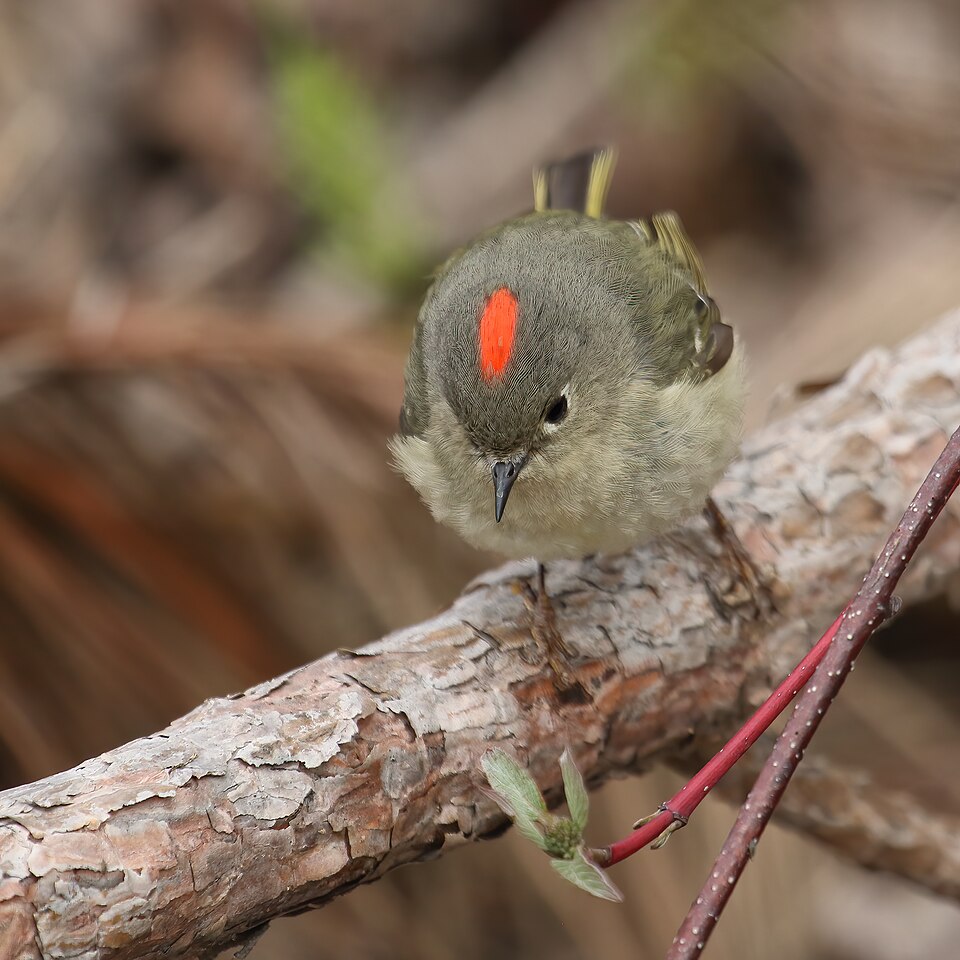
The Ruby-crowned Kinglet is one of the smallest songbirds in North America, a hyperactive little olive-gray bird that almost never holds still. If you spot a tiny bird flicking its wings nonstop as it hops through the outer twigs of a shrub or evergreen, picking at bark and buds, there's a good chance it's a kinglet. They weigh about as much as two pennies, yet they survive brutal northern winters and migrate thousands of miles, fueled almost entirely by insects and an appetite that never seems to quit.
The bird gets its name from a scarlet patch on the male's crown that stays hidden almost all the time, only flaring up when he's excited, singing, or squaring off with a rival. Most of the time you'll see no red at all, just a plain little bird with a bold white eyering and a couple of white wingbars. What truly gives them away is their behavior and their voice: for such a minuscule bird, the male's tumbling, chattering song is astonishingly loud and complex. Recently reclassified into its own genus, Corthylio, the Ruby-crowned Kinglet is a familiar sight to birders across the continent during migration and winter.
Think tiny, round, and twitchy. The Ruby-crowned Kinglet is a plump-bodied mite with a short tail, a thin pointed bill, and a large-headed look. Its constant nervous wing-flicking is often the first clue, visible from across a yard even before you can make out a single field mark.
| Size | Among the smallest North American songbirds, only slightly larger than a hummingbird and smaller than a chickadee. |
| Eyering | Bold, complete white eyering broken at the top, giving a surprised, big-eyed expression. This is the key field mark. |
| Wingbars | Two whitish wingbars; the lower one is bordered below by a dark bar that makes it stand out. |
| Color | Plain olive-green to grayish above, paler dusty-olive below, with no strong head pattern. |
| Crown | Male has a ruby-red crown patch, usually concealed; flared into a brilliant tuft only when agitated or singing. |
| Behavior | Almost constant nervous wing-flicking and restless hopping through outer foliage. |
Male vs. female
Males and females look essentially identical in the field, both plain olive-gray with the white eyering and wingbars. The only reliable difference is the crown patch: adult males have a concealed ruby-red crown that they can erect into a vivid flame, while females and immatures lack any red entirely. Since the male keeps that patch hidden most of the time, the safe assumption is that any kinglet showing no red could be either sex, and you generally can't sex a quiet bird with confidence.
Juveniles
Juveniles look much like adult females, plain and red-free, though freshly fledged young can appear slightly browner and fluffier. Young males do not show the ruby crown in their first weeks; the red feathers come in as they mature. By the time most birders encounter them on fall migration, immatures are essentially indistinguishable from adult females in the field, plain little birds defined by the eyering and wing-flicking rather than any bold markings.
The song is the showstopper. For a bird this small, the volume is almost comical: a male will launch into a long, rollicking performance that starts with a few high, thin, almost inaudible notes, then drops into a rich, tumbling warble often written as see-see-see, tew-tew-tew, ti-dadee ti-dadee ti-dadee. That final repeated, bouncing phrase is distinctive and carries a surprising distance through the woods.
Far more often than the full song, you'll hear the call: a dry, scolding, husky ji-dit or je-dit, frequently doubled, like two pebbles tapped together. This stuttering chatter is a great year-round identifier, since the birds give it constantly as they forage, even in the dead of winter when they aren't singing.
Ruby-crowned Kinglets breed across the boreal forest and western mountains, from Alaska and across much of Canada south through the Rockies, the Sierra Nevada, and other high-elevation conifer country in the western United States. They favor cool, dense spruce and fir forests for nesting.
They are strongly migratory. In fall they spread across most of the lower 48 states and into Mexico and the Gulf Coast, becoming one of the most widespread and commonly encountered winter songbirds in the southern and coastal U.S. For much of the country, the Ruby-crowned Kinglet is a bird of migration and winter, arriving in October and departing by April, when you'll find them working hedgerows, woodlots, and backyard shrubs far from any breeding habitat.
This is an insect specialist. Ruby-crowned Kinglets feed mostly on tiny arthropods, spiders, insect eggs, and larvae, gleaning them from bark, twigs, and the undersides of leaves. Their restless wing-flicking may actually help flush hidden prey into view. They often hover briefly at the tips of branches to snatch an insect, a hummingbird-like trick that few small songbirds manage so deftly.
In winter, when insects are scarce, they round out the diet with small fruits, berries, and tree sap, and they will take suet, bits of fat, and sometimes peanut hearts at feeders. Their tiny size means they must eat almost constantly to stay warm, which is why you so rarely see one sitting still.
Ruby-crowned Kinglets nest high in conifers, typically well off the ground in a spruce or fir. The female builds a remarkably deep, cup-shaped nest woven from moss, lichen, spider silk, and fine bark strips, lined with feathers and soft plant down, often tucked against the trunk or suspended among hanging twigs and partly hidden from below.
The clutch is unusually large for such a small bird, sometimes packed in two layers in the deep cup. The female does the incubating, while the male feeds her and later helps provision the nestlings. Because they breed in remote northern and montane forests, their nests are seldom seen by casual birders, and much of the breeding life of this species plays out far from where most people watch them.
Ruby-crowned Kinglets are not classic seed-feeder birds, but you can absolutely draw them into your yard, especially during migration and winter when they roam widely. The trick is to think like an insect-eater rather than offering sunflower seed.
- Offer suet or fat-based foods; this is your best bet, as kinglets will visit suet cages for the energy-rich fat in cold weather.
- Try peanut butter, bark butter, or peanut hearts smeared on or pressed into tree bark, which mimics their natural foraging surface.
- Provide moving water; a dripper or small fountain in a birdbath is a strong draw for these active little birds.
- Plant or keep native conifers, shrubs, and brushy cover that host insects and spiders for natural foraging.
- Skip the pesticides; kinglets need the tiny insects and spiders that sprays eliminate, so a chemical-free yard is far more attractive.
- Watch your shrubs and evergreens closely in fall and winter, when these wandering birds are most likely to pass through.
- Golden-crowned Kinglet: Has a bold black-and-white striped face with a yellow (or orange) crown stripe, lacks the plain face and white eyering, and gives higher, thinner calls.
- Hutton's Vireo: Looks deceptively similar with its eyering and wingbars, but is chunkier, slower-moving, has a thicker hooked bill, and does not flick its wings constantly.
- Orange-crowned Warbler: Similarly plain and olive, but is slimmer with a thin straight warbler bill, lacks the bold eyering and wingbars, and shows a faint eyeline instead.
- Blue-gray Gnatcatcher: Also tiny and active, but bluish-gray above with a long white-edged tail it cocks and waves, very different from the kinglet's short tail and wing-flicking.
Why is it called a Ruby-crowned Kinglet if I never see any red?
The red crown belongs only to the male, and even he keeps it hidden almost all the time, flattened under his head feathers. He flares it into a brilliant ruby tuft only when excited, singing, or confronting a rival, so most sightings show a plain bird with no red at all. That's completely normal.
How do I tell a Ruby-crowned Kinglet from a Golden-crowned Kinglet?
Look at the face. The Ruby-crowned has a plain face with a bold white eyering and no head stripes. The Golden-crowned has a strongly striped black-and-white face with a yellow or orange crown stripe that is always visible. Their calls differ too, with the Golden-crowned giving much higher, thinner notes.
What is that tiny bird constantly flicking its wings?
Constant nervous wing-flicking, combined with tiny size and a white eyering, is a classic sign of a Ruby-crowned Kinglet. They flick their wings almost without pause as they forage, which is one of the easiest ways to pick them out even before you see field marks.
Will Ruby-crowned Kinglets come to a bird feeder?
They won't eat seed, but they do visit suet, bark butter, peanut butter, and sometimes peanut hearts, especially in winter when insects are scarce. Offering fat-based foods, moving water, and insect-friendly native plantings gives you the best chance of attracting one.
When and where am I most likely to see one?
For most of the U.S., they appear during fall and spring migration and through the winter, roughly October to April. They breed in northern and mountain conifer forests, so outside those areas you'll find them passing through hedgerows, woodlots, and backyard shrubs rather than nesting locally.