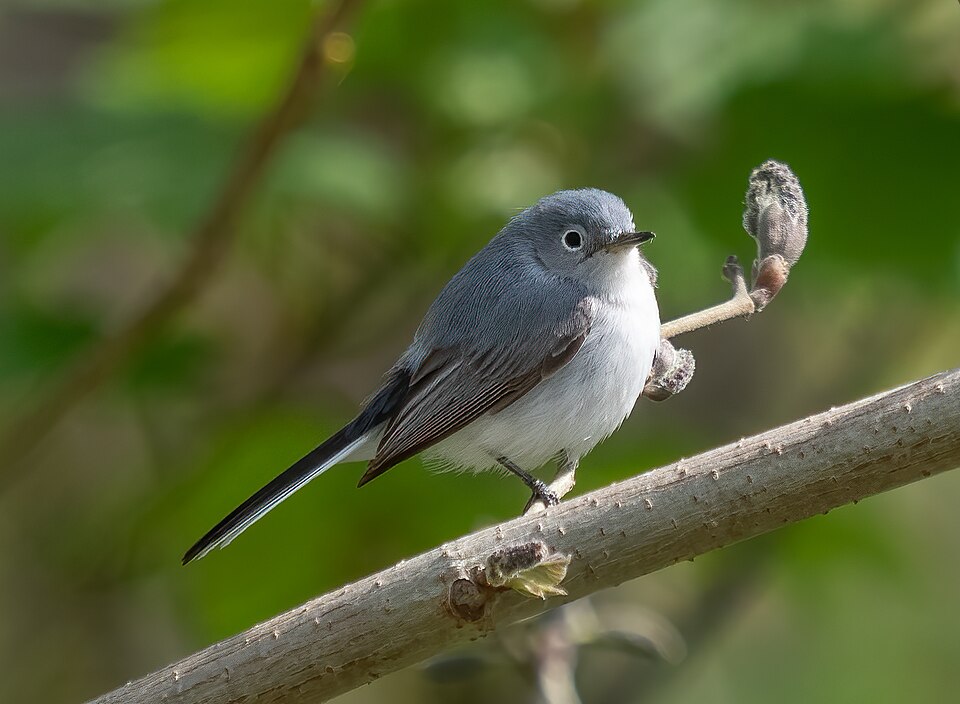
The Blue-gray Gnatcatcher is one of North America's smallest songbirds, a slender wisp of pale blue-gray that seems almost too light to bend the twigs it lands on. What it lacks in size it makes up for in restless energy: it never stops moving, hopping through the outer foliage of trees and shrubs, cocking and flicking its long white-edged tail at every angle as it snaps up tiny insects. Birders often notice the voice before the bird itself, a thin, wheezy, almost peevish note drifting down from the canopy.
Despite the name, gnatcatchers eat far more than gnats, and they are not closely related to the warblers they superficially resemble. They belong to a small New World family (Polioptilidae) of long-tailed, insect-gleaning birds. The Blue-gray is by far the most widespread member in the United States, breeding across much of the East and a good part of the West, and it has been steadily expanding its range northward over the past century. For many people it is a spring arrival worth listening for, a sign that the woods are filling back up with leaves and bugs.
Think of a miniature mockingbird that has been shrunk and dipped in soft blue-gray: long-tailed, slim, and elegant, with a thin straight bill and a habit of holding that long tail high and swishing it from side to side. It is smaller than a chickadee and noticeably more delicate, and the bright white outer tail feathers flash conspicuously whenever it fans or flicks the tail.
| Upperparts | Soft blue-gray above, palest and grayest on the back, brighter blue-gray on a breeding male's crown. |
| Underparts | Clean whitish to grayish-white below, with no streaking or strong markings. |
| Eye ring | Bold, complete white eye ring that stands out on the plain face. |
| Tail | Long and often cocked or flicked; black above with extensive white outer feathers, so it looks white-edged or mostly white from below. |
| Black brow | Breeding males show a thin black 'eyebrow' line over the eye (the supraloral); females and winter birds lack it. |
| Bill | Thin, straight, and dark, suited to picking tiny insects from leaves. |
Male vs. female
The sexes look very similar and both are blue-gray above and white below, but breeding males are a touch brighter and bluer, especially on the crown, and they wear a distinctive thin black line above the eye that arches across the forehead like a narrow black brow. Females and non-breeding males are plainer, a more uniform gray with a slight brownish wash and no black brow. Outside the breeding season even males lose the black eyebrow, so by fall the two sexes can be nearly impossible to separate in the field.
Juveniles
Juveniles closely resemble adult females, plain gray above and pale below with the same bold white eye ring and white-edged tail, but tend to look slightly browner or more washed-out, with a softer, looser-feathered appearance. They lack any trace of the black male brow. By their first fall they are essentially indistinguishable from adults in non-breeding plumage, so age is rarely something backyard birders can pin down in the field.
The most familiar sound is the call, a thin, wheezy, slightly nasal spee or pwee, often repeated and with a complaining, querulous quality, as if the bird were faintly annoyed. It carries surprisingly well through the treetops and is often the first clue that a gnatcatcher is overhead.
The song is much quieter and easy to miss, a soft, rambling, scratchy warble that mixes thin wheezes and squeaky notes into a jumbled, almost mumbled phrase. Blue-gray Gnatcatchers are also accomplished mimics, weaving fragments of other birds' songs into their own quiet, run-on performances, so a careful listener may catch snatches of imitation buried in the warble.
Blue-gray Gnatcatchers breed across the eastern United States and southern Ontario, west through the southern Great Plains and the Southwest, and up the West Coast into parts of Oregon and California. They favor open deciduous and mixed woodlands, woodland edges, brushy thickets, oak and pinyon-juniper habitats in the West, and riverside groves. Over the last several decades their breeding range has crept noticeably northward.
They are migratory in the northern part of the range and largely resident in the warmer south. Northern and interior breeders winter in the southern United States, Mexico, Central America, and the Caribbean, while populations along the Gulf Coast, Florida, and the desert Southwest may be present year-round. Spring migrants are early arrivals, often appearing as the first leaves emerge, which is one reason their wheezy calls feel like such a reliable herald of the season.
Despite the name, this bird is a generalist insect-eater rather than a gnat specialist. Its diet is dominated by small arthropods: leafhoppers, tiny beetles, true bugs, caterpillars, flies, ants, and especially spiders, along with the eggs and larvae of many of these. It takes whatever small soft-bodied prey is abundant in the foliage at the moment.
Watching one feed is half the fun. Gnatcatchers are hyperactive gleaners, hopping and fluttering through the outer twigs and leaves, peering under foliage and snatching prey from leaf surfaces. They frequently hover briefly to pluck an insect from the underside of a leaf, dart out flycatcher-style after a passing bug, and constantly flick and fan that white-sided tail. The tail-flicking may actually help flush hidden insects into the open, turning the bird's restlessness into a hunting strategy.
The nest is a tiny architectural marvel: a deep, compact cup saddled onto a horizontal branch or fork, built of fine plant fibers, grasses, and spider silk and shingled on the outside with flakes of lichen and bark so that it blends seamlessly into the limb. The result looks much like a slightly oversized hummingbird nest and can be remarkably hard to spot even at close range. Both members of the pair build it, and they will readily tear apart and recycle material to start a new nest if the first is disturbed or parasitized.
Clutches typically hold 3 to 5 pale bluish or greenish eggs lightly speckled with reddish-brown. Both parents incubate, for roughly two weeks, and both feed the young, which leave the nest at around 10 to 15 days old. Pairs often raise two broods in a season. Blue-gray Gnatcatchers are frequent hosts to Brown-headed Cowbirds, and their tiny cup makes them especially vulnerable to this nest parasitism.
The Blue-gray Gnatcatcher is not a feeder bird, so you won't lure one in with seed or suet. It is, however, very much a backyard possibility if your property borders or contains the kind of leafy, insect-rich habitat it loves. The way to attract it is to make your yard hospitable to the insects and trees it depends on.
- Plant and keep native trees and shrubs. Oaks, in particular, host enormous numbers of caterpillars and other insects that gnatcatchers feed on, and mature deciduous trees provide the foraging foliage they need.
- Skip the insecticides. Gnatcatchers are pure insect-eaters, so a yard sprayed for bugs offers them nothing. Tolerating insects is the single biggest thing you can do.
- Maintain leafy edges and brushy layers. They favor woodland edges and thickets, so an unmanicured border between lawn and trees gives them places to forage and nest.
- Offer water. A clean birdbath, especially one with moving or dripping water, can draw gnatcatchers to drink and bathe even though they ignore feeders.
- Learn the call. Because they stay high in the canopy, you are far more likely to find one by ear, so listening for that thin wheezy spee in spring is the best way to know one is around.
- Black-tailed Gnatcatcher: A southwestern desert resident; very similar shape but its tail is mostly black underneath (not white-edged), and breeding males have a full black cap. Its call is rougher and more scolding.
- California Gnatcatcher: Restricted to coastal sage scrub in southern California; darker gray overall with a dark undertail and a distinctive kitten-like, mewing call quite unlike the Blue-gray's thin wheeze.
- Ruby-crowned Kinglet: Similar tiny, restless, eye-ringed bird, but greenish rather than blue-gray, with wing bars, a short tail, and constant wing-flicking instead of tail-flicking.
- Tufted Titmouse: Also gray with a white belly but much larger and stockier, with a pointed crest and a stout black bill; lacks the long white-edged tail.
What does a Blue-gray Gnatcatcher sound like?
Most often you'll hear its call: a thin, wheezy, slightly nasal 'spee' or 'pwee' that sounds a bit complaining and carries well from high in the trees. Its actual song is quieter, a soft scratchy warble that sometimes includes imitations of other birds.
Do Blue-gray Gnatcatchers come to bird feeders?
No. They are strict insect- and spider-eaters and will not visit seed or suet feeders. The best way to attract them is to grow native trees and shrubs, avoid insecticides, and provide a birdbath, especially one with moving water.
Are Blue-gray Gnatcatchers related to warblers?
No, even though they look like a slim gray warbler. They belong to the gnatcatcher family (Polioptilidae), a small group of New World birds. Their long, often-cocked white-edged tail and bold white eye ring set them apart from true warblers.
When do Blue-gray Gnatcatchers show up in spring?
They are early migrants, often arriving just as trees begin to leaf out. In much of the eastern U.S. that means March into April, with their wheezy calls being one of the first signs they're back on the breeding grounds.
How do I tell a Blue-gray Gnatcatcher from a Ruby-crowned Kinglet?
Both are tiny, hyperactive, and have a white eye ring, but the gnatcatcher is blue-gray with a long white-sided tail it constantly flicks, while the kinglet is greenish with wing bars, a short tail, and a habit of nervously flicking its wings.