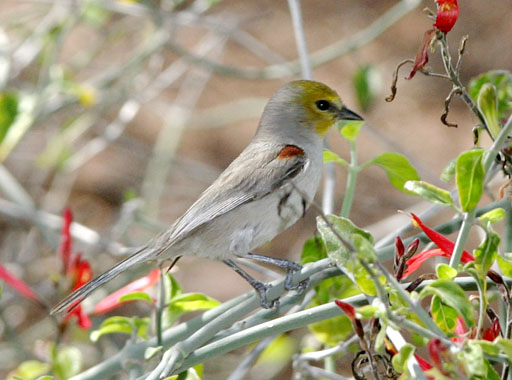
The Verdin is one of the desert Southwest's smallest songbirds, a restless gray scrap of a bird with a sunny yellow head that seems almost too bright for so plain a body. Barely larger than a hummingbird, it spends its days clambering through thorny mesquite, palo verde, and creosote, gleaning insects and probing flowers while keeping up a steady stream of sharp chip notes. Once you learn its silhouette and voice, you start noticing it everywhere across the Sonoran and Chihuahuan deserts, from washes and brushy hillsides to suburban yards with the right native plantings.
What makes the Verdin remarkable is its toughness. It is the only North American member of the penduline-tit family, a group better known from the Old World, and it has adapted to some of the hottest, driest country on the continent. It builds conspicuous, sturdy domed nests year-round, not just for breeding but also as insulated roosts that help it survive cold desert nights. For backyard birders in Arizona, Texas, and southern California, the Verdin is a welcome and characterful resident, active and vocal in every season.
The Verdin is a very small, plump-bodied songbird with a short, slightly notched tail, a sharply pointed conical bill, and an overall drab gray body that contrasts strikingly with a bright yellow head and a small chestnut-red shoulder patch. In silhouette it resembles a tiny, big-headed warbler or a chickadee-sized acrobat, often hanging upside down to feed.
| Head | Bright lemon-yellow on the face, forehead, and throat in adults, sharply set off from the gray body |
| Body | Uniform pale gray above and below, slightly paler on the belly, with no wing bars |
| Shoulder | Small rusty-chestnut patch at the bend of the wing (lesser coverts), often hidden when perched |
| Bill | Sharp, conical, dark gray, finer and more pointed than a chickadee's |
| Size | Tiny, only about 4 to 4.5 inches, smaller than a Bushtit, with a relatively short tail |
| Eye | Dark, with a faint reddish or yellowish cast to the lores in good light |
Male vs. female
Male and female Verdins look essentially alike and cannot be reliably told apart in the field. Both show the yellow head and gray body. The chestnut shoulder patch tends to average slightly larger and brighter on males, but this is subtle, variable, and usually impossible to judge without a bird in the hand. For practical backyard birding, treat the sexes as identical.
Juveniles
Juvenile Verdins are the source of much confusion because they lack the diagnostic yellow head entirely. Young birds are plain gray-brown overall, slightly paler below, with no yellow and no chestnut shoulder patch, and they often show a pinkish or pale base to the lower bill. This drab, washed-out look can suggest a Bushtit or a small flycatcher, but the tiny size, conical bill, and active foraging style give them away. They gradually acquire the yellow head and rusty shoulder through their first fall and winter.
The Verdin's song is a clear, whistled three-note phrase, often written as tee-tee-tee or tsee-tsee-tsee, with the notes on a level pitch or with the last note dropping slightly. It is surprisingly loud and far-carrying for such a small bird, and males sing through much of the year, not just in spring.
Far more often, though, you will hear the Verdin's calls: a sharp, insistent chip or tschep, frequently repeated in a rapid, scolding series when the bird is agitated or moving through cover. These dry, emphatic chip notes are one of the most reliable ways to detect a Verdin you cannot yet see, and learning them turns a hard-to-spot bird into an easy one.
The Verdin is a year-round resident of the arid Southwest. Its range covers southern and western Arizona, southern Nevada, southeastern California (including the Colorado and Mojave desert fringes), southern New Mexico, and the trans-Pecos and southern regions of Texas, extending well south through much of arid Mexico to the central plateau and Baja California.
It is essentially non-migratory. Verdins hold territories all year and do not undertake seasonal migrations, though young birds disperse to find their own ground after fledging. Because it is so tied to desert scrub, the Verdin does not stray far from its preferred habitat, and you will rarely encounter one outside the hot, dry country it calls home.
Verdins are primarily insectivorous, foraging actively through foliage and along twigs for caterpillars, beetles, true bugs, ants, small spiders, and insect eggs. They are agile gleaners, frequently hanging upside down or sideways to inspect the undersides of leaves and the tips of branches, and they will hover briefly to snatch prey. This constant, fidgety foraging is part of what makes them so noticeable.
They also have a notable sweet tooth. Verdins drink nectar from desert flowers such as ocotillo, chuparosa, and agave, sometimes piercing the base of blossoms to reach it, and they readily visit hummingbird feeders for sugar water. They eat small fruits and berries as well, and in suburban areas they take advantage of whatever insects and nectar sources native and ornamental plantings provide.
Verdins are famous nest builders. They construct large, conspicuous, fully enclosed spherical nests of thorny twigs, with a small entrance hole low on one side, woven into the outer branches of a spiny shrub or tree like mesquite, palo verde, or cholla. The outer shell is a dense, prickly ball; inside, the chamber is lined with grasses, plant down, feathers, and spider silk, creating a snug, insulated space well suited to the desert's temperature extremes.
The male typically builds breeding nests, and the species also makes simpler nests used only as roosting shelters outside the breeding season, sometimes building several in a territory. The female lays a clutch of usually 3 to 4 pale blue-green eggs lightly spotted with reddish-brown, and incubates them for roughly 10 days. Both parents feed the nestlings, which leave the nest in about two to three weeks. In the warm Southwest, pairs commonly raise more than one brood per year.
Within its desert range, the Verdin is genuinely a backyard bird, and you can encourage it with the right approach. It is more of a nectar-and-insect visitor than a seed feeder, so attracting it is less about a seed feeder and more about water, sugar water, and native desert plants.
- Offer a hummingbird feeder. Verdins regularly sip sugar water (a 1 part sugar to 4 parts water ratio) and will perch right on hummingbird feeders.
- Plant native desert nectar sources like ocotillo, chuparosa, desert honeysuckle, and agave, which provide both nectar and the insects Verdins hunt.
- Provide water. A shallow dish or dripping fountain is a strong draw in arid country, where reliable water is scarce.
- Keep native, thorny shrubs and trees such as mesquite, palo verde, and acacia, which offer foraging cover, insects, and nest sites.
- Skip pesticides. Verdins depend heavily on small insects and spiders, so an insecticide-free yard supports them directly.
- Don't expect them at seed feeders. Unlike chickadees, Verdins rarely take seed, so focus on nectar, water, and insect-rich plantings instead.
- Bushtit: Similar tiny size and active foraging, but Bushtits are plain gray-brown all over with no yellow head, travel in chattering flocks, and have a longer tail.
- Lucy's Warbler: Another small pale gray desert bird, but Lucy's Warbler has a thin warbler bill, a rusty rump and crown patch rather than a yellow head, and a different song.
- Yellow Warbler: Much yellower overall, including the body, with a thin warbler bill; the Verdin's yellow is confined to the head against a gray body.
- Black-tailed Gnatcatcher: Shares the desert scrub and small size, but gnatcatchers are bluish-gray with a long black-and-white tail they flick constantly, and lack any yellow.
What is the small gray bird with a yellow head in my desert yard?
If you are in the Southwest desert and see a tiny gray songbird with a bright yellow head and face, it is almost certainly a Verdin. It is one of the few small desert birds with that combination of plain gray body and lemon-yellow head, often with a small rusty shoulder patch.
Do Verdins come to bird feeders?
Verdins rarely visit seed feeders, but they do come to hummingbird feeders for sugar water and will use a sugar feeder regularly. To attract them, offer nectar, fresh water, and native flowering desert plants rather than relying on a seed feeder.
Why does a Verdin build such a big nest for such a small bird?
Verdins build large, enclosed, thorny domed nests for both breeding and roosting. The dense twig shell and insulated inner chamber help the bird survive the desert's hot days and cold nights, and the thorns provide protection from predators. They often build extra nests just for sleeping in.
Are Verdins year-round residents or do they migrate?
Verdins are non-migratory residents that hold their desert territories all year. You can find them in the same areas of Arizona, southern California, New Mexico, and Texas in every season, though young birds disperse to establish their own territories.
How do I tell a Verdin from a Bushtit?
Both are tiny and active, but adult Verdins have a bright yellow head and a small chestnut shoulder patch, while Bushtits are uniformly gray-brown with no yellow and a longer tail. Bushtits also move in chattering flocks, whereas Verdins are usually seen singly or in pairs. Note that juvenile Verdins lack the yellow and can look more Bushtit-like.