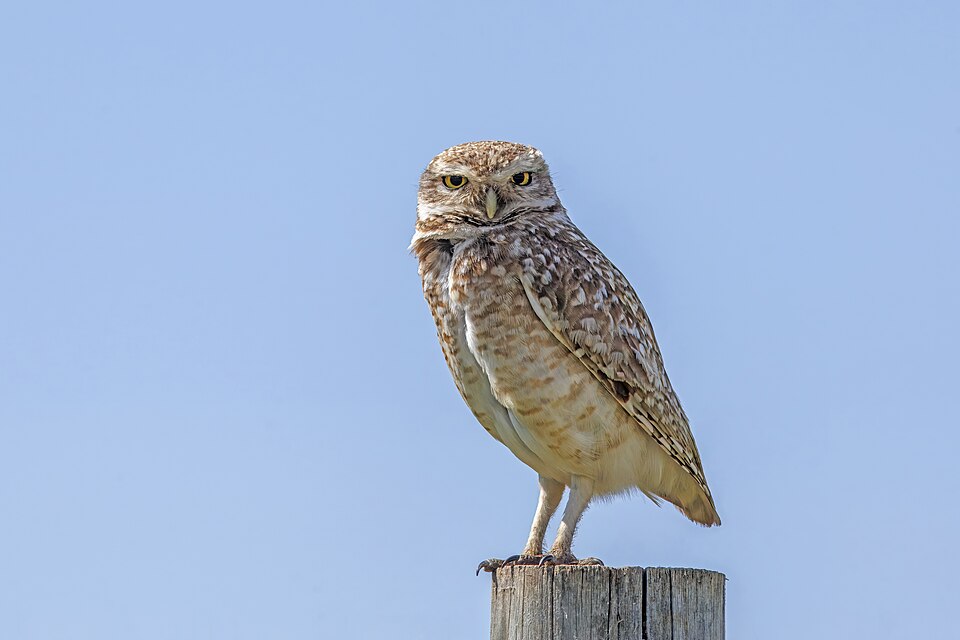
The Burrowing Owl is one of the easiest owls to actually see, because it breaks nearly every rule we associate with owls. Instead of roosting hidden in dense trees, it spends much of its day standing tall on long, bare legs at the mouth of an underground burrow, often in broad daylight. Find a patch of short-grass prairie, a prairie dog town, an airport margin, a golf course, or a vacant lot in the right part of the country, and you may spot one perched on a fence post or a low mound, swiveling that round, flat-faced head to watch you right back.
For backyard birders this is a thrilling owl precisely because it is a creature of open ground rather than deep forest. It is small (roughly robin-bodied but longer-legged), tied to the burrows of digging mammals, and active across the day, so it rewards patient watching. Sadly, those same open habitats are exactly what gets paved, plowed, and developed, which is why this characterful little owl has been declining across much of its range even as it remains locally common where good grassland survives.
Think "owl on stilts." The Burrowing Owl is a small, rounded owl with a strikingly upright, leggy stance, no ear tufts, and a flat-topped head. When it stands at attention on the ground or a low perch, the long legs and short tail give it an unmistakable profile no other North American owl shares.
| Size & shape | Small and compact, about the size of a robin but taller, with notably long, sparsely feathered legs and a short tail. No ear tufts; rounded, flat-crowned head. |
| Upperparts | Sandy brown heavily spotted and barred with white or buff, giving a freckled, dappled appearance that blends with dry soil and grass. |
| Underparts | Whitish to buff, barred with brown across the breast and belly; the throat shows a pale collar that flares when the bird bobs. |
| Face & eyes | Bright lemon-yellow eyes set in a pale, loosely defined facial disk, framed by white eyebrows and a white chin stripe. |
| Behavior | Often perches on the ground or low posts in daylight; bobs and bows the whole body when alarmed or curious. |
| In flight | Long-winged and undulating low over open ground, sometimes hovering briefly like a small harrier or kestrel before dropping on prey. |
Male vs. female
Males and females look nearly identical and are hard to tell apart in the field. The clearest clue is seasonal and behavioral: during the breeding season males are often paler and more bleached-looking, because they spend more time standing guard in the sun outside the burrow while the female incubates below ground, where her plumage stays a richer, darker brown. Males also average very slightly larger, but the difference is too small to call reliably on a lone bird.
Juveniles
Recently fledged young are easy to recognize. They are buffier overall, with largely unbarred, plain pale-buff or cinnamon underparts rather than the crisp brown barring of adults, and they look softer and fluffier. Juveniles emerge to stand at the burrow entrance well before they can fly strongly, often lined up like a row of bobbing fenceposts beside the adults in early to midsummer.
The Burrowing Owl's signature sound is a soft, two-note coo given by the male, often rendered as coo-coooo or who-whooo, mellower and more dovelike than you'd expect from an owl. It's delivered mostly at dawn and dusk and at night during courtship and territory defense.
The most famous vocalization, though, is the alarm call: a buzzy, hissing rattle that startlingly mimics the warning buzz of a rattlesnake. A threatened owl, especially a chick deep in the burrow, will produce this raspy rrrrrr hiss, which is thought to deter predators that reach into the tunnel. Adults also give sharp chattering and chuckling notes, clucks, and screams when agitated.
Burrowing Owls occupy open country across the Americas. In North America the western subspecies breeds through the Great Plains, the Intermountain West, the Southwest, and into the grasslands and deserts of Mexico, reaching north into the Canadian prairies of Alberta, Saskatchewan, and Manitoba. A separate resident population, the Florida Burrowing Owl, lives year-round in central and southern Florida, where it favors pastures, prairies, and even suburban lots. The species also ranges widely through Central and South America.
Northern and interior breeders are migratory, withdrawing south for winter to the southern United States, Mexico, and beyond, while birds in the milder Southwest, California, Florida, and Latin America are largely year-round residents. Spring arrival on northern breeding grounds is typically in March and April, with a return south in September and October.
This is an opportunistic hunter with a broad menu. Large insects make up a huge share of the diet, especially beetles, grasshoppers, crickets, and moths, which the owl snaps up on the ground or catches in the air. It also takes small mammals such as voles, mice, ground squirrels, and young rabbits, plus small birds, lizards, snakes, frogs, and even scorpions.
Burrowing Owls hunt around the clock but peak at dawn and dusk. They sprint and hop after insects on foot, pounce from a low perch, and will hover or course low over the grass like a tiny harrier. One charming and well-documented habit: they sometimes gather mammal dung and scatter it around the burrow entrance, which appears to bait in dung beetles for easy eating.
True to its name, this owl nests underground. Rather than digging much itself, it relies on the abandoned burrows of fossorial mammals, prairie dogs and ground squirrels in the West, gopher tortoises and armadillos elsewhere, though the Florida population and birds in soft soil will excavate or enlarge their own tunnels. The pair lines the nest chamber at the end of the burrow with dry dung, grass, feathers, and debris.
The female lays a clutch of about 6 to 11 white eggs and does almost all the incubating for roughly 28 days while the male hunts and stands sentinel above. Chicks hatch helpless, climb to the burrow mouth at around two weeks to beg and sunbathe, and fledge at roughly six weeks. Pairs usually raise a single brood per year and often reuse productive burrow colonies in successive seasons.
The Burrowing Owl is not a feeder or birdhouse-in-the-maple sort of bird, so you won't lure one with seed or suet. It is a specialist of wide-open, short-grass ground with available burrows, and that habitat, not handouts, is what draws it. If you happen to own or steward acreage in its range, though, there are real, proven ways to roll out the welcome mat.
- Protect open, short-grass habitat. These owls need wide sightlines and bare or sparsely vegetated ground; mowing or grazing to keep grass low makes a site attractive.
- Conserve the diggers. Where legal and safe, tolerating prairie dogs, ground squirrels, or gopher tortoises provides the burrows the owls absolutely depend on.
- Install artificial nest burrows. In areas with active conservation programs, buried chambers connected to the surface by a length of tubing are readily adopted, especially near other owls.
- Avoid rodenticides and broad insecticides, which poison the small mammals and insects the owls eat and can kill the owls directly.
- Give nesting birds distance and quiet during the breeding season, and keep dogs and cats away from burrow entrances.
- Report sightings to a local birding or conservation group; known colonies are often monitored and legally protected.
- Short-eared Owl: Also hunts low over open grassland by day, but it is much larger, has dark eye-patches on a paler face, mothlike flapping flight, and normal-length legs; it does not perch upright on the ground at burrows.
- American Kestrel: A small open-country raptor often seen on the same fence posts, but it is a falcon with pointed wings, a long tail, dark eyes, and bold facial stripes rather than yellow eyes and a round owl face.
- Northern Saw-whet Owl: Similar small size, but a strictly nocturnal forest owl with short legs that roosts hidden in dense conifers, never standing upright on open ground in daylight.
- Western Screech-Owl: Comparable in size and range, but it has ear tufts, a tree-cavity lifestyle, and is camouflaged against bark; it never adopts the leggy, ground-standing posture of a Burrowing Owl.
Do Burrowing Owls really live underground?
Yes. They roost and nest in underground burrows, usually ones dug by mammals like prairie dogs or ground squirrels, though some populations dig or enlarge their own. They are one of the only owls that nest below the surface.
Are Burrowing Owls active during the day?
They are, which is part of what makes them so spotable. They forage most at dawn and dusk but commonly stand watch outside the burrow in full daylight, unlike most owls that hide and sleep until dark.
Why does a Burrowing Owl bob up and down?
The whole-body bobbing and bowing is a sign of alarm or alertness. It helps the owl judge distance to a potential threat and signals agitation; the more nervous the bird, the more vigorously it bobs.
Do Burrowing Owls really imitate rattlesnakes?
Their defensive hiss does sound remarkably like a rattlesnake's buzz, especially from a chick deep in a burrow. It is widely believed to deter predators that might otherwise reach into the tunnel after the young.
Are Burrowing Owls endangered?
Globally they are listed as Least Concern, but they are declining across much of their range and are considered threatened, endangered, or of special concern in several U.S. states and Canada, mainly due to loss of grassland habitat and burrowing mammals.