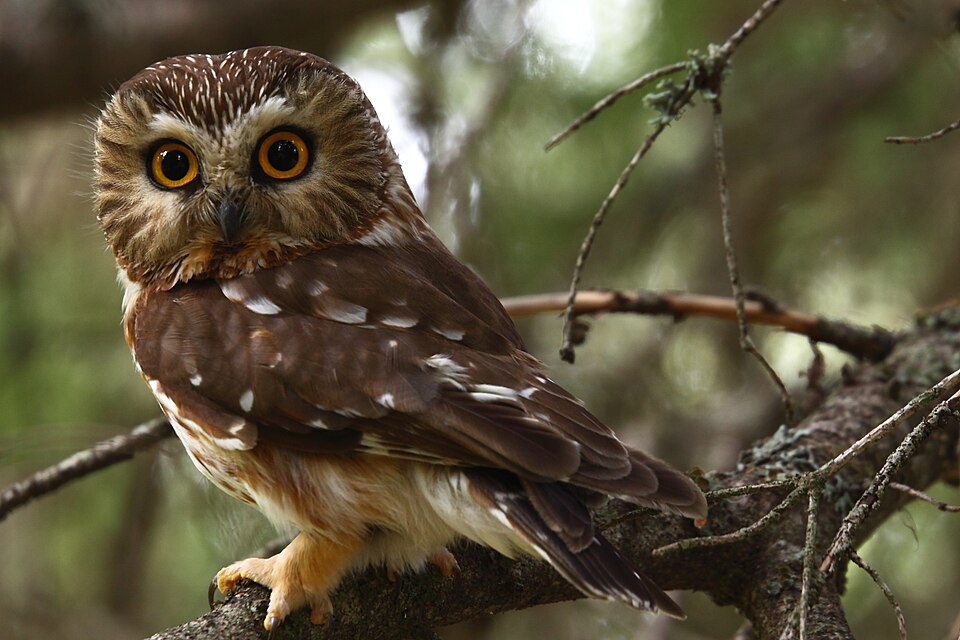
The Northern Saw-whet Owl is one of the smallest owls in North America, a round-headed sprite barely bigger than a robin and light enough to perch on a pencil-thin twig. For most of the year it is almost impossible to see, roosting motionless in dense conifers and cedar thickets by day and hunting under cover of darkness. Yet in late winter and early spring the males give themselves away with one of the most distinctive sounds in the northern woods: a steady, monotonous tooting that can carry for hundreds of yards and go on, tirelessly, for hours.
What this owl lacks in size it makes up for in charm. It has an oversized, rounded head, big yellow eyes set in a soft brown facial disk, and no ear tufts, giving it an almost cartoonish, wide-eyed expression. Famously tame on the roost, a saw-whet will often let a careful observer approach within a few feet, relying on its camouflage rather than flight. Banding stations across the continent have revealed that this little owl is far more numerous and migratory than anyone once suspected, slipping south through the night by the thousands each autumn.
Identify the Northern Saw-whet Owl by its tiny size, oversized round head with no ear tufts, and bright yellow eyes set in a reddish-brown face. It is a compact, almost neckless little owl, noticeably smaller and rounder-headed than a screech-owl.
| Size | Very small - only 7-8.5 in long, smaller than an American Robin and roughly fist-sized |
| Head | Large, rounded, and tuftless, with a soft brown facial disk and pale Y or V-shaped marks between the eyes |
| Eyes | Large and bright yellow, giving a wide-eyed, surprised expression |
| Upperparts | Warm reddish-brown above with scattered white spots on the back and wings |
| Underparts | White below with broad, blurry rusty-brown vertical streaks |
| Bill & feet | Dark bill (not pale); feet feathered to the toes |
Male vs. female
Male and female Northern Saw-whet Owls look essentially identical in plumage, so you cannot reliably tell them apart by sight in the field. As with most owls, the female is the larger and heavier of the two, but the difference is slight and only obvious when birds are measured in the hand at a banding station. Behavior offers a better clue during breeding season: it is the male who delivers the persistent tooting song to defend a territory and attract a mate, while the female does most of the incubating and brooding at the nest.
Juveniles
Juvenile saw-whet owls look strikingly different from adults and are unmistakable once you have seen one. Recently fledged young are a rich chocolate-brown above and on the chest, with an unmarked, warm tawny-orange or cinnamon belly and a bold white triangle or eyebrow mark between the eyes. They lack the streaked underparts of adults entirely. This handsome juvenile plumage is held only briefly through the summer; by their first fall they molt into the streaked, adult-like plumage they will keep for life.
The signature sound is the male's advertising song: a long, steady series of single low whistled toots, toot-toot-toot-toot, repeated at a rate of roughly two notes per second and often continuing without pause for minutes on end. Many describe it as the sound of a small, repetitive bell or the backup beeper of a truck heard far off in the night. It is given mainly from late winter into spring (often January through May) and can carry a remarkable distance through cold, still air.
The bird's odd name comes from another vocalization: a harsh, rasping, two-note call once likened to the sound of a saw being whetted (sharpened) on a stone. Saw-whets also give a variety of squeaks, soft whines, and a sharper tssst or wail, especially near the nest or when alarmed. Outside the breeding season they are largely silent, which is part of why they so often go undetected.
Northern Saw-whet Owls breed across the forests of southern Canada and the northern United States, south through the Appalachians in the East and down the Rocky Mountains and Pacific coastal ranges in the West, wherever there are suitable conifer or mixed woodlands. A distinctive non-migratory subspecies is resident on the Queen Charlotte Islands (Haida Gwaii) off British Columbia.
In winter, many northern breeders move south, and the species can turn up across much of the central and southern United States in dense cover. This migration is far heavier than was long believed: continent-wide banding projects capture huge numbers of southbound owls each fall, mostly passing through silently at night. Numbers vary year to year, with bigger flights following good breeding seasons fueled by rodent population peaks.
The Northern Saw-whet Owl is a fierce little predator that lives mainly on small mammals. Deer mice and white-footed mice are the staples across much of its range, supplemented by voles, shrews, young squirrels, and other rodents. It also takes small birds, large insects, and occasionally bats. A prey item like a mouse is often too big to swallow whole, so the owl will eat it in pieces over more than one sitting.
It hunts at night from a low perch, dropping silently onto prey detected by its exceptional hearing - its asymmetrical ear openings let it pinpoint a rustling mouse in total darkness. In cold weather a saw-whet may cache surplus prey, and there is a charming detail to this habit: a frozen, cached mouse is sometimes thawed by the owl sitting on it as if incubating an egg before it settles down to eat.
Northern Saw-whet Owls are cavity nesters and do not build a nest of their own. They rely on old woodpecker holes - especially those of Northern Flickers and Pileated Woodpeckers - as well as natural tree cavities, and they take readily to nest boxes of the right size. The female lays her eggs on whatever debris lies at the bottom of the cavity, with no added lining.
A typical clutch is about 5 to 6 white eggs, occasionally as many as 7 or more in food-rich years, with usually a single brood per season (a male with abundant prey may occasionally pair with a second female). The female does all the incubating, roughly four weeks, and broods the young while the male delivers food. Once the chicks are larger, the female often leaves to begin molting or even to re-nest, leaving the male to feed the brood until the young fledge at around four to five weeks old.
This is not a feeder bird, and you will never lure one with seed or suet - it eats live mice, not handouts. But it is one of the few owls you can realistically encourage to nest on your property if you have the right habitat, and the surest way to find one is to put up the right kind of nest box in the right kind of woods.
- Put up a saw-whet nest box. A box with roughly a 5 x 5 inch floor and a 2.5 to 3 inch entrance hole (Northern Flicker box dimensions) mounted 8 to 15 feet up on a tree at the edge of woodland can attract a breeding pair.
- Have the right habitat. Saw-whets favor dense conifers and mixed forest near openings or wetlands. A wooded lot with mature trees and thick evergreen cover is far more likely to host one than an open suburban yard.
- Add a few inches of wood shavings to the bottom of the nest box, since the owls add no nesting material of their own.
- Keep mouse-friendly habitat. Brush piles and uncut field edges support the rodents these owls hunt, making your area more attractive to a wintering or nesting bird.
- Listen at dusk in late winter and spring. The monotonous tooting song is the easiest way to confirm one is present; learn it and step outside on still March evenings.
- Check dense evergreens for day roosts. Look low in cedars, spruces, and tangles of conifer for a roosting owl, and if you find one, admire it from a respectful distance and keep the location quiet.
- Eastern Screech-Owl: Larger, with prominent ear tufts and either gray or rufous plumage; its whinnying and trilling calls are completely different from the saw-whet's steady toot.
- Boreal Owl: A close northern relative that is noticeably larger with a pale (whitish) bill, a black-framed facial disk, and white spotting on the forehead rather than streaks; ranges overlap mainly in the far north.
- Northern Pygmy-Owl: Even smaller and long-tailed, with a more rounded crown finely spotted and false eyespots on the back of the head; hunts by day, unlike the strictly nocturnal saw-whet.
- Flammulated Owl: Similar tiny size but has dark brown eyes (not yellow), small ear tufts, and a low hooting voice; a western pine-forest migrant rather than a conifer-thicket resident.
Why is it called a saw-whet owl?
The name comes from one of its calls - a harsh, rasping note that early observers thought sounded like a saw blade being sharpened (whetted) on a whetstone. Ironically, the sound most people associate with the bird today is its monotonous tooting song, not the rasp that gave it its name.
How big is a Northern Saw-whet Owl?
It is tiny - only about 7 to 8.5 inches long and weighing roughly 2.5 to 3.5 ounces, less than a small can of soda. It is one of the smallest owls in North America, smaller than an American Robin, with a wingspan of around 17 to 22 inches.
When and where can I hear or see one?
Listen on still nights from late winter into spring (roughly January to May), when males toot persistently to attract mates. By day they roost hidden in dense conifers and cedar thickets. Many also migrate south through the U.S. in fall, so wintering birds can turn up in evergreen cover well south of the breeding range.
Are Northern Saw-whet Owls rare or endangered?
No. They are listed as Least Concern and are fairly common across their range, but they are so small, nocturnal, and secretive that they are vastly underdetected. Banding stations regularly catch large numbers during migration, revealing that the species is far more numerous than casual observation suggests.
Will a saw-whet owl use a nest box in my yard?
It can, if you have the right habitat - dense conifer or mixed woodland near openings or water. Use a box with about a 5 x 5 inch floor and a 2.5 to 3 inch entrance hole (Northern Flicker dimensions), mounted 8 to 15 feet up, with a few inches of wood shavings in the bottom. Open suburban yards without nearby woods are unlikely to attract one.