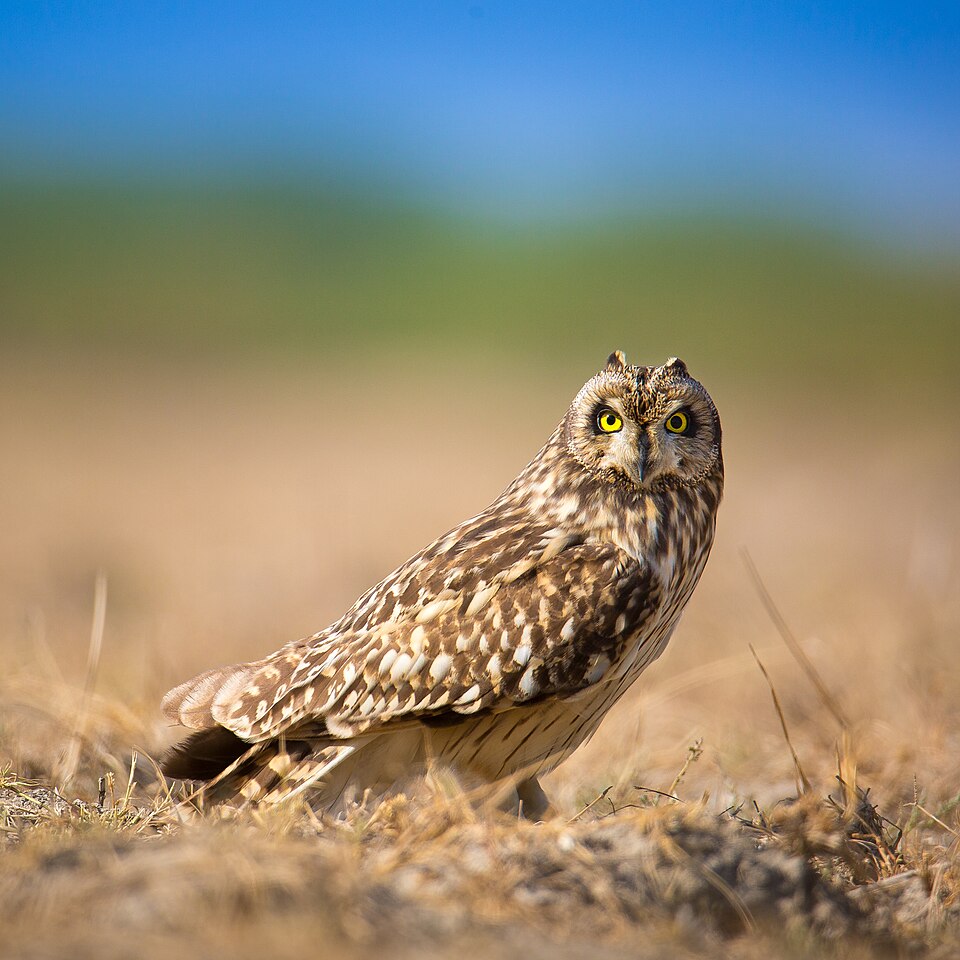
The Short-eared Owl is one of the few owls you have a real chance of seeing in broad daylight. It hunts over open country with a slow, floppy, moth-like flight, tilting and wheeling low over grass and marsh as it listens for voles. With its round, pale face, piercing yellow eyes ringed in dark, and long wings, it looks unlike almost any other North American owl on the wing. Where prey is abundant it can gather in loose groups, several birds quartering the same field at dusk.
This is a bird of wide-open spaces rather than woodlots. It favors prairie, tundra, coastal dunes, reclaimed farmland, airfields, and large marshes across the Northern Hemisphere. Its fortunes rise and fall with rodent cycles, so numbers in any given area can swing dramatically from year to year. Grassland loss has made it scarcer in many regions, and it is a conservation priority in much of its range, which makes a sighting feel like a genuine gift.
In flight the Short-eared Owl is a medium-large, long-winged owl with a big rounded head and a notably short tail, flapping in a loose, irregular, almost butterfly-like rhythm interspersed with stiff-winged glides. Perched on the ground or a low post it sits fairly upright with a flat, broad facial disk. The "ears" of its name are tiny feather tufts that are usually invisible and only raised when the bird is alarmed.
| Overall color | Tawny-buff to sandy brown above, heavily streaked; paler below with bold dark streaking on the chest fading to a cleaner belly. |
| Face | Round, pale facial disk with staring yellow eyes set in smudgy black 'mascara' patches that give a fierce, surprised look. |
| Ear tufts | Very short and usually flattened out of sight; raised only briefly when alert, never the long 'horns' of a Long-eared Owl. |
| Wings in flight | Long and broad with a distinctive buffy patch near the wingtip on the upperwing and a bold dark comma at the 'wrist' on the underwing. |
| Flight style | Low, buoyant, and erratic with deep loose wingbeats and tilting glides, often quartering back and forth over a field. |
| Size | Crow-sized body but with a wingspan well over three feet, giving it a deceptively large, rangy look aloft. |
Male vs. female
Males and females look broadly similar and are hard to separate with certainty in the field, but there are useful tendencies. Males average paler and colder-toned, with whiter underparts and lighter, sandier upperparts, and they show less heavy streaking on the belly. Females tend to be larger, darker, and warmer buff overall, with more extensive streaking below. In a courting pair flying together, the paler bird is usually the male, but lone birds are best left unsexed.
Juveniles
Recently fledged young leave the nest on foot before they can fly and are sometimes called "branchers" or simply runners as they scatter into the grass. Downy chicks are buff with a darker face, and juveniles soon resemble adults but look fluffier and more uniformly warm-buff, with a darker, less sharply defined facial disk and softer streaking. By their first autumn they are essentially adult-like and difficult to age in the field.
Short-eared Owls are fairly quiet for much of the year, but on the breeding grounds the male gives a low, hollow, pulsing series of hoots during a display flight high overhead, a soft voo-voo-voo-voo-voo repeated rapidly, almost like a distant muffled engine or someone blowing across a bottle. It is surprisingly easy to overlook.
The most memorable sound is the wing-clap: a displaying male claps his wings together beneath his body in a sharp burst as he tumbles in a "sky-dance." When agitated near the nest or in disputes, both sexes give a raspy, barking, scratchy kee-aw or waow and various wheezy hisses and squeals.
The Short-eared Owl is one of the most widespread owls in the world, breeding across northern North America, Europe, and Asia, with island populations as far afield as Hawaii (the native pueo) and South America. In North America it nests across Alaska, northern and central Canada, and the northern United States, favoring tundra, prairie, and large marshes.
In winter it withdraws from the far north and spreads across much of the United States and into Mexico, turning up on coastal marshes, grasslands, airports, and agricultural fields. It is a nomadic, irruptive wanderer that follows rodent abundance, so it can be numerous in a region one winter and nearly absent the next. Look for it at dusk and dawn from late fall through early spring across open country.
Voles are the heart of this owl's diet, and in many areas its breeding success tracks vole populations almost exactly. It also takes mice, shrews, pocket gophers, young rabbits, and other small mammals, supplemented by birds, especially on islands and coastlines where it may hunt shorebirds and songbirds.
It hunts mainly by quartering low over open ground, flying slowly into the wind and dropping feet-first onto prey detected by its exceptionally acute hearing as much as its eyesight. Unusually among owls, it is frequently active in daylight, particularly the last hours before dark and early morning, which is exactly why birders have such a good shot at watching it work a field.
Almost alone among North American owls, the Short-eared Owl nests on the ground. The female scrapes a shallow depression in dense grass or low vegetation, sometimes lining it with grasses and a few feathers, often on a slight rise that offers a view. This ground-nesting habit leaves eggs and young vulnerable to flooding, mowing, grazing, and predators such as foxes, skunks, and Northern Harriers.
Clutch size is closely tied to food supply and can be large in good vole years. The female does the incubating while the male delivers prey, and she begins sitting with the first egg, so chicks hatch at staggered sizes. Young leave the nest on foot well before fledging, dispersing into surrounding cover where the parents continue to feed them.
The Short-eared Owl is not a backyard or feeder bird, and there is no realistic way to draw one to a typical yard. It needs large, open, undisturbed grasslands and marshes to hunt and nest. That said, you can support it on the landscape scale and improve your odds of seeing one.
- Protect open grassland and wet meadow if you own or manage acreage, avoiding mid-season mowing that destroys ground nests.
- Go where it lives: scan large fields, reclaimed mines, airfields, coastal marshes, and prairie at dusk in late fall and winter.
- Time it right: the last hour before dark and the first light of morning are prime, especially on calm evenings.
- Watch from your car along field edges, which serves as an excellent blind and keeps you from flushing hunting birds.
- Support rodent-friendly habitat by avoiding rodenticides, which poison the voles owls depend on and can kill the owls themselves.
- Long-eared Owl: Slimmer, strictly nocturnal woodland-edge owl with long upright ear tufts, orange face, and rusty tones; rarely seen flying by day.
- Northern Harrier: A hawk, not an owl, but shares the same low quartering flight over fields; look for its white rump patch, longer tail, and flat (not round) head.
- Barn Owl: Also pale and open-country, but with a heart-shaped white face, dark eyes, golden back, and ghostly white underparts; almost entirely nocturnal.
- Great Horned Owl: Far larger and bulkier with prominent true ear tufts, a barred body, and deep hooting; a perch-and-pounce woodland hunter, not a field-quartering flier.
Why is a Short-eared Owl out flying during the day?
It's normal. Short-eared Owls are among the most diurnal of owls, hunting actively at dusk, dawn, and even midday in winter. Their food, voles, are active around the clock, and hunting in low light over open country suits this owl's keen hearing and buoyant flight.
How can I tell a Short-eared Owl from a Northern Harrier?
Both glide low over fields, but the harrier is a hawk with a flat head, longer tail, narrower wings, and a flashing white rump patch. The owl has a big round head, broad blunt wings, a short tail, and a floppy, moth-like flight, plus pale buffy wing patches and dark wrist commas.
Where is the best place to see a Short-eared Owl?
Large open grasslands and marshes: prairie, reclaimed mine land, coastal salt marsh, airfields, and weedy reclaimed farmland. Scan these areas at dusk in late fall and winter, watching for a long-winged owl quartering low over the grass.
Do Short-eared Owls really nest on the ground?
Yes. Unusually for North American owls, they nest in a shallow scrape on the ground hidden in dense grass. This makes their nests vulnerable to mowing, flooding, grazing, and ground predators, one reason the species is declining in many areas.
Are Short-eared Owls endangered?
Globally they are listed as Least Concern, but they are declining across much of North America and are a species of conservation concern in many states and provinces due to the loss of grassland and marsh habitat. Local numbers also swing widely with rodent cycles.