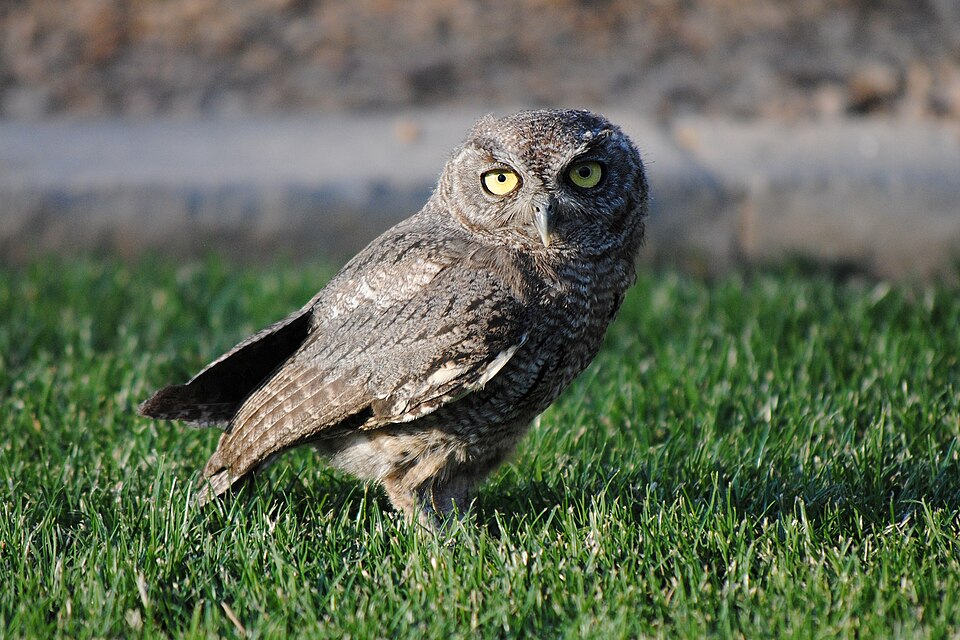
The Western Screech-Owl is one of the West's most widespread small owls, yet most people who live alongside it never know it's there. Barely taller than a soda can, it spends its days dozing in a tree cavity or tucked against a trunk, where its bark-colored plumage makes it almost impossible to spot. Come nightfall it slips out to hunt, and its presence is far more often heard than seen, a soft, accelerating series of whistles drifting from a wooded canyon, a desert wash, or a leafy neighborhood after dark.
Despite its name, this owl doesn't screech. The "screech-owl" label is a holdover that fits its eastern cousin no better. What makes the Western Screech-Owl worth knowing is its sheer adaptability: it thrives from the deserts of the Southwest to the wet coastal forests of the Pacific Northwest, from cottonwood-lined rivers to suburban backyards with mature trees. If you live in the western half of North America and have big trees nearby, there's a real chance one of these owls is hunting your yard while you sleep.
Look for a small, compact, large-headed owl with prominent ear tufts that it can raise or flatten depending on its mood. When alarmed or roosting in the open, it stretches tall and thin to mimic a broken branch; when relaxed, it looks round and squat. The bill is dark to blackish, a useful, reliable mark.
| Size | Small and stocky, roughly robin-sized but bulkier, with a large rounded head |
| Ear tufts | Prominent, pointed tufts that can be raised into 'horns' or laid flat |
| Plumage | Intricately streaked and vermiculated in gray-brown (some birds reddish-brown), mimicking tree bark |
| Eyes | Bright lemon-yellow irises |
| Bill | Dark gray to blackish, a key feature separating it from the Eastern Screech-Owl |
| Facial disk | Pale grayish face bordered by a darker rim, with fine streaking |
| Underparts | Whitish below with bold vertical streaks crossed by finer horizontal barring |
Male vs. female
Males and females look alike in plumage and color, so you can't reliably tell them apart by sight. As with most owls, the female is the larger and heavier of the pair, but the size difference is slight and hard to judge in the field. Voice offers a better clue during the breeding season: the male's call is typically lower-pitched, while the female answers in a higher, slightly thinner voice, and paired birds often duet back and forth.
Juveniles
Recently fledged young are softer and fluffier than adults, with downy, loosely barred plumage that lacks the crisp bark-like patterning of grown birds. Their ear tufts are short and barely developed, giving the head a rounder, more uniform look. Juveniles already show the yellow eyes and dark bill, and they often beg with raspy, insistent calls near the nest for several weeks after leaving the cavity while parents continue to feed them.
The signature song is the "bouncing ball" trill: a series of short, hollow whistled hoots that start slow and accelerate, like a dropped ping-pong ball coming to rest, poo... poo... poo-poo-poo-poo-poopoopoopoo. It's mellow rather than harsh, and on a still night it carries surprisingly far.
A second common vocalization is the "double trill," a short trill immediately followed by a longer one, often used between members of a pair. You may also hear soft barks, a sharp kew-kew-kew, and bill-snapping when the bird is agitated. Mated pairs frequently duet, the two voices overlapping in the dark, one of the most atmospheric sounds of a western night.
The Western Screech-Owl is a year-round resident across much of western North America, from southeastern Alaska and coastal British Columbia south through the Pacific states, the Rockies, the Great Basin, and the Southwest deep into Mexico. It does not migrate; pairs typically hold the same territory throughout the year and often for life.
Its habitat is remarkably broad: oak and riparian woodlands, pinyon-juniper, cottonwood groves along desert rivers, saguaro stands in the Sonoran Desert, suburban parks, and backyards with mature trees. The main requirement is trees or large cacti with cavities for roosting and nesting. In the desert Southwest it overlaps with the closely related Whiskered Screech-Owl, which favors higher-elevation oak canyons.
This little owl is a versatile, opportunistic hunter. Its core diet is small mammals, mice, voles, woodrats, and pocket gophers, along with large insects like beetles, moths, crickets, and grasshoppers. It also takes small birds, lizards, and in some areas earthworms, crayfish, and other invertebrates. Remarkably for its size, it sometimes kills prey as large as itself, including rats and small cottontails.
It hunts mostly by sit-and-wait ambush, perching on a low branch and watching or listening for movement, then dropping silently onto prey. Soft-fringed flight feathers let it fly almost soundlessly. It also hawks flying insects on the wing and will snatch prey from the ground or off foliage. Like all owls, it coughs up pellets of undigested fur, bone, and insect parts, which collect beneath favored roosts.
Western Screech-Owls are cavity nesters that don't excavate their own holes. They rely on natural tree cavities, old woodpecker holes (especially those of flickers and other large woodpeckers), holes in saguaro cacti, and readily accept nest boxes. The female does all the incubating while the male hunts and delivers food to her at the nest.
Pairs add no nesting material, eggs are laid directly on whatever debris lies at the bottom of the cavity. The female lays a clutch of typically 2 to 5 white, nearly round eggs and incubates them for roughly a month. The young remain in the cavity for about four to five weeks before fledging, then stay near the parents while learning to hunt. Most pairs raise a single brood per year.
Yes, this is one of the few owls you can genuinely invite into a backyard. It won't visit a seed feeder, but it readily uses nest boxes and will hunt yards that offer cover, perches, and prey. A mature-tree neighborhood within its western range is the ideal setting.
- Put up a nest box sized for screech-owls (about a 3-inch entrance hole, 8x8-inch floor, mounted 10-20 feet up on a tree or post) before late winter, when birds prospect for nest sites.
- Add a few inches of wood shavings to the box floor, since the owls bring no nesting material of their own.
- Keep mature trees and snags when you can, dead limbs and natural cavities provide roosting and nesting spots.
- Avoid rodenticides entirely; poisoned mice and rats can kill the owls that eat them, and a healthy rodent population is exactly what draws owls in.
- Reduce bright outdoor lighting at night so the owls can hunt naturally, and keep cats indoors to protect fledglings.
- Listen at dusk on still nights in late winter and spring for the bouncing-ball song to learn whether a pair already holds your area.
- Eastern Screech-Owl: Nearly identical in shape but ranges barely overlap; Eastern has a pale or greenish-yellow bill (vs. dark) and a very different song, a descending whinny and a long even trill rather than an accelerating bounce.
- Whiskered Screech-Owl: Smaller, found in high-elevation oak canyons of the Southwest; best told apart by voice (an evenly spaced 'Morse code' series) and proportionally smaller feet.
- Northern Pygmy-Owl: Even smaller, lacks ear tufts, has a long tail and false 'eye' spots on the back of the head, and is often active by day.
- Flammulated Owl: Smaller with very short ear tufts and dark eyes (not yellow); a summer-only migrant of mountain pine forests with a soft, deep single hoot.
Do Western Screech-Owls actually screech?
No. Despite the name, they don't screech at all. Their main song is a mellow, accelerating series of whistled hoots known as the 'bouncing ball' call. The 'screech-owl' name is a historical label that fits the group poorly.
Will a Western Screech-Owl use a nest box?
Yes, readily. They're cavity nesters that often accept boxes with about a 3-inch entrance hole, placed 10-20 feet up on a tree or post. Add a few inches of wood shavings inside, since the owls bring no nesting material themselves.
What does a Western Screech-Owl eat?
Mostly small mammals like mice, voles, and woodrats, plus large insects such as beetles and moths. They also take small birds, lizards, and occasionally prey as large as themselves, hunting by ambush from a perch at night.
How can I tell a Western from an Eastern Screech-Owl?
Range is the biggest clue, they barely overlap. Where you must separate them, the Western has a dark (gray to blackish) bill, while the Eastern's bill is pale or greenish-yellow. Their songs differ sharply too: Western gives an accelerating bounce, Eastern a descending whinny and even trill.
Are Western Screech-Owls rare or endangered?
No, they're listed as Least Concern and remain fairly common across the West. They do face local declines from habitat loss, rodenticides, and competition with larger owls, but overall the population is considered stable.
When and where are Western Screech-Owls most active?
They're strictly nocturnal, becoming active around dusk and hunting through the night. The best time to detect one is on a calm evening in late winter or spring, when pairs call and duet to defend territory and attract mates.