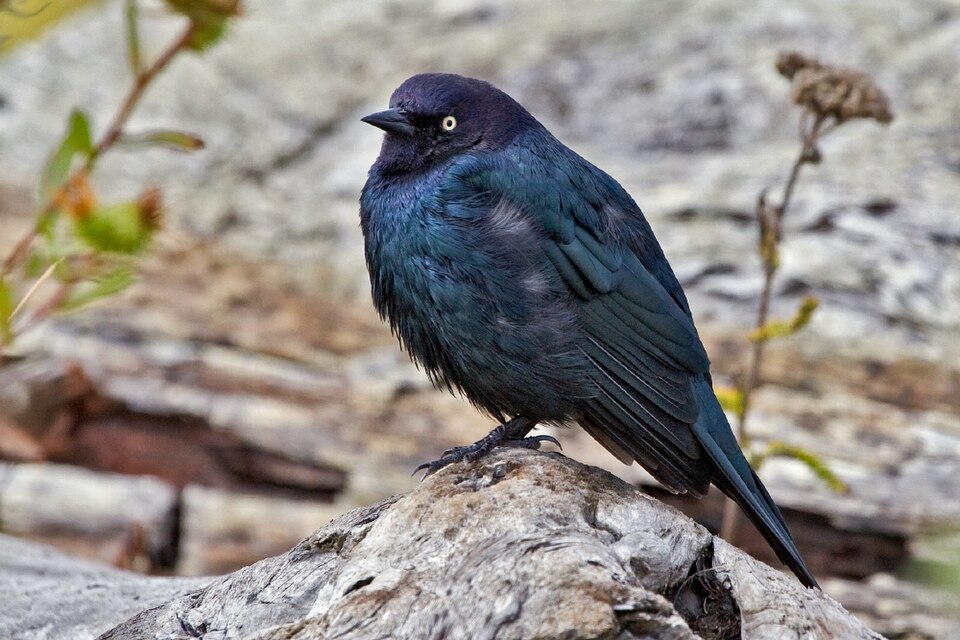
The Brewer's Blackbird is one of the most familiar birds of open country across the western and central United States, yet it's easy to overlook as "just another blackbird." Look closer and the males reward you: a glossy black body that catches the sun in iridescent flashes of purple on the head and bottle-green on the body, finished with a startling pale yellow eye. They stride confidently across lawns, feedlots, and parking lots with a head-bobbing walk, often within a few feet of people who never give them a second glance.
Named for the 19th-century ornithologist Thomas Mayo Brewer, this is a true generalist that has thrived alongside human development. It nests in loose colonies, forages in flocks, and adapts to almost any open habitat from sagebrush flats and irrigated fields to city streets and golf courses. Where the closely related Common Grackle dominates the East, the Brewer's Blackbird fills much the same niche in the West, and the two overlap broadly across the Great Plains.
A slim, medium-sized blackbird with a rounded head, a fairly long tail, and a sharp, straight, conical bill. It's slightly larger and longer-tailed than a starling but distinctly smaller and shorter-tailed than a grackle. On the ground it walks (rather than hops) with a quick, rhythmic head-bob.
| Male plumage | Glossy black overall with iridescent purple on the head and greenish sheen on the body, visible in good light |
| Male eye | Bright pale yellow to whitish eye that stands out against the dark face |
| Female plumage | Plain grayish-brown all over, plainer and darker-eyed than the male |
| Female eye | Dark brown, not yellow - a key way to tell the sexes apart |
| Bill | Black, straight, sharply pointed and conical |
| Shape & gait | Slim body, fairly long tail, walks with a distinctive head-bobbing stride |
Male vs. female
Males and females look quite different. The male is uniformly glossy black with iridescent purple and green highlights and, most distinctively, a pale yellow eye that gives him an alert, slightly fierce expression. The female is much plainer: a soft grayish-brown without iridescence, and her eye is dark brown rather than yellow. If you see a brown blackbird and a black one foraging together with the black one showing a pale eye, you're almost certainly looking at a Brewer's pair.
Juveniles
Juveniles resemble adult females - dull grayish-brown overall with dark eyes and no gloss. Young males gradually develop black, iridescent feathers and a paler eye as they mature toward their first winter, so late-summer flocks can include intermediate-looking birds that are partly brown and partly glossy black. By their first spring, young males are essentially indistinguishable from adult males.
The Brewer's Blackbird is not much of a singer. Its "song" is a short, harsh, creaky note often written as a wheezy k-seee or tsch-eee, given with the wings and tail flared in display. It has a rusty, unmusical quality - more like a squeaky gate than a melody.
The common call is a low, hard chuck or chack, similar to other blackbirds and often given in flight or as flock members keep contact. In a noisy feeding flock you'll hear a steady chorus of these chucks mixed with thin, high whistles.
Brewer's Blackbirds breed across western and central North America, from southern Canada and the Great Plains west to the Pacific coast, and from British Columbia south into the Southwest. They favor open and semi-open habitats: grasslands, sagebrush, agricultural fields, marsh edges, suburbs, and any place with short vegetation and scattered shrubs or low trees for nesting.
In winter, northern and interior populations move south and east, spreading across the southern United States and well into Mexico. Coastal and southwestern birds are largely resident year-round. During winter they form large flocks, often mixing with grackles, cowbirds, and Red-winged Blackbirds at feedlots, fields, and grain spills.
An opportunistic omnivore, the Brewer's Blackbird eats whatever is abundant. In the breeding season it takes large numbers of insects and other invertebrates - beetles, caterpillars, grasshoppers, and aquatic insects - many of them gleaned from the ground or short grass. This insect diet makes it a useful, if unsung, control on agricultural pests.
Outside the breeding season it shifts heavily toward seeds and waste grain, and it readily scavenges crumbs and scraps around restaurants, picnic areas, and parking lots. You'll often see flocks methodically walking across lawns and pavement, probing the turf and picking at whatever they turn up, frequently flipping leaves or debris to expose hidden prey.
Brewer's Blackbirds usually nest in loose colonies of a few to several dozen pairs. The female builds a bulky open cup of twigs, grasses, and rootlets, often reinforced with mud or dried manure and lined with finer grass and hair. Nests are placed in a wide variety of sites - in low shrubs, in the forks of trees, in marsh vegetation, or even on the ground - typically not far above the surface.
The female lays a clutch of eggs that are pale gray to greenish, blotched with brown, and she does most or all of the incubation. Both parents feed the nestlings a protein-rich insect diet. Pairs commonly raise two broods in a season where the climate allows.
Brewer's Blackbirds aren't classic feeder birds in the way chickadees or finches are, but they will visit yards in open or suburban settings, especially in the West, and they'll happily clean up spilled seed below feeders.
- Scatter cracked corn or mixed grain on the ground or a low platform feeder - these ground-foragers prefer eating low rather than clinging to tube feeders.
- Keep a short, open lawn nearby; Brewer's Blackbirds love walking across grass and pavement hunting insects and seeds.
- Expect them mainly in fall and winter flocks, often arriving with grackles, cowbirds, and Red-winged Blackbirds.
- Provide a ground-level or shallow birdbath - they drink and bathe readily where water is open and easy to reach.
- If large flocks overwhelm your feeders, switch to tube feeders with small perches and offer only nyjer or sunflower hearts, which discourage blackbirds while still feeding songbirds.
- Common Grackle: Larger, with a much longer keel-shaped tail and a longer bill; male shows a bronzy or purplish gloss. Overlaps on the Great Plains.
- Brown-headed Cowbird: Smaller with a shorter, thicker, finch-like bill; male has a chocolate-brown head contrasting with a black body, and a dark eye.
- Rusty Blackbird: Very similar yellow eye but favors wet woodlands and swamps; breeding males are duller and winter birds show rusty feather edges.
- European Starling: Chunkier with a short tail and a longer, thinner bill (yellow in breeding season); shows white spangling in winter and a dark eye.
What is the blackbird with the yellow eyes?
In open country across the West, a glossy black bird with a bright pale yellow eye is most likely a male Brewer's Blackbird. The Rusty Blackbird also has a yellow eye but prefers wet woodlands and shows rusty feather edges in winter.
How do I tell a Brewer's Blackbird from a grackle?
Grackles are noticeably larger with a long, keel-shaped (V-shaped) tail and a longer bill. Brewer's Blackbirds are slimmer, shorter-tailed, and the male shows purple-and-green gloss with a pale yellow eye rather than the grackle's bronzy sheen.
Are Brewer's Blackbirds aggressive at feeders?
They aren't especially aggressive toward people, but they arrive in flocks and can crowd out smaller birds and clean out ground feeders quickly. Switching to tube feeders with nyjer or sunflower hearts usually discourages them.
Why do Brewer's Blackbirds walk instead of hop?
Like other blackbirds, they're built for foraging on the ground in open habitats, so they walk with a steady, head-bobbing stride that lets them cover ground efficiently while scanning for insects and seeds.
Where do Brewer's Blackbirds go in winter?
Northern and interior breeders migrate south and east into the southern United States and Mexico, gathering in large flocks at fields and feedlots. Birds along the Pacific coast and Southwest are largely year-round residents.