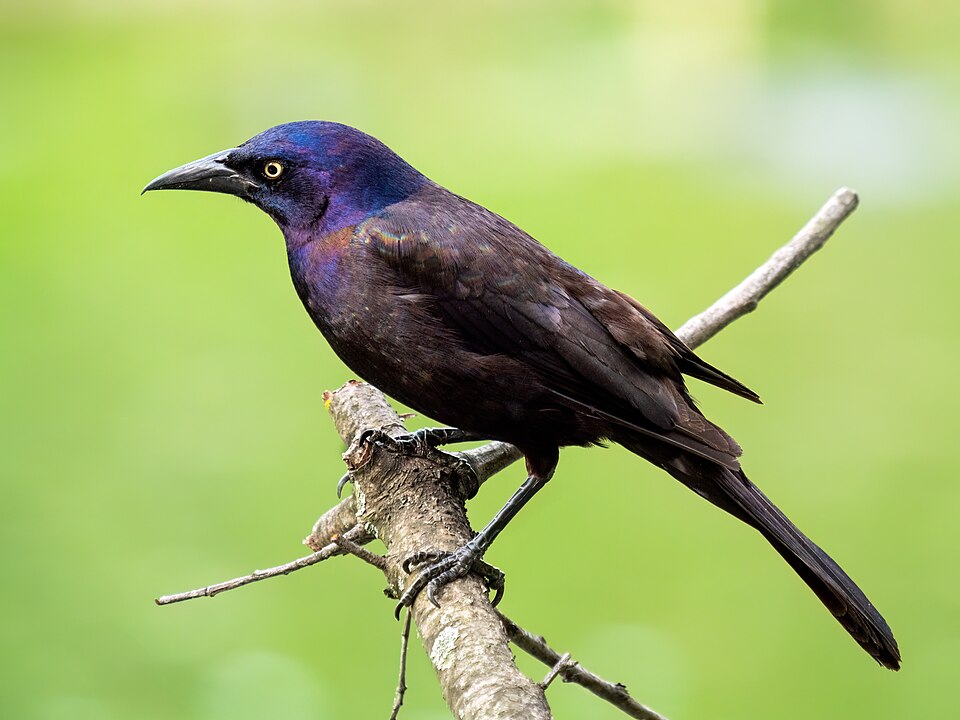
The Common Grackle is one of the most recognizable blackbirds in eastern and central North America, a bird most people have watched striding stiff-legged across a park lawn or descending on a backyard feeder in a noisy, jostling flock. Larger and lankier than a robin, it cuts a distinctive silhouette: a long body, a heavy pointed bill, a long tail it often folds into a deep V, and a piercing pale-yellow eye that gives it a perpetually intense, slightly menacing expression. At a glance it can look plain black, but catch one in good light and its head shimmers a glossy blue-purple while its body glints bronze, green, or steel.
Grackles are loud, gregarious, and unmistakably opportunistic. They roost in enormous mixed flocks with other blackbirds in fall and winter, sometimes numbering in the millions, and they forage on almost anything they can find or steal. Their boldness and adaptability have made them a fixture of farms, suburbs, marshes, and city parks alike. Yet despite their abundance, Common Grackle numbers have fallen sharply over recent decades, a quiet decline that has earned this once-overlooked bird a place on conservation watch lists.
Common Grackles are large, slim blackbirds with a long body and a notably long tail. The best structural cues are the heavy, slightly downcurved bill, the long legs that give them a confident upright walk, and that tail, which males in particular fold lengthwise into a keeled, boat-shaped wedge in flight and display.
| Eye | Bright pale yellow to whitish, staring against the dark head, a key field mark at any distance |
| Plumage | Looks black at a distance; in sunlight shows iridescent blue-purple head and bronze, green, or bluish body sheen |
| Tail | Long and often held in a deep V or keel shape, especially in flight and display |
| Bill | Long, stout, and pointed with a slight downward curve, heavier than a Red-winged Blackbird's |
| Size & shape | Bigger and lankier than a robin, with long legs and an upright, walking posture on the ground |
| Voice | A grating, rising 'readle-eak' like a rusty gate, plus harsh chack notes |
Male vs. female
Males and females look broadly similar but can be told apart with a good view. Males are larger, more strongly iridescent, and show the most dramatic keeled tail, with the blue-purple head and bronzy or greenish body gloss at its brightest. Females are noticeably smaller and duller, with less sheen, a shorter tail, and often a slightly browner cast to the body, though they share the same pale-yellow eye. In a mixed flock, the bigger, glossier, longer-tailed birds are typically males.
Juveniles
Juvenile Common Grackles look quite different from adults and can briefly puzzle backyard birders. They are dull sooty brown to dark gray-brown all over, lacking the metallic iridescence, and crucially they have a dark eye rather than the staring pale eye of adults. Young birds often beg loudly and follow parents around feeders and lawns in summer. As they molt into their first winter, the body darkens and gains gloss, and the eye gradually pales to the adult yellow.
The Common Grackle is not a songbird in the melodic sense, its signature sound is a harsh, mechanical squeak often written as readle-eak or chu-seek, rising at the end like the screech of a rusty gate hinge being forced open. Males deliver it with a stiff, puffed-up posture, fluffing their feathers and partly spreading their wings and tail in a display known as the "song spread."
Beyond that grating squeak, grackles give a wide range of harsh calls: a flat, scolding chack or chuck used as a contact and alarm note, and a babble of clucks and whistles from large flocks that can fill an entire roost with noise. None of it is musical, but it is one of the most characteristic soundscapes of a North American summer.
Common Grackles breed across much of central and eastern North America, from the Great Plains east to the Atlantic and from the Gulf Coast north well into central and eastern Canada. They favor open and semi-open country with scattered trees: farmland, suburbs, city parks, marsh edges, and woodland clearings.
Birds in the north are migratory, moving south in fall to spend the winter across the southeastern and south-central United States, where they gather in immense communal roosts with Red-winged Blackbirds, cowbirds, and starlings. Populations in milder southern and mid-latitude regions are largely year-round residents. Spring migration brings a conspicuous, noisy return north as early as late winter, often among the first signs that the season is turning.
The Common Grackle is a true generalist, eating almost anything it can handle. Its diet shifts with the seasons and includes seeds and waste grain (especially corn), insects, spiders, earthworms, acorns, fruit, and small aquatic animals. They are notorious among farmers for raiding ripening corn and sprouting grain, and among backyard birders for emptying feeders of sunflower and cracked corn in minutes.
Grackles forage mostly on the ground with a deliberate walk, flipping leaves and probing soil, but they are also bold predators and scavengers. They will wade into shallow water for minnows and tadpoles, raid other birds' nests for eggs and nestlings, snatch food from parking lots and dumpsters, and even follow plows for exposed grubs. One memorable habit is "anting" and food-washing, grackles will dunk hard or dry food items, such as dog kibble or stale bread, in water to soften them before eating.
Common Grackles often nest in loose colonies, frequently choosing dense conifers, but they readily use deciduous trees, shrubs, marsh vegetation, and even cavities or human structures. The female builds a bulky, sturdy cup of grasses, twigs, and plant stems, reinforced with mud and lined with finer material, typically placed well off the ground.
She lays a clutch of about 4 to 5 pale eggs marked with brown and purplish scrawls and does the incubating herself for roughly two weeks. Both parents feed the nestlings, which leave the nest after another two weeks or so. Most pairs raise a single brood per year, though a second is possible in the south. Grackles can be aggressive nest defenders and are themselves frequent nest predators of smaller songbirds.
You usually do not need to try to attract Common Grackles, if you live within their range and offer food, they will find you. They are enthusiastic, even overwhelming, feeder visitors, and the real challenge for many backyard birders is the opposite: keeping a flock of grackles from dominating feeders and crowding out smaller birds.
- Scatter cracked corn or mixed grain on the ground or on a low platform, grackles strongly prefer feeding on open, flat surfaces.
- Offer black-oil sunflower seed, peanuts, and suet, all of which grackles readily take at platform and hopper feeders.
- Provide a birdbath or shallow water source; grackles drink, bathe, and famously dunk dry food to soften it.
- To discourage them, switch to feeders with weight-sensitive perches that close under a grackle's weight, or use tube feeders with short perches and small ports.
- Offer safflower seed and nyjer (thistle), which many grackles avoid, to keep cardinals and finches fed without a grackle takeover.
- Avoid open ground feeding if grackles are a problem, clean up spilled seed promptly to reduce the large flocks they attract.
- Boat-tailed Grackle: Much larger with an even longer, broader keeled tail; coastal Southeast; males glossy black, females rich brown. Eye color varies by region (often dark on the Atlantic coast).
- Great-tailed Grackle: Larger and longer-tailed, of the South and West; males have a dramatically longer tail and a brighter pale eye, females are pale brown below.
- Brewer's Blackbird: Smaller and shorter-tailed with a shorter, straighter bill; western counterpart. Males glossy with a yellow eye but lack the grackle's long keeled tail; females are gray with a dark eye.
- Common Grackle vs European Starling: Starlings are chunky and short-tailed with a yellow bill in breeding season and a dark eye, lacking the grackle's long V-shaped tail and pale staring eye.
What is the difference between a grackle and a blackbird?
"Blackbird" is a loose name for several glossy dark icterids. Grackles are a specific group of large, long-tailed blackbirds with heavy bills and pale eyes. Compared with a Red-winged Blackbird or Brewer's Blackbird, a Common Grackle is bigger and lankier, has a much longer tail it often folds into a V, and shows iridescent bronze, blue, and purple in good light.
Why are grackles considered a problem at bird feeders?
Common Grackles arrive in noisy flocks, eat a lot quickly, and prefer the same ground and platform feeding spots as many smaller birds, so they can crowd out cardinals, finches, and sparrows and empty feeders fast. To manage them, switch to safflower or nyjer seed, use weight-sensitive or short-perch feeders, and clean up spilled seed.
Are Common Grackle populations declining?
Yes. Despite still being abundant and widespread, Common Grackles have declined substantially over recent decades, by well over half since the mid-20th century by some estimates. The causes likely include changes in agriculture, habitat loss, and control efforts at large roosts. The trend has put this familiar bird on conservation watch lists.
What does a Common Grackle sound like?
Its signature sound is a harsh, rising squeak often written as 'readle-eak,' likened to a rusty gate hinge. Grackles also give a flat scolding 'chack' or 'chuck' note, and large flocks produce a loud babble of clucks and whistles at their roosts. None of it is melodic.
How can I tell a male Common Grackle from a female?
Males are larger, glossier, and have a longer tail that folds into a deeper keel, with brighter blue-purple heads and bronzy bodies. Females are smaller and duller with shorter tails and less sheen. Both adults share the distinctive pale-yellow eye, while juveniles are dull brown with a dark eye.