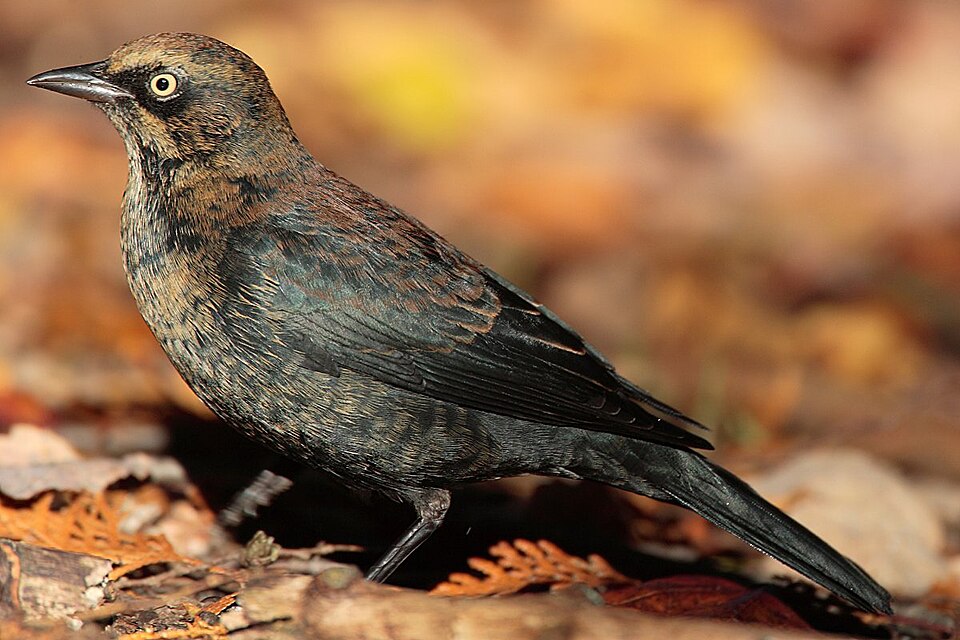
The Rusty Blackbird is the quiet, wetland-loving member of the blackbird family that most birders never quite get to know. Unlike the brash Common Grackle or the roadside-flock Red-winged Blackbird, this is a bird of flooded woods, beaver ponds, and boggy spruce forests across the boreal north. For much of the year it wears a plain, glossy dark coat brightened only by a startlingly pale, pale-yellow eye. Then, in autumn, it transforms, feather edges of warm cinnamon and rust scallop across its body, giving the species its name and one of the more beautiful seasonal makeovers in North American birds.
What makes the Rusty Blackbird matter so much right now is its trouble. Once abundant, the species has suffered one of the steepest long-term population declines of any North American landbird, estimates point to losses well upward of 85 percent over the past half-century or so. The exact causes are still being pieced together, but loss of wooded wetlands on both the breeding and wintering grounds, along with methylmercury contamination in the swamps where it feeds, are leading suspects. Spotting one isn't just a nice tick on a list; it's a small window into the health of forested wetlands.
Rusty Blackbirds are medium-sized, slim blackbirds, a touch larger than a Red-winged Blackbird, clearly smaller and slimmer-tailed than a grackle. They have a longish, slender body, a fairly thin, sharply pointed bill, and a rounded tail of even length (not the long, keeled tail of a grackle). The single most useful field mark in any season is the pale, staring yellow eye, which jumps out against the dark face.
| Eye | Pale yellow to whitish, conspicuous in all plumages and both sexes, the key fieldmark. |
| Bill | Slender, sharply pointed, and slightly downcurved, thinner than a grackle's heavy bill. |
| Fall plumage | Bold rusty and buff feather edges scalloping the head, back, and breast; a pale buff eyebrow. |
| Breeding male | Mostly flat black with a faint greenish (not purple) gloss; little to no rust. |
| Tail | Medium length, rounded, and even, lacks the long, wedge-shaped, keeled grackle tail. |
| Size & shape | Slim and medium-sized, roughly robin-length but slimmer; smaller than Common Grackle. |
Male vs. female
In breeding plumage the sexes differ. Males are essentially uniform black with a subtle, dull greenish gloss, never the strong purple-and-bronze iridescence of a grackle. Females are slate-gray to brownish-gray, a bit paler and plainer than males, with the same pale eye. In fall and winter both sexes show the rusty feather edging, but females tend to look warmer and more strongly patterned overall, often with a more obvious pale eyebrow and grayer underparts, while fall males show rust over a blacker base. The glowing pale eye is shared by both, which makes it the safest mark when sex is unclear.
Juveniles
Juveniles look much like fresh-plumaged fall birds, washed with brown and buff and heavily scalloped with rusty feather edges, so young birds in their first autumn are often the rustiest-looking individuals you'll see. One important difference: young Rusty Blackbirds start life with a dark eye that gradually pales to the adult's yellow over their first months, so a dark-eyed, rusty bird in late summer or early fall is likely a juvenile. As the buffy feather tips wear away through winter and spring, first-year birds gradually darken toward adult tones.
The Rusty Blackbird's song is unmistakable once you know it and is one of the few truly memorable sounds of the species. It's a short, gurgling, mechanical phrase that ends in a high, thin, squeaky whistle, often written as "koonk-a-lee" or "chuck-la-weee," with the final note rising and sounding remarkably like a rusty hinge or a squeaky gate. Flocks singing together produce a creaky, bubbling chorus that carries a wet, swampy quality.
The common call is a sharp, low "chuck" or "chack," similar to other blackbirds but generally softer and less harsh than a grackle's. In migration, listen for that squeaky-hinge song note rising out of mixed blackbird flocks, it's often the first clue that Rusties are mixed in.
Rusty Blackbirds breed across the boreal zone, from Alaska and across Canada to Newfoundland and northern New England, nesting in wet conifer forests, bogs, beaver ponds, and the margins of muskeg. They are strongly tied to standing water and wooded wetlands throughout their range.
In winter they retreat to the southeastern United States, concentrating in bottomland hardwood forests, wooded swamps, flooded fields, and pond edges roughly from the Mid-Atlantic and Ohio Valley south to the Gulf Coast and east Texas. For most birders, the best chances come during spring and fall migration, when Rusties move through the eastern half of the continent, often singly or in small numbers tucked into larger flocks of grackles and Red-winged Blackbirds. They tend to migrate a bit earlier in spring and later in fall than some other blackbirds.
This is a ground- and water-foraging bird with a real fondness for shallow water. Rusty Blackbirds wade and walk along the edges of flooded woods, pools, and swampy margins, flipping over wet leaves and probing the muck for aquatic insects, snails, crustaceans, and other invertebrates. This watery, invertebrate-heavy diet sets them apart from the more seed-and-grain-focused blackbirds and is part of why they're so dependent on wetlands, and so exposed to mercury that accumulates in those food chains.
In the colder months and during migration they broaden their menu to include seeds, waste grain, acorns and other mast, and fruit. There are also well-documented records of Rusty Blackbirds being unexpectedly predatory for a songbird, occasionally killing and eating small birds, especially in harsh weather, an unusual streak for the family.
Rusty Blackbirds nest in the boreal wetlands where they breed, typically placing a bulky cup nest in a dense conifer, shrub, or tangle close to or over standing water. The female builds the nest from twigs, grasses, and lichens, often with a layer of wet, rotting vegetation or mud that hardens into a sturdy base, then lines it with finer grasses.
She lays a clutch of usually 4-5 pale blue-green eggs marked with brown and gray blotches, and she does the incubating for roughly two weeks while the male helps feed her. Both parents then bring food to the nestlings, which leave the nest after about a week and a half to two weeks. Pairs generally raise a single brood per season, fitting the short boreal summer.
The Rusty Blackbird is not really a feeder bird, and you shouldn't expect a flock at your sunflower tube. It's a wetland specialist that wanders through wooded, wet habitat mostly during migration and winter. That said, if you live within its range and have the right setting, you can improve your odds of hosting one, and supporting a species that genuinely needs the help.
- Have water and wet woods. Rusties favor flooded woodland, pond edges, swampy corners, and seasonally wet low spots, wet leaf litter near standing water is the magnet, far more than any feeder.
- Offer ground food in winter. Within the wintering range, scattered cracked corn, millet, and other seed on the ground near cover can draw migrating or wintering birds, especially after cold snaps.
- Leave the leaf litter. They forage by flipping wet, decaying leaves for insects, so an unraked, soggy woodland edge is exactly what they want.
- Scan mixed blackbird flocks. The best 'attraction' is really detection, check grackle and Red-winged flocks for pale-eyed, slimmer-billed birds, especially in fall and early spring.
- Protect wetlands. The most meaningful thing you can do is help conserve wooded wetlands and report sightings to eBird, which feeds population monitoring for this declining species.
- Brewer's Blackbird: Western counterpart; breeding male has bright purple-and-green gloss and never shows rusty edges. Female Brewer's has a dark eye, unlike the pale-eyed female Rusty. Brewer's favors open, dry habitat rather than wet woods.
- Common Grackle: Larger and bulkier with a long, keeled, wedge-shaped tail and a heavy bill. Glossier, more iridescent, and at home in lawns and towns rather than flooded woods.
- Red-winged Blackbird: Male shows red-and-yellow shoulder patches; heavily streaked brown female looks nothing like a Rusty. Red-wingeds have dark eyes and favor marshes and open fields.
- Brown-headed Cowbird: Smaller with a short, thick, conical finch-like bill and a brown head on the male. Dark-eyed and lacks any rusty scalloping.
Why is it called a Rusty Blackbird if it looks black?
The name comes from its fall and winter plumage, when warm rusty and buff edges scallop across the feathers of the head, back, and breast. In breeding season the male loses most of that rust and looks plain glossy black, so you really only see the 'rusty' look from late summer through winter.
How do I tell a Rusty Blackbird from a grackle?
Look at size, tail, and bill. Grackles are larger and bulkier with a long, wedge-shaped, keeled tail and a heavy bill, and they show strong iridescence. Rusty Blackbirds are slimmer, with a medium even tail, a thin pointed bill, and, crucially, a pale yellow eye combined with rusty feather edges in fall. Habitat helps too: grackles love lawns and towns, Rusties love flooded woods.
Are Rusty Blackbirds endangered?
They aren't formally listed as endangered, but they're considered Vulnerable and have undergone one of the steepest long-term declines of any North American landbird, losses well above 85 percent over the past several decades. Loss of wooded wetlands and mercury contamination in their feeding areas are leading suspected causes, and they're a high conservation priority.
Where and when can I see a Rusty Blackbird?
They breed in boreal wetlands across Alaska and Canada and winter in wooded swamps and bottomlands of the southeastern U.S. For most birders the best chances are during spring and fall migration in the eastern half of the continent, scanning wet woods, flooded fields, and mixed blackbird flocks for pale-eyed birds.
Will Rusty Blackbirds come to my feeder?
Not typically, they're wetland foragers, not classic feeder birds. If you live within their winter or migration range and have wet, wooded habitat nearby, scattered cracked corn or millet on the ground near cover can occasionally draw one, especially in cold weather. But standing water and wet leaf litter attract them far more than any feeder.