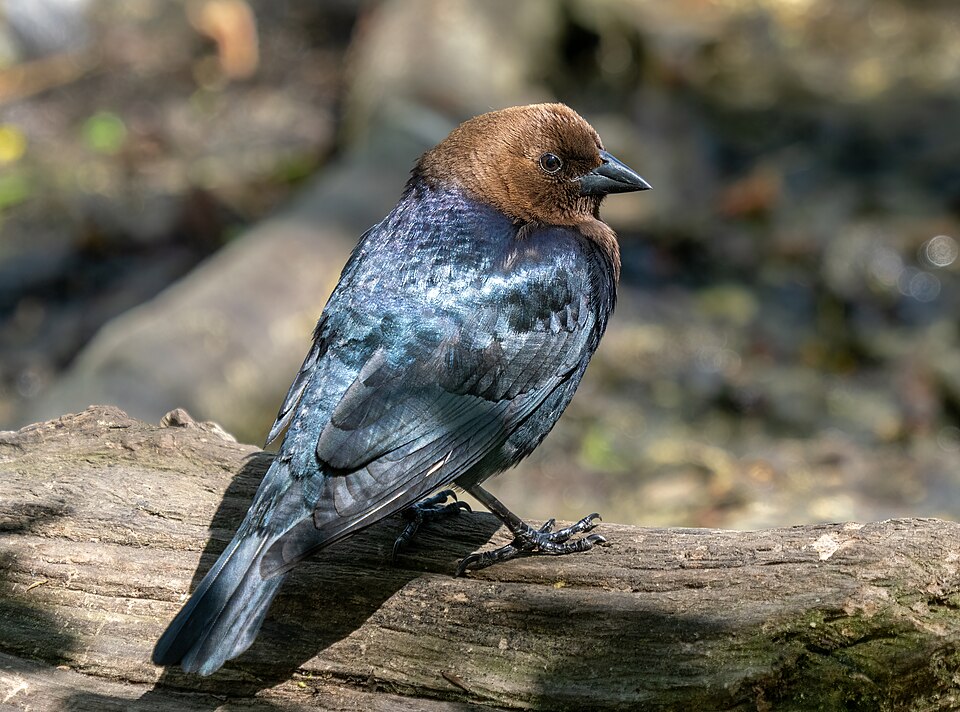
The Brown-headed Cowbird is a stocky, short-tailed member of the blackbird family that you have almost certainly seen feeding on the ground in mixed flocks with grackles, Red-winged Blackbirds, and starlings. Its name comes from an old habit: the birds once followed roaming herds of American bison across the Great Plains, snapping up the insects the animals flushed from the grass. Today they trail cattle, lawn mowers, and tractors with the same opportunism, which is part of why they have spread so successfully across the continent.
What makes this otherwise plain bird endlessly interesting is its reproductive strategy. Female cowbirds build no nest of their own. Instead, they lay their eggs in the nests of other songbirds and let the unwitting hosts do all the work of incubating and feeding. This brood parasitism has made the cowbird both a fascinating subject for scientists and a genuine conservation concern for some declining songbirds. Loved or not, it is a true native bird and a fixture of fields, woodland edges, suburbs, and feeders across North America.
Look for a chunky, sparrow-to-robin-sized blackbird with a noticeably short, square tail and a thick, conical, finch-like bill that sets it apart from other blackbirds. Cowbirds often feed on the ground with their tails cocked slightly upward, and males have a distinctive hunched, ruffled posture when they sing.
| Male body | Glossy black with a strong green-purple iridescence in good light |
| Male head | Solid chocolate-brown head and neck contrasting with the black body |
| Female | Plain grayish-brown overall, palest on the throat, with faint diffuse streaking below |
| Bill | Short, thick, conical (finch-like), not slender and pointed like a grackle's |
| Tail | Short and square, giving a front-heavy, stubby look |
| Size | Smaller than a grackle, larger and chunkier than a House Sparrow |
Male vs. female
The sexes look quite different, which often confuses beginners. The male is unmistakable once you learn it: a glossy black body with a rich, milk-chocolate brown head and neck, the two-tone effect best seen in direct sunlight. The female is far plainer, a soft uniform grayish-brown all over, slightly paler on the throat and faintly, blurrily streaked underneath. People frequently mistake the dull brown female for a large sparrow or a female finch until they notice the thick blackbird bill and short tail.
Juveniles
Juveniles look much like the female but are even more strongly streaked below, with crisp dusky streaks on a buffy-brown chest and pale scaly edges to the back and wing feathers. A telltale sight in summer is a streaky young cowbird, often larger than its foster parent, begging loudly and being fed by a smaller bird such as a warbler, vireo, or sparrow. By their first fall, young males begin showing patchy black feathers as they molt toward adult plumage.
The male's song is one of the strangest sounds in the backyard: a liquid, bubbling glug-glug-glee that rises into a thin, squeaky, almost electronic high whistle at the end. Males deliver it with a dramatic display, fluffing their feathers, spreading their wings, and bowing forward as if they might tip over. The whistled finish carries surprisingly far for such a quiet-looking bird.
Calls include a sharp, dry chuck and a fast, high, chattering rattle, especially from females. Females also give a distinctive woodpecker-like rattle that has no real equivalent among other blackbirds. In flight, you may hear thin, high seep or whistled notes from passing flocks.
Brown-headed Cowbirds breed across nearly all of the United States and southern Canada, and into northern Mexico. Originally a bird of the open Great Plains, the species expanded dramatically as forests were cleared and agriculture spread, since fragmented woods and field edges give it more host nests to exploit.
Birds in the northern part of the range are migratory, withdrawing south in fall to spend the winter across the southern United States and Mexico, where huge mixed blackbird flocks form. In the milder southern and coastal regions, many cowbirds are year-round residents. Spring migrants return north quite early, often arriving by March or April just as their host species begin nesting.
Cowbirds are primarily ground foragers with a diet dominated by seeds and grain, especially grass and weed seeds and waste grain in agricultural fields. In the breeding season they shift to eating more insects and other invertebrates, including the grasshoppers, beetles, and caterpillars they flush while following livestock or feeding in mown grass.
This is the original behavior that gave the bird its name: walking among cattle (and historically bison), it grabs the insects the large animals stir up, and will even perch on their backs. At feeders, cowbirds readily take spilled seed on the ground and will land on platform feeders for cracked corn, millet, and sunflower.
The Brown-headed Cowbird is North America's best-known obligate brood parasite, meaning it never builds a nest or raises its own young. Instead, the female quietly watches other songbirds build nests, slips in (often at dawn) to remove or eat one of the host's eggs, and lays one of her own in its place. An individual female may lay dozens of eggs in a single season, spread across many different nests. More than 220 host species have been recorded, from tiny gnatcatchers and warblers to sparrows, vireos, and finches.
Cowbird eggs typically hatch a day or two earlier than the host's, and the larger, faster-growing chick out-competes its nestmates for food, often causing the host's own young to starve or be crowded out. Some hosts fight back: Yellow Warblers may bury cowbird eggs under a new nest floor, and a few species recognize and eject the foreign egg. For several rare songbirds, such as Kirtland's Warbler and the Black-capped Vireo, cowbird parasitism has been a serious threat requiring active management.
Cowbirds need no encouragement and are not a bird most people set out to attract. They readily visit feeders, but many birders take steps to discourage them because of the harm their parasitism does to favored songbirds. If you want fewer cowbirds at your feeders, the goal is to make your offerings less appealing to flocking blackbirds while still feeding the birds you love.
- They come to ground feeding readily, millet, cracked corn, and spilled seed on the ground draw cowbirds fast, so reduce these if you want fewer of them.
- Switch to less-favored foods, straight Nyjer (thistle) and safflower are largely ignored by cowbirds and blackbirds, while still feeding finches, cardinals, and chickadees.
- Use selective feeders, tube feeders with short perches and weight-sensitive feeders exclude heavier cowbirds and grackles.
- Keep the ground clean, sweep up dropped seed promptly, since ground spillage is what flocks key in on.
- Do not remove cowbird eggs from nests yourself, they are a native species protected by the Migratory Bird Treaty Act, so leave any management to licensed programs.
- Common Grackle: Much larger and lankier with a long keel-shaped tail, pale yellow eye, and slim pointed bill; lacks the cowbird's brown head.
- Brewer's Blackbird: Male is all glossy black with a pale eye and no brown head; slimmer and longer-tailed than a cowbird.
- Red-winged Blackbird: Male shows red-and-yellow shoulder patches; streaky female is longer-billed and more heavily striped than a female cowbird.
- European Starling: Has a long pointed yellow bill (breeding), short tail, and spangled spots in winter; very different bill shape from the cowbird's stubby cone.
Why do Brown-headed Cowbirds lay eggs in other birds' nests?
It is their natural breeding strategy, called brood parasitism. By letting other species incubate her eggs and raise her chicks, a female cowbird is free to keep laying many more eggs in a season than she could if she built and tended her own nest. Scientists think the habit evolved when cowbirds followed roaming bison herds and could not stay in one place long enough to nest.
Are Brown-headed Cowbirds bad for other birds?
They can be. Because a cowbird chick often out-competes or crowds out the host's own young, heavy parasitism can hurt local songbird populations, especially for rare species with small ranges. That said, cowbirds are a native bird that has lived alongside other species for thousands of years, and most common hosts coexist with them fine.
How do I tell a female cowbird from a sparrow?
Look at the bill and tail. A female cowbird has a thick, conical blackbird bill and a short, square tail, and her brown plumage is plain and only faintly streaked. Most sparrows are smaller, more boldly patterned, and have thinner bills and longer, more notched tails.
Should I remove a cowbird egg if I find one in a nest?
No. Brown-headed Cowbirds are protected under the Migratory Bird Treaty Act, so removing their eggs without a federal permit is illegal. Any control is handled by licensed wildlife programs, usually only where an endangered host species is at risk. Leave the nest alone and let nature take its course.
How can I keep cowbirds away from my feeders?
Offer foods they dislike, such as straight Nyjer (thistle) seed and safflower, use weight-sensitive or short-perch feeders that exclude heavier birds, and keep the ground swept clear of spilled seed, since flocks are drawn to ground scraps. Avoid millet and cracked corn if cowbirds are a problem.