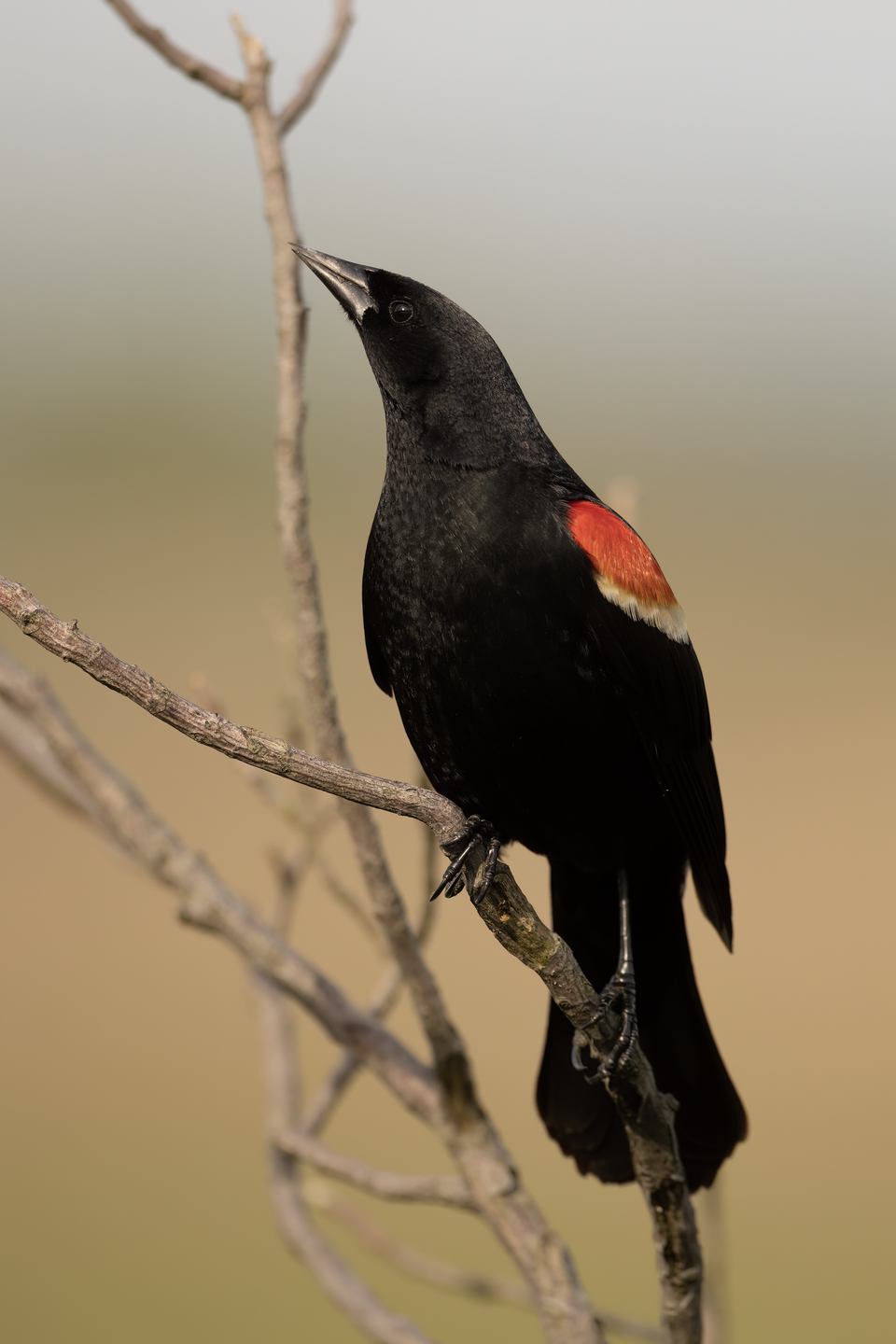
Few birds announce spring as confidently as the Red-winged Blackbird. By late winter, males stake out cattail stands, wet ditches, and roadside marshes, flashing their scarlet shoulder patches and shouting a buzzy conk-la-ree from the top of every reed. They are among the most numerous birds on the continent, and across much of the United States and Canada they are also among the easiest to find, a quick scan of nearly any marsh, wet field, or flooded ditch in the warmer months will usually turn one up.
What makes them such a rewarding bird to watch is their personality. Males are loud, territorial, and theatrical, spreading their wings and fanning their red epaulets to intimidate rivals and impress females. Females, by contrast, are streaky brown and surprisingly easy to mistake for a large sparrow. Outside the breeding season, Red-winged Blackbirds gather into enormous mixed flocks with grackles, cowbirds, and starlings, sometimes numbering in the millions as they roam farmland and roost together at night.
This is a sturdy, medium-sized blackbird with a fairly long, conical bill and a slightly rounded tail. Males and females look so different that beginners often assume they are separate species. The shape is the same in both: a plump body, broad-based pointed bill, and an upright posture when perched on a reed or fence wire.
| Male plumage | Glossy jet black overall with bright red shoulder patches (epaulets) bordered below by a yellow or buffy stripe. |
| Female plumage | Heavily streaked dark brown and buff above and below, often with a pale eyebrow and a faint warm wash on the throat, looks like an oversized sparrow. |
| Bill | Sharply pointed, conical, and blackish, longer and more dagger-like than a sparrow's seed-cracking bill. |
| Size | Noticeably larger than a sparrow but smaller and slimmer than a Common Grackle, with a shorter tail than a grackle. |
| Epaulet display | Males can hide most of the red, showing only the yellow border when calm, then flare the full red patch when displaying or alarmed. |
| Flight | Direct, slightly undulating flight; flocks move in dense, coordinated waves over fields and marshes. |
Male vs. female
The sexes are strikingly different, which is unusual among common backyard birds. The adult male is unmistakable: solid glossy black with brilliant red shoulder patches trimmed in yellow. The female looks like a completely different bird, densely streaked brown and cream with a pale stripe over the eye and often a peachy tinge on the face and throat. Because she is so cryptic, the female blends into reeds and grass while she incubates and feeds young. First-year males are intermediate: blackish but mottled with rust and brown, and their red patches are duller and less complete than an adult male's.
Juveniles
Juveniles closely resemble adult females, streaky brown and buff overall, but look softer and scalier, with broad pale feather edges and a more uniformly streaked underside. Young males begin showing patchy black feathering and dull orange-red shoulder hints as they molt into their first winter, gradually acquiring the bold adult pattern over their first year. A blotchy, half-black bird with messy reddish shoulders in late summer or fall is almost always a young male in transition.
The male's signature song is a loud, gurgling conk-la-ree! (often written oak-a-lee), ending in a long, buzzy trill that seems to rasp through the marsh. He usually delivers it from a high, exposed perch while spreading his wings and flashing his red epaulets, sound and display go together. The song carries well and is one of the most recognizable sounds of wetlands across the continent.
Both sexes give a sharp, descending check or chack call, and an alarmed, slurred cheer when a hawk or human gets too close to a nest. Females have their own series of chattering and scolding notes. In big winter flocks, the constant overlapping chorus of chack calls becomes a steady background din.
Red-winged Blackbirds breed across almost all of North America, from Alaska and central Canada south through the Lower 48 and into Mexico and Central America. They are habitat generalists for nesting as long as there is water or damp ground nearby, cattail and bulrush marshes are classic, but they also use wet meadows, ditches, hayfields, and the edges of ponds and rivers.
Northern populations are migratory, withdrawing from Canada and the northern states in fall and wintering across the southern and central U.S., where they form huge roving flocks in farm country. Birds in the southern U.S. and along the coasts are largely year-round residents. In spring, returning males arrive at the marshes weeks before the females to claim the best territories.
Red-winged Blackbirds are omnivores with a strongly seasonal diet. In spring and summer they eat large numbers of insects and other invertebrates, caterpillars, beetles, dragonflies, mayflies, grasshoppers, and spiders, which they glean from cattails, pluck from the water's surface, or chase down in the grass. This protein-rich food is especially important for feeding nestlings.
In fall and winter the diet shifts heavily toward seeds and grain. Flocks descend on weed seeds, waste corn, rice, and grain in agricultural fields, and they will readily visit feeders and spilled seed beneath them. Their habit of foraging in dense flocks on crops sometimes brings them into conflict with farmers, though they also consume large quantities of crop-pest insects.
The female builds the nest low in dense vegetation, typically lashed among standing cattails, bulrushes, or shrubs over or near water, usually just a few feet up. She weaves a sturdy open cup of wet vegetation, sedge, and grass, lining it with fine grasses and mud. The male defends the surrounding territory aggressively and may have several females nesting within it, as the species is often polygynous.
A typical clutch is 3 to 4 pale bluish-green eggs marked with dark scrawls and blotches. The female does all the incubating, for roughly 11 to 13 days, and the young leave the nest about 11 to 14 days after hatching. Pairs often raise two or even three broods in a season. Red-winged Blackbirds are common hosts of Brown-headed Cowbirds, which lay their eggs in the nest.
Red-winged Blackbirds are not a classic dainty feeder bird, but they readily visit yards near suitable habitat, especially in spring migration and winter. If you live near a marsh, pond, ditch, or wet field, you have a good chance of drawing them in.
- Offer mixed seed, cracked corn, and sunflower seeds on platform feeders or scattered on the ground, which suits their flocking, ground-feeding habits.
- Provide a low, open tray or platform feeder, they are too large and clumsy for small tube or finch feeders.
- Keep water available; they are drawn to wet areas and will use birdbaths and shallow water features.
- If you have space, leave a patch of cattails, reeds, or unmowed wet edge, natural nesting and foraging habitat is the strongest attractant.
- Expect them mainly in flocks during migration and winter; a few males may sing nearby in spring if there is marshy habitat close by.
- Be aware they often arrive in numbers and can dominate a feeder briefly, using less desirable seed like cracked corn on the ground can keep them from monopolizing premium feeders.
- Tricolored Blackbird: Very similar male but with a white (not yellow) border below a darker red shoulder patch; restricted mostly to California and forms dense colonies.
- Brown-headed Cowbird: Smaller with a shorter, thicker finch-like bill; male has a brown head on a black body and lacks any red shoulder patch.
- Common Grackle: Larger and longer-tailed with an iridescent purple-bronze sheen and pale yellow eye; no red shoulders.
- Yellow-headed Blackbird: Shares marshes in the West but the male has a bright yellow head and chest with a white wing patch, unmistakable.
Why does a Red-winged Blackbird keep attacking me or my head?
During nesting season (roughly spring into early summer), territorial males dive-bomb anything they see as a threat near the nest, including people, dogs, and even hawks. It looks alarming but they rarely make hard contact. The behavior stops once the young fledge, so simply avoiding the spot for a few weeks, or wearing a hat and watching the bird, is usually enough.
What does the female Red-winged Blackbird look like?
She looks nothing like the black-and-red male. Females are heavily streaked brown and buff with a pale eyebrow and often a warm peachy wash on the throat, resembling a large sparrow. Their longer, pointed bill, larger size, and marsh habitat help separate them from actual sparrows.
What is the conk-la-ree song I hear in the marsh?
That loud, gurgling conk-la-ree ending in a buzzy trill is the male Red-winged Blackbird's territorial song. He sings it from a high perch while flaring his red shoulder patches. It is one of the most common and recognizable wetland sounds across North America.
Will Red-winged Blackbirds come to bird feeders?
Yes, especially if you live near water or wet fields. They prefer platform or ground feeding and favor mixed seed, cracked corn, and sunflower seeds. They typically show up in flocks during migration and winter and can briefly crowd out smaller birds.
Where do Red-winged Blackbirds go in winter?
Birds from Canada and the northern states migrate south, while populations in the southern and coastal U.S. stay year-round. In winter they gather into enormous flocks, often mixed with grackles, cowbirds, and starlings, that forage in farm country by day and gather in huge communal roosts at night.