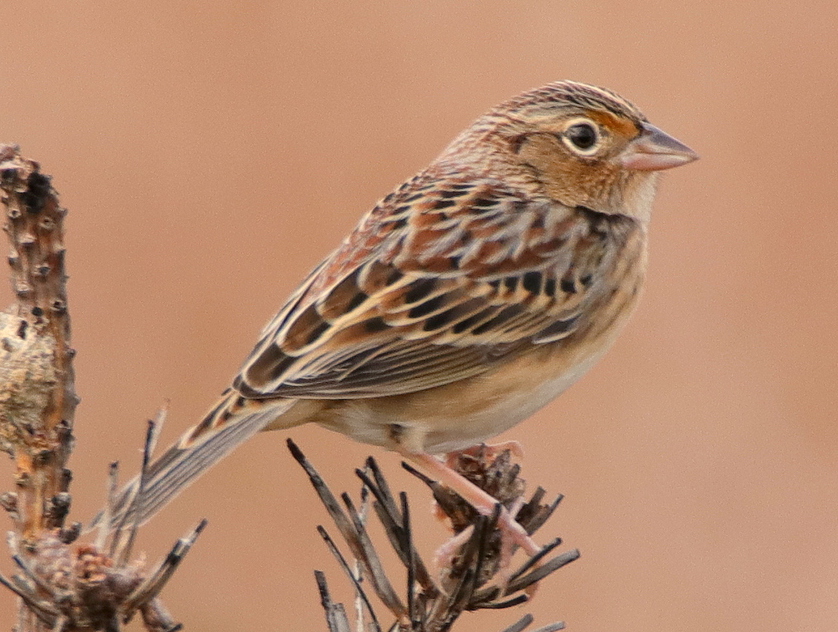
The Grasshopper Sparrow is a small, flat-headed sparrow of open grasslands, named not for what it eats so much as for what it sounds like. Its primary song is a thin, dry, insect-like buzz that you could easily mistake for a real grasshopper sawing away in the weeds. It is a bird that rewards patience: for much of the day it stays hidden in the grass, but in the breeding season a male will climb to the top of a tall stem, fence post, or low shrub and deliver that quiet buzzing song over and over.
This is a quintessential bird of prairies, hayfields, pastures, and reclaimed mine lands across much of North America. Compact and short-tailed with a large, oddly flat-topped head, it can be surprisingly tricky to glimpse well because it prefers to run mouse-like through the grass rather than fly. Grasshopper Sparrows have declined steadily across their range as native grasslands have been plowed under or developed, which makes finding one a small thrill for anyone who works to learn the sparrows.
Look for a small, chunky, large-headed sparrow with a notably short tail and a flat-crowned profile. Compared with most sparrows it looks oddly big-headed and almost neckless, and its tail seems too short for its body, giving it a stub-tailed, front-heavy shape as it perches low in the grass.
| Head | Flat-topped, large head with a pale central crown stripe dividing a dark crown; plain buffy face with a small white eyering |
| Underparts | Clean buffy breast and flanks with no streaking in adults, fading to whitish on the belly |
| Upperparts | Back scaled with chestnut, gray, and black; chestnut tones often show on the nape and shoulder |
| Lores | Often a small spot of yellow-orange in front of the eye and at the bend of the wing |
| Tail | Short and spiky-looking, with pointed tail feathers |
| Bill | Fairly large and pale-based for such a small sparrow |
Male vs. female
Males and females look essentially alike, with the same buffy unstreaked breast, flat head, and short tail; they cannot be reliably told apart in the field by plumage. Behavior is the best clue: in the breeding season it is the male that perches up on a grass stem, weed, or fence and delivers the buzzy song, while the female stays low and inconspicuous in the grass.
Juveniles
Juvenile Grasshopper Sparrows differ from adults in a way that can confuse birders: they show fine dark streaking across the buffy breast, which adults lack. Otherwise they share the flat head, short tail, and overall buffy coloring. This streaking fades as the bird molts into its first winter plumage, so a streak-breasted "Grasshopper Sparrow" in mid to late summer is almost always a young bird of the year.
The song that gives the bird its name is a thin, dry, high buzz, often written as tik-tik-tik-zeeeee or simply a faint, sustained insect-like trill that fades at the end. It is so quiet and so much like a real grasshopper that many people walk right past a singing male without realizing a bird is making the sound. Listen for it from a low, exposed perch in spring and early summer.
Males also give a second, very different song that is easy to overlook: a longer, jumbled series of squeaky, tinkling, almost sputtering notes, sometimes called the "sustained" or "warble" song, usually delivered later in the season and often at dawn or dusk. Common calls include a sharp, thin tik or tsick note.
Grasshopper Sparrows breed widely across the central and eastern United States and into southern Canada, with separate populations in the western U.S. and a non-migratory resident form in Florida (the endangered Florida Grasshopper Sparrow). They favor open grasslands, prairies, hayfields, pastures, and weedy fields with scattered taller stems for singing perches.
Northern and interior breeders are migratory, withdrawing in fall to the southern United States, Mexico, and Central America for the winter. During migration and winter they continue to use grassy and weedy open country, where they are even more secretive and rarely sing, making them genuinely hard to detect outside the breeding season.
True to its name, the Grasshopper Sparrow eats a great many grasshoppers, along with crickets, beetles, caterpillars, spiders, and other invertebrates, especially in the breeding season when it needs protein-rich food for its young. It also eats seeds of grasses and weeds, which become a larger part of the diet in fall and winter.
It forages almost entirely on the ground, walking and running through the grass and gleaning insects from low vegetation and the soil surface. Birds will sometimes remove the legs of large grasshoppers before swallowing them. Because it feeds and moves so low in dense cover, you will usually hear or briefly glimpse this sparrow far more often than you watch it feed.
The nest is built on the ground, tucked at the base of a clump of grass or a low plant, and is often domed or partially roofed over with overhanging vegetation so that the birds slip in from the side rather than from above. This concealment makes nests extremely hard to find. The female does most of the nest building, weaving grasses and fine plant material into a cup.
A typical clutch is 3 to 5 eggs, which are whitish with reddish-brown speckling. The female incubates for roughly 11 to 12 days, and the young leave the nest after about 9 days, often before they can fly well, scattering into the grass. Pairs commonly raise two broods in a season, and they tend to walk away from the nest through the grass before flushing, which helps keep its location hidden from predators.
Honestly, the Grasshopper Sparrow is not a backyard or feeder bird. It is a habitat specialist of open grasslands and will not visit suburban yards or seed feeders. If you own or manage acreage, though, you can help support this declining species through grassland-friendly land practices.
- If you have open land, maintain native grassland or hayfield habitat rather than mowing it short or converting it to lawn.
- Delay mowing until after the nesting season (generally late summer) to avoid destroying ground nests and flightless young.
- Leave scattered tall weeds, forbs, and fence posts as singing perches for territorial males.
- Avoid broad insecticide use; grasshoppers and other insects are essential breeding-season food.
- To actually see one, visit a prairie, pasture, or grassland preserve in late spring and listen for the dry, buzzy song from low perches.
- Search at dawn, when males are most likely to be singing from exposed stems.
- Savannah Sparrow: Also a grassland sparrow but has a streaked breast (often with a central spot), a notched longer tail, and usually a yellow wash above the eye; lacks the flat-headed, big-headed, stub-tailed look.
- Henslow's Sparrow: Another flat-headed grassland sparrow but shows a greenish-olive face, a streaked breast, and gives a short, weak hiccup-like song rather than a long buzz.
- Le Conte's Sparrow: Brighter orange-buff on the face and breast with fine dark streaks on the sides and a gray ear patch; favors wetter, marshy grass and looks more colorful overall.
- Field Sparrow: Has a clean unstreaked breast too but shows a pink bill, bold white eyering, rusty cap, and a longer tail, and sings an accelerating series of clear whistles rather than a buzz.
Why is it called a Grasshopper Sparrow?
It is named for its song, which is a thin, dry, insect-like buzz that sounds remarkably like a grasshopper. The name also fits its diet, since grasshoppers are a major food source, but the song is the original reason for the name.
What does a Grasshopper Sparrow look like?
It is a small, chunky sparrow with a large, flat-topped head, a short pointed tail, a clean buffy unstreaked breast, and a scaly chestnut-and-gray back. Look for a pale stripe through the center of the crown and often a small yellow spot in front of the eye.
Where can I see a Grasshopper Sparrow?
Look in open grasslands, prairies, hayfields, pastures, and weedy fields across much of the central and eastern U.S. in the breeding season. Visit grassland preserves at dawn in late spring and listen for the buzzy song coming from a low perch.
Will Grasshopper Sparrows come to bird feeders?
No. They are grassland habitat specialists that forage on the ground for insects and grass seeds and do not visit feeders or suburban yards. To see one you need to go to suitable open grassland habitat.
Are Grasshopper Sparrows endangered?
The species overall is rated Least Concern but is declining due to grassland loss. One subspecies, the Florida Grasshopper Sparrow, is federally endangered and one of the rarest birds in North America, the subject of intensive recovery efforts.